Today was the spring version of the BARA hamfest.BARA (Bergen Amateur Radio Association) runs these twice a year (once in the spring, usually around Memorial Day weekend), and once in the fall (around the first weekend in October). I try to go whenever I can since it's by far the closest hamfest to my home, about 7 miles driving distance. In addition to the usual socializing, I usually buy a couple of things, which I did this time as well. I picked up a couple of spare power cables that I use with my radios, some snap-on ferrites (to see if I can keep my 6m transmissions out of my son's speakers), and I splurged with some of my birthday money to pick up a Heil "Traveler" headset and adapter for my 706, which I'll use in Cayman and elsewhere.
I picked up the headset from Gene, K2KJI, of KJI Electronics. I've bought the vast majority of my ham gear from Gene for a few reasons. First of all, I'm lucky that he's fairly local to me, so I can drive out to his store if I need something. (Ordering online is great, and I do that too, but there's nothing like having a local store that you can run into when you need something on a Saturday afternoon.) Second, Gene's prices are extremely competitive with all the major competitors (HRO, AES, Texas Towers, etc.) Finally, I like buying things from Gene because, aside from just being a nice guy in general, I've always felt that Gene's a "straight shooter". There were a few times, especially when I was just starting out, that I had gone into Gene's to pick up something, and Gene talked me out of it and into buy something less expensive. I'm reasonably sure that Gene didn't do this because perhaps his markup on the cheaper item was higher (meaning he'd make more, even though I'd pay less), but rather because he wanted to guide me to a better choice. Bravo. So that's why I try to give Gene as much business as I can. I guess I also feel that by supporting Gene, it'll keep him around in the area, and that's a really good thing.
I should mention that I have nothing at all against John, who runs Advanced Specialties, which is also in the area. (In fact, I've bought a few things from him too), I guess I just got "started" with Gene, so I tend to go back to him.
I briefly mentioned socializing at the hamfest. It seems that every time I go I not only get to meet folks who I've "eyeballed" before, but I usually run into someone that I've worked on the radio buy have never met. The honor this time goes to Dave, K2SIX, who I've spoken to many times on six meter but had never met in person. Honorable mention goes to Paul, W2PWE, not so much for him, but for getting to meet his wife, son, and daughter. (Unfortunately, I can't remember any of their names. Sorry.)
In other news (if you can call it that), the announcement that I'd sent out for my trip to Cayman has started to show up in some of the DX bulletins, which is kind of fun. The first place that I happened to see it is in the Ohio/Penn DX Bulletin, and I've also seen it on the NJDXA DX Tips page but I've heard from some other folks that they've seen it elsewhere, so I'll keep looking. It's kind of fun to see your own call in one of those.
Saturday, May 26, 2007


Monday, May 21, 2007
Paperwork
Just a quick update for today. The official copy of my ZF2DK license and the import certificate arrived today from the ICTA. It's much nicer actually having the paperwork in hand than just an email message.
Yesterday, I sent out announcement to various DX-related lists and I've gotten quick notes from most of the editors thanking me for the information. I'll put in an update on the IOTA website as well, but that site seems to be down for the moment. (I did see a note a couple of days ago about the site moving.)
I also updated my website, adding a page with some basic information and I even did some propagation predictions using Hamcap. Thanks to Alex, VE3NEA, for making this available as freeware. I got to give back a little by modifying the script that he originally used to support Firefox, Safari, and other browsers as it initially only supported Internet Explorer.
Yesterday, I sent out announcement to various DX-related lists and I've gotten quick notes from most of the editors thanking me for the information. I'll put in an update on the IOTA website as well, but that site seems to be down for the moment. (I did see a note a couple of days ago about the site moving.)
I also updated my website, adding a page with some basic information and I even did some propagation predictions using Hamcap. Thanks to Alex, VE3NEA, for making this available as freeware. I got to give back a little by modifying the script that he originally used to support Firefox, Safari, and other browsers as it initially only supported Internet Explorer.
Saturday, May 19, 2007
More info about the upcoming trip
Since it's starting to get a little closer to the date of the trip, I figured that I'd put up a little information about when we'll be there, and some other information about the operation.
We'll be in Cayman from July 22 through July 29. As I noted earlier, this is a "vacation style" operation, so I'll be on when I'm not doing something else. The Buddistick covers all bands down to 40m, but I expect that I'll likely spend a lot of time on 20m, conditions permitting. However, I'll probably see what bands are open when I'm there, and operate accordingly. I do plan to try a little 6m if the band is open. I will primarily be operating SSB (I'd love to try CW but my skills are really not up to it) and I may operate a little PSK as well. Most likely, I'll be hanging out around the IOTA frequencies (7.060 [listening up for NA], 14.260, 18.128, 21.260, 24.950, 28.460) QSL will be to my home call, and I plan to upload the logs to LoTW (possibly even during the operation; I believe that the place where we're staying has Internet access).
If there are any particular bands that you need, please let me know and I'll try to accomodate.
We'll be in Cayman from July 22 through July 29. As I noted earlier, this is a "vacation style" operation, so I'll be on when I'm not doing something else. The Buddistick covers all bands down to 40m, but I expect that I'll likely spend a lot of time on 20m, conditions permitting. However, I'll probably see what bands are open when I'm there, and operate accordingly. I do plan to try a little 6m if the band is open. I will primarily be operating SSB (I'd love to try CW but my skills are really not up to it) and I may operate a little PSK as well. Most likely, I'll be hanging out around the IOTA frequencies (7.060 [listening up for NA], 14.260, 18.128, 21.260, 24.950, 28.460) QSL will be to my home call, and I plan to upload the logs to LoTW (possibly even during the operation; I believe that the place where we're staying has Internet access).
If there are any particular bands that you need, please let me know and I'll try to accomodate.
Monday, May 14, 2007
ZF2DK
At last, the email that I've been waiting for came from the ICTA this morning informing me that my paperwork has been processed and I've been issued ZF2DK as my Caymanian callsign. I got a nice email from Nikki Forbes of ICTA telling me that the callsign had been issued, and asking if I'd like to have the original paperwork mailed to me or if I'd be picking it up when I arrived. Since we'll be getting there over a weekend, I asked to have it mailed to me (which should also mean that I'll have the import certificate, which will make bringing my gear into the country a lot easier.
I've already set up a page for ZF2DK on qrz.com and I'll be updating that as well as my regular ham website with a few details about the upcoming trip.
I've already set up a page for ZF2DK on qrz.com and I'll be updating that as well as my regular ham website with a few details about the upcoming trip.
Saturday, April 28, 2007
Quiet week
It was a very, very quiet week as far as anything with the radio. Between working late most nights and having bad weather a few nights, I had very little time to play radio this week.
The only thing I did of note was that thanks to Larry, N4VA, I was able to find a form that I could use to send in the fee for my Cayman license. Larry found it on a "rent-a-shack" site on Cayman so I downloaded it and faxed it to the ICTA. I still haven't heard back from them regarding either the original faxed form or the new form, but I'm trying to be patient (things moving slowly on the islands, etc.)
The only thing I did of note was that thanks to Larry, N4VA, I was able to find a form that I could use to send in the fee for my Cayman license. Larry found it on a "rent-a-shack" site on Cayman so I downloaded it and faxed it to the ICTA. I still haven't heard back from them regarding either the original faxed form or the new form, but I'm trying to be patient (things moving slowly on the islands, etc.)
Sunday, April 22, 2007
New Toy!
As you may know from previous posts, I've been waiting for a few weeks for my new Buddistick to arrive. There had been a delay because they ran out of the bags that they ship/store in and apparently the manufacturer was slow in filing the order.
Yesterday morning, the postman came up to the front door carrying a box, which I assumed was for someone else, since the only thing that I was expecting was the Buddistick and Budd, W3FF, hadn't told me that mine had shipped yet.
Surprise! Turns out that Budd and his son Chris had gotten the bags in and immediately shipped out my order (and many others), and didn't really have a chance to notify me. I'm not complaining.
Even nicer was the fact that we finally had a decent, no, great weekend, weather-wise. Beautiful sunny days, highs in the upper 70s, very little wind, so it was a great time to be outside.
The only minor glitch was that Budd had accidentally shipped the wrong instruction sheet in with my order, but based on what I knew, plus finding an older version of the instructions on the Buddipole Users Group (B.U.G) I really had very little trouble setting up the antenna. (Budd responded to my email about the wrong instructions and send me the correct version a few hour later). Getting it resonant on 40m is a bit tricky (and in fact, I've emailed Budd asking for some tips on this), but I did set it up on the lawn, working at the patio table with my 706 MkIIG plugged into a little 25A switcher power supply (my "travel setup"), and made a few contacts, mostly to folks in the Michigan QSO Party on 40m. One nice thing about these kinds of contests is that except for a few really big stations who are always really busy, the guys in these contests will usually have a few minutes to chat, and I asked for "real" signal reports from a few of them. The reports varied from a low of 33 to 59 (the best possible report; that's a blog entry for another time) I then switched to 20m, and made a handful of DX contacts into mostly central Europe. I don't think I'll be competing with guys with big beams and amplifiers, but for portable use this should be just fine.
Nothing back from ICTA on the form to use to send in my credit card information. If nothing shows up in the next day or soon, I guess I'll fax the info to them, and maybe just ask on the fax for the authorization form.
Yesterday morning, the postman came up to the front door carrying a box, which I assumed was for someone else, since the only thing that I was expecting was the Buddistick and Budd, W3FF, hadn't told me that mine had shipped yet.
Surprise! Turns out that Budd and his son Chris had gotten the bags in and immediately shipped out my order (and many others), and didn't really have a chance to notify me. I'm not complaining.
Even nicer was the fact that we finally had a decent, no, great weekend, weather-wise. Beautiful sunny days, highs in the upper 70s, very little wind, so it was a great time to be outside.
The only minor glitch was that Budd had accidentally shipped the wrong instruction sheet in with my order, but based on what I knew, plus finding an older version of the instructions on the Buddipole Users Group (B.U.G) I really had very little trouble setting up the antenna. (Budd responded to my email about the wrong instructions and send me the correct version a few hour later). Getting it resonant on 40m is a bit tricky (and in fact, I've emailed Budd asking for some tips on this), but I did set it up on the lawn, working at the patio table with my 706 MkIIG plugged into a little 25A switcher power supply (my "travel setup"), and made a few contacts, mostly to folks in the Michigan QSO Party on 40m. One nice thing about these kinds of contests is that except for a few really big stations who are always really busy, the guys in these contests will usually have a few minutes to chat, and I asked for "real" signal reports from a few of them. The reports varied from a low of 33 to 59 (the best possible report; that's a blog entry for another time) I then switched to 20m, and made a handful of DX contacts into mostly central Europe. I don't think I'll be competing with guys with big beams and amplifiers, but for portable use this should be just fine.
Nothing back from ICTA on the form to use to send in my credit card information. If nothing shows up in the next day or soon, I guess I'll fax the info to them, and maybe just ask on the fax for the authorization form.
Sunday, April 15, 2007
A little DX and some good news from Cayman
As mentioned in my last update, I worked N8S, the operation from Swains Island, for an "all-time new country". Since then, I've worked them a few more times, and now have worked them on both 17m and 20m on both phone and CW. Considering that I've only very briefly heard them on 15m and only very weakly on 30m, I'm pretty happy with the results.
I also managed to work Oman (A4) on 40m CW, which while not a new country, was pretty nice to get especially on such a low band at this point in the solar cycle.
I finally heard back from the ICTA, the folks responsible for licensing in Grand Cayman, and they sent me the proper forms for licensing and for importing my radio gear. The only problem was that although they said that they'd included a charge card authorization form (so that I can pay via credit card rather than having to get a certified check or bank draft) but it actually wasn't included with the other attachments in the email. I've sent an email back to the ICTA folks asking for the form, but if I don't hear from them in a day or so, I'll probably just fax my info to them and hope for the best.
I heard back from Budd, W3FF, regarding the buddistick. Apparently they are having a big problem with the folks that make the bags, with really long lead times. He's been told (again, apparently) that the bags are to ship "soon", but still hasn't gotten info from UPS that they are on the way. He sounded more frustrated than I am. (Well, I'm just one customer; I guess he's got a few dozen more folks all waiting.)
I also managed to work Oman (A4) on 40m CW, which while not a new country, was pretty nice to get especially on such a low band at this point in the solar cycle.
I finally heard back from the ICTA, the folks responsible for licensing in Grand Cayman, and they sent me the proper forms for licensing and for importing my radio gear. The only problem was that although they said that they'd included a charge card authorization form (so that I can pay via credit card rather than having to get a certified check or bank draft) but it actually wasn't included with the other attachments in the email. I've sent an email back to the ICTA folks asking for the form, but if I don't hear from them in a day or so, I'll probably just fax my info to them and hope for the best.
I heard back from Budd, W3FF, regarding the buddistick. Apparently they are having a big problem with the folks that make the bags, with really long lead times. He's been told (again, apparently) that the bags are to ship "soon", but still hasn't gotten info from UPS that they are on the way. He sounded more frustrated than I am. (Well, I'm just one customer; I guess he's got a few dozen more folks all waiting.)
Sunday, April 08, 2007
New Country!
In general, this week was pretty quiet. I helped out with a VE session for my club this week on Wednesday night, helped out with another VE session on Saturday, and attended an ARES meeting after that.
But the real fun this week was that I got to work the DXpedition to Swains Island, N8S. Swains became a new DXCC Entity as the result of a rules change for what qualifies as a DXCC Entity last year. At the time, there was a very short Dxpedition there, but I didn't even hear them, and did not make contact. However, on this past Friday afternoon, at about 2:30 PM local time, while working from home (no, really, I was working from home!), I did manage to work the guys on Swains on 17m CW, and although I was reasonably sure at the time that the contact was a good one, it was nice to see that my callsign is listed in their recently updated logs.
No news from either the ICTA on Cayman this week, nor from the Buddipole guys about my Buddistick. (Last I heard from Budd, W3FF, was the problem with the bags not being available.) If I don't hear from the ICTA in another day or two, I think I may try emailing the guy who is listed as the head of licensing there.
But the real fun this week was that I got to work the DXpedition to Swains Island, N8S. Swains became a new DXCC Entity as the result of a rules change for what qualifies as a DXCC Entity last year. At the time, there was a very short Dxpedition there, but I didn't even hear them, and did not make contact. However, on this past Friday afternoon, at about 2:30 PM local time, while working from home (no, really, I was working from home!), I did manage to work the guys on Swains on 17m CW, and although I was reasonably sure at the time that the contact was a good one, it was nice to see that my callsign is listed in their recently updated logs.
No news from either the ICTA on Cayman this week, nor from the Buddipole guys about my Buddistick. (Last I heard from Budd, W3FF, was the problem with the bags not being available.) If I don't hear from the ICTA in another day or two, I think I may try emailing the guy who is listed as the head of licensing there.
Saturday, March 31, 2007
Even less than last time
I probably wouldn't have even bothered doing an update this week other than I do want to try to update this on a regular basis. Not a whole lot has been going on radio-wise.
I tried contacting some guys with ZF1 (meaning locals) ham licenses but so far haven't heard back from anyone. A little disappointing, but I'm trying to be patient. I also discovered that there were a couple of more general email addresses on the ICTA website (one for general "enquiries" and the other for licensing issues), so I sent an email to both of them today. I'm hoping that I get a response back.
Still no news on the Buddistick, I guess the bags haven't come in yet. Budd said he'd contact me when they did, and from everything I've heard about him, Budd's a man of his word, so I'll just have to wait a bit more.
I've started using a Google Spreadsheet to keep track of the things I have to do as well as the things that I need to take with me on the trip. There are doubtless many other ways of tracking these things, but the nice thing about having it up on Google is that I can get it to from any computer anywhere, so when I have one of those "have to remember to do this" things pop into my head, I can easily update the spreadsheet. You just need to have a Google ID, which of course is free, and you can use this facility. Check it out if you haven't already done so.
I tried contacting some guys with ZF1 (meaning locals) ham licenses but so far haven't heard back from anyone. A little disappointing, but I'm trying to be patient. I also discovered that there were a couple of more general email addresses on the ICTA website (one for general "enquiries" and the other for licensing issues), so I sent an email to both of them today. I'm hoping that I get a response back.
Still no news on the Buddistick, I guess the bags haven't come in yet. Budd said he'd contact me when they did, and from everything I've heard about him, Budd's a man of his word, so I'll just have to wait a bit more.
I've started using a Google Spreadsheet to keep track of the things I have to do as well as the things that I need to take with me on the trip. There are doubtless many other ways of tracking these things, but the nice thing about having it up on Google is that I can get it to from any computer anywhere, so when I have one of those "have to remember to do this" things pop into my head, I can easily update the spreadsheet. You just need to have a Google ID, which of course is free, and you can use this facility. Check it out if you haven't already done so.
Friday, March 23, 2007
No news is ... um .... no news
Well, there hasn't been a lot to write about over the last couple of days for a few reasons, most of which are pretty much related. I really haven't done much radio "stuff" this week in general because I've been unusually busy at work this week. In fact, my usual evening routine of sitting at my computer and answering email, reading blogs, catching up on favorite websites, all while keeping the radio on and the spot cluster up (I use DX4WIN for general DX use, which has a spiffy feature where it will audibly announce an "interesting" spot, like a new country, so I just keep it running in the background) has been pretty disrupted since I've had to do a significant amount of work in the evenings for my "day" job. Well, as I say, if you're busy, it presumably means that you're valued and that's always a good thing.
A couple of things that I have somehow managed to squeeze in are a series of email conversations with Bruce, K0BJ, regarding operating from the Caymans, mostly about some of the locals down there, operating from ZF1A, the Cayman Amateur Radio Society club station. (Sure wish I could find a valid link for them; occasionally I've run across it, but most of the places that have links point to a now-dead link.)
The one other thing is that Bob, K0NR, suggested that I take a look at the ICTA website for information about operating down there. It looks like the ICTA is the Caymanian version of the FCC. I'd emailed one individual a while back, but hadn't heard from him, and apparently he may be quite ill, so I'm going to write to anyone else on that website that I can find who seems like they might have information about Amateur Radio licensing. Interestingly enough, there's a "Radio" tab on the page, which pops out a list of various radio services, but although Amateur Radio is included, it says "(soon)" next to it and doesn't link to anything.
Budd, W3FF, told me that there's been a delay in shipping my Buddistick because they have run out of cases, and were expecting a new batch this week, but apparently they did not arrive. I've still got plenty of time, and as anxious as I am about playing with the antenna, since the weather has finally warmed up, most of the snow has melted resulting in a significant amount of mud all over the place ... so perhaps it's just as well that I wait a bit longer to play with the new radio.
The CQ WPX SSB contest is this weekend, but given the week I've had, I'll probably pass on spending much time in it at all, and maybe just work a new band or a new country, if I happen to see anything.
Hopefully I'll have time to write to the ICTA folks and make some headway on licensing over the weekend.
A couple of things that I have somehow managed to squeeze in are a series of email conversations with Bruce, K0BJ, regarding operating from the Caymans, mostly about some of the locals down there, operating from ZF1A, the Cayman Amateur Radio Society club station. (Sure wish I could find a valid link for them; occasionally I've run across it, but most of the places that have links point to a now-dead link.)
The one other thing is that Bob, K0NR, suggested that I take a look at the ICTA website for information about operating down there. It looks like the ICTA is the Caymanian version of the FCC. I'd emailed one individual a while back, but hadn't heard from him, and apparently he may be quite ill, so I'm going to write to anyone else on that website that I can find who seems like they might have information about Amateur Radio licensing. Interestingly enough, there's a "Radio" tab on the page, which pops out a list of various radio services, but although Amateur Radio is included, it says "(soon)" next to it and doesn't link to anything.
Budd, W3FF, told me that there's been a delay in shipping my Buddistick because they have run out of cases, and were expecting a new batch this week, but apparently they did not arrive. I've still got plenty of time, and as anxious as I am about playing with the antenna, since the weather has finally warmed up, most of the snow has melted resulting in a significant amount of mud all over the place ... so perhaps it's just as well that I wait a bit longer to play with the new radio.
The CQ WPX SSB contest is this weekend, but given the week I've had, I'll probably pass on spending much time in it at all, and maybe just work a new band or a new country, if I happen to see anything.
Hopefully I'll have time to write to the ICTA folks and make some headway on licensing over the weekend.
Monday, March 19, 2007
A little contesting, since I was stuck home anyway
Some of you who know me may be aware that I've had some back issues lately. Nothing too horrible, but things got to the point where it was really getting annoying enough that it was time to have something done about it. I had a small procedure (done at a hospital but as an outpatient, but was probably in and out of the hospital in under 90 minutes) last Saturday, and the one real restriction was that I really needed to limit my physical activity for the next 24 hours. (Shucks, I couldn't shovel out the mess that was left from the storm. Well, I wouldn't have done that anyway, since we actually pay a guy to plow. But I digress.) As it turns out, the chair in my office/shack happens to be extremely comfortable to sit in when my back is bothering me. Well, gee, here I am in my shack, might as well play a little radio while I'm at it.
As it turns out, this was a very busy weekend for contesting, with at least a dozen contests all going on simultaneously. Over the last couple of years, encouraged by Larry, N4VA I've "played around" making a few contacts in the Virginia QSO Party.
In general, the way "QSO Party" contests work is that, like other contests, you want to make contacts with other ham stations based on a certain criteria. Generally, for state QSO party contests, folks outside of the state can work anyone inside the QSO Party state, with "multipliers" being the various counties within the state. (Virginia also has something called "Independent Cities" which also count as "mults".) You usually can only count a multiplier one time, so once you've worked, for instance, Fairfax County, you can work it again, but you can't count it as a multiplier. The rules about whether you can count a mult once only, or once per band vary with the different contests. Anyway, for folks who are inside the state, they can also work the other counties inside the state, but they can also count as mults typically things like other states and other countries (though for some contests, you only get one "mult" regardless of how many different countries you've contacted.) And to really complicate things, sometimes Canada counts as a foreign country, sometimes each province counts as a state. Yeah, it can get confusing. Generally your score is the number of contacts you've made times the number of multipliers.
Anyway, for the past few years, Larry has been a "mobile" in the Va QP, which is sort of a third option: Mobiles drive around to different places in the state, operate for a while from there, then move on to another location (another county or independent city, in the case of Virginia), and so on. The idea is that there are areas which would otherwise be unavailable, and (here's the key), it's fun. So for the last couple of years, Larry has driven around, and I'd have a lot of fun "following" his progress, while working maybe a few more stations along the way. Incidentally, in-state vs. out-of-state are considered different "classes" of operating, since in-state operators have the capability to get a lot more multipliers, which is what really helps build your score.
This year, Larry had other plans for the weekend, so he didn't operate mobile (though he did spend some time operating the contest from his home station), but after having "played" in the VaQP previously, I thought it might be fun to see how well I could do. So, I sat back in my nice comfy chair, put an ice pack on my back, and starting making some contacts in the contest. Because of the distance between NJ and Va, for the most part, you're fairly limited in which bands you can use. Generally, 40 meters works well during the day whereas 75/80 meters works after the sun sets. (There's 160 meters too, but my antenna for that band is very poor, though I did get to make a contact there.) It's sort of an interesting challenge, since the phone (voice) part of the 40m band is "shared" by European commercial shortwave broadcast stations, which, because they are running a lot more power than hams, tend to wipe out communications. The challenge when trying to operate 40m phone in the afternoon when the Europeans come in is to find an open spot and/or hope that the guy on the other end has a really strong signal (and vice-versa). Of course, the other thing you can do is to operate CW (what hams call Morse Code). Contrary to some of the recent discussions, there is still plenty of CW use, and I did make about 30% of all my contacts on CW.
When it gets a little later, you can then go and start operating on 75 and 80 meters, but while the sun is still up, with the exception of some relatively nearby very strong stations that just won't work.
I wound up probably spending around 9 hours or so "in the chair" on Saturday, and I really did have a lot of fun. I spent less time on Sunday because I was feeling better and could move around, but more importantly, it was Brett's birthday and was spending time with him setting up his new computer. Overall, it looks like I had about 56 different "mults" out of a total of 134 possible, so I was pretty happy with that. I made around 140 or so separate contacts, so I guess I did ok, considering the limitations that I have.
Again, as I've noted, I think that it's important that ham radio be fun. The emergency perspective of ham radio is absolutely, positively of vital importance, but in my perspective, you've got to be able to just plain have fun and relax and "play radio" now and then.
As it turns out, this was a very busy weekend for contesting, with at least a dozen contests all going on simultaneously. Over the last couple of years, encouraged by Larry, N4VA I've "played around" making a few contacts in the Virginia QSO Party.
In general, the way "QSO Party" contests work is that, like other contests, you want to make contacts with other ham stations based on a certain criteria. Generally, for state QSO party contests, folks outside of the state can work anyone inside the QSO Party state, with "multipliers" being the various counties within the state. (Virginia also has something called "Independent Cities" which also count as "mults".) You usually can only count a multiplier one time, so once you've worked, for instance, Fairfax County, you can work it again, but you can't count it as a multiplier. The rules about whether you can count a mult once only, or once per band vary with the different contests. Anyway, for folks who are inside the state, they can also work the other counties inside the state, but they can also count as mults typically things like other states and other countries (though for some contests, you only get one "mult" regardless of how many different countries you've contacted.) And to really complicate things, sometimes Canada counts as a foreign country, sometimes each province counts as a state. Yeah, it can get confusing. Generally your score is the number of contacts you've made times the number of multipliers.
Anyway, for the past few years, Larry has been a "mobile" in the Va QP, which is sort of a third option: Mobiles drive around to different places in the state, operate for a while from there, then move on to another location (another county or independent city, in the case of Virginia), and so on. The idea is that there are areas which would otherwise be unavailable, and (here's the key), it's fun. So for the last couple of years, Larry has driven around, and I'd have a lot of fun "following" his progress, while working maybe a few more stations along the way. Incidentally, in-state vs. out-of-state are considered different "classes" of operating, since in-state operators have the capability to get a lot more multipliers, which is what really helps build your score.
This year, Larry had other plans for the weekend, so he didn't operate mobile (though he did spend some time operating the contest from his home station), but after having "played" in the VaQP previously, I thought it might be fun to see how well I could do. So, I sat back in my nice comfy chair, put an ice pack on my back, and starting making some contacts in the contest. Because of the distance between NJ and Va, for the most part, you're fairly limited in which bands you can use. Generally, 40 meters works well during the day whereas 75/80 meters works after the sun sets. (There's 160 meters too, but my antenna for that band is very poor, though I did get to make a contact there.) It's sort of an interesting challenge, since the phone (voice) part of the 40m band is "shared" by European commercial shortwave broadcast stations, which, because they are running a lot more power than hams, tend to wipe out communications. The challenge when trying to operate 40m phone in the afternoon when the Europeans come in is to find an open spot and/or hope that the guy on the other end has a really strong signal (and vice-versa). Of course, the other thing you can do is to operate CW (what hams call Morse Code). Contrary to some of the recent discussions, there is still plenty of CW use, and I did make about 30% of all my contacts on CW.
When it gets a little later, you can then go and start operating on 75 and 80 meters, but while the sun is still up, with the exception of some relatively nearby very strong stations that just won't work.
I wound up probably spending around 9 hours or so "in the chair" on Saturday, and I really did have a lot of fun. I spent less time on Sunday because I was feeling better and could move around, but more importantly, it was Brett's birthday and was spending time with him setting up his new computer. Overall, it looks like I had about 56 different "mults" out of a total of 134 possible, so I was pretty happy with that. I made around 140 or so separate contacts, so I guess I did ok, considering the limitations that I have.
Again, as I've noted, I think that it's important that ham radio be fun. The emergency perspective of ham radio is absolutely, positively of vital importance, but in my perspective, you've got to be able to just plain have fun and relax and "play radio" now and then.
Thursday, March 15, 2007
It looks like I might actually get to be DX!
We're still working out some of the final details, but it looks like Sharon and I, along with two of the three couples who went to the Outer Banks with us a couple of summers ago, will be spending a week on vacation in Grand Cayman. Cayman is not particularly rare as DX entities go, but I know that anytime I hear someone on with a ZF prefix on the air there is generally a pretty good-sized pileup, so I figured that if I can operate a little radio now and then, it should be a lot of fun. Fortunately, the couples that we're going with already know about "that radio thing" that I do so I don't have to explain the whole thing to them.
Aside from the actual trip logistics (which are relatively trivial, compared to going to really rare places; Cayman is an extremely civilized place with direct air flights from the US, modern electrical and telecommunications facilities, etc.), what I'm working on now is starting to get the licensing paperwork taken care of and figuring out what gear to take.
As for the paperwork, I emailed the folks who are in charge there around a week ago, and while I haven't heard anything back yet, I know that things move a bit slower in the islands, so I can be patient.
From an equipment standpoint, I'm going to bring my Icom 706 MkIIG along with a relatively lightweight switching power supply that I picked up a few years ago (same one I took to the Outer Banks.) That was the easy part, trying to figure out what to do about antennas was a little more difficult, since I don't have a lot of details about the place we'll be staying yet. I was originally thinking of bringing a G5RV (either full-sized or "shorty"), but that means that I'd need to bring a tuner, and it also means that I need to be able to string it up. Bringing along a dipole or two cut for specific bands generally solves the tuning problem, but still presents the "how do you get it up in the air?" problem.
After a little research, I've decided to purchase and take a Buddistick which is sort of the baby brother (vertical only) of W3FF's Buddipole. The Buddipole has some advantages over the 'stick in terms of flexibility of use, but the stick, with accessories, breaks down into a bag that's just over a foot long, making it pretty easy to travel with. I've had a couple of emails back and forth with Budd, W3FF, who founded the company (his son Chris now runs it), and he gave me a couple of great tips for configuration. I'm anxiously awaiting the arriving of the antenna so that I can start to play with it a bit. It does need per-band adjustment, but I'll bring my Autek VA1 antenna analyzer with me (which is also very small) which should make any adjustments a snap.
That's about it for now, hopefully I'll be able to get the licensing process started soon, since I expect that will take a while to get through. Just a quick addendum: The site that I used for info about the licensing process is OH2MCN's Worldwide Licensing Website, which has an amazing amount of information about getting licensed pretty much anywhere in the world.
BTW, if anyone reading this has any comments/suggestions/whatever, particularly about operating from Cayman, but about this kind of "lightweight vacation style" operating, please do let me know!
Aside from the actual trip logistics (which are relatively trivial, compared to going to really rare places; Cayman is an extremely civilized place with direct air flights from the US, modern electrical and telecommunications facilities, etc.), what I'm working on now is starting to get the licensing paperwork taken care of and figuring out what gear to take.
As for the paperwork, I emailed the folks who are in charge there around a week ago, and while I haven't heard anything back yet, I know that things move a bit slower in the islands, so I can be patient.
From an equipment standpoint, I'm going to bring my Icom 706 MkIIG along with a relatively lightweight switching power supply that I picked up a few years ago (same one I took to the Outer Banks.) That was the easy part, trying to figure out what to do about antennas was a little more difficult, since I don't have a lot of details about the place we'll be staying yet. I was originally thinking of bringing a G5RV (either full-sized or "shorty"), but that means that I'd need to bring a tuner, and it also means that I need to be able to string it up. Bringing along a dipole or two cut for specific bands generally solves the tuning problem, but still presents the "how do you get it up in the air?" problem.
After a little research, I've decided to purchase and take a Buddistick which is sort of the baby brother (vertical only) of W3FF's Buddipole. The Buddipole has some advantages over the 'stick in terms of flexibility of use, but the stick, with accessories, breaks down into a bag that's just over a foot long, making it pretty easy to travel with. I've had a couple of emails back and forth with Budd, W3FF, who founded the company (his son Chris now runs it), and he gave me a couple of great tips for configuration. I'm anxiously awaiting the arriving of the antenna so that I can start to play with it a bit. It does need per-band adjustment, but I'll bring my Autek VA1 antenna analyzer with me (which is also very small) which should make any adjustments a snap.
That's about it for now, hopefully I'll be able to get the licensing process started soon, since I expect that will take a while to get through. Just a quick addendum: The site that I used for info about the licensing process is OH2MCN's Worldwide Licensing Website, which has an amazing amount of information about getting licensed pretty much anywhere in the world.
BTW, if anyone reading this has any comments/suggestions/whatever, particularly about operating from Cayman, but about this kind of "lightweight vacation style" operating, please do let me know!
Wednesday, March 14, 2007
Let's get going with this again
Well, I see it's been quite a while since I've done any updates here. I'll try to see if I can get update more than once every couple of years. I have to admit that I've gotten a bit inspired about doing this after again after spending a while reading Scott, NE1RD's "100 Pound Dxpedition" blog which talks about (among other things) his recent trip to Monserrat. Thanks Scott.
First off, I'm going to just make this a quick entry (more coming separately) to say that my "regular" ham radio site is now at k2dbk.com (domain registration is cheap!) which at least I find easier to get to.
I've got some exciting news about a trip coming up, but I'm going to leave that for a separate posting, since last time I started a post and meant to finish it because I had "just a little more to add" it sat there for six months.
More coming soon ...
First off, I'm going to just make this a quick entry (more coming separately) to say that my "regular" ham radio site is now at k2dbk.com (domain registration is cheap!) which at least I find easier to get to.
I've got some exciting news about a trip coming up, but I'm going to leave that for a separate posting, since last time I started a post and meant to finish it because I had "just a little more to add" it sat there for six months.
More coming soon ...
Sunday, November 20, 2005
New (non-blog) ham page for K2DBK
Just a very quick update (despite the fact that I "owe" an update anyway): I've moved my ham radio home page to http://k2dbk.kozinn.com. That should be much faster to access, and I may start updating it a bit more frequently.
Friday, October 07, 2005
The Doldrums at The Bottom of The Cycle
There may be some people out there who have read this blog in the past and have wondered why I haven't posted anything since after the Outer Banks trips (other than the VE session story). Well, unfortunately, there just hasn't been a whole lot to write about. At this point in the 11-year solar cycle, things are just not all that good as far as HF propagation is concerned. Over the last month or so, pretty much all I've done has been to work some stations on 6 meters (during some occasional Sporadic E openings and during the September VHF contest), and worked a bunch of stations during the California QSO Party.
I did do a bit of mobile 6m while driving home from work, which was fun, when the bands were open. My setup is pretty simple: I have an Icom 706MkIIG (which normally acts as my home 2m/440 station). I put that in the car, usually sitting it the backpack with the head separated and sitting on the seat next to me. I use a tri-magnet mount from Lakeview (the "hamstick" folks) with a 6m stick on the roof, and that's about it. That all sits on top of my truck, and I think that I get a pretty decent groundplane from the roof of the truck (2004 Chevy Trailblazer), so it seems to get out. I actually have sticks for most HF bands, but I've always been nervous about driving home with the longer sticks on top of the truck, because for for any bands lower than 20m, the combined length of the stick, truck, and mount makes it over 14' (I think), and there are a few underpasses that I go through every day that are only at 13' 6" (which I think is the state minimum required height). I've been told that if I go through those at any kind of speed at all, the top ("stinger") part of the antenna will A) probably be bent back anyway, and B) is supposed to withstand being whacked into concrete anyway...but I haven't gotten brave enough to try. For now, I'll stick with 6m when it's open.
Other than that, I did participate in the 2005 California QSO Party, though I didn't have as much time nor make as many contacts as I would have liked to. I like to at least break 100 QSOs, but things just didn't work out for that this year. This is one of the contests that I really like to work because while there's plenty of activity to keep things busy (no calling CQ for 20 minutes or searching around to find a station to work for 30 minutes at a time), there isn't so much that a "little pistol" (meaning a station that's running a fairly low amount of power, 100 watts, in my case, with pretty low-end antennas, a G5RV, for me) can't make contacts. Plus, for the most part, even the really big stations just seem friendlier here than for some of the other big contests. I know that with my station I'm not going to win any awards, but I like to "play" in these contests, and I know that I'm actually helping out the other guys (a point is a point is a point). This is the kind of contest that I'd recommend for someone who hasn't really done any contests but would like to see what it's like.
I did do a bit of mobile 6m while driving home from work, which was fun, when the bands were open. My setup is pretty simple: I have an Icom 706MkIIG (which normally acts as my home 2m/440 station). I put that in the car, usually sitting it the backpack with the head separated and sitting on the seat next to me. I use a tri-magnet mount from Lakeview (the "hamstick" folks) with a 6m stick on the roof, and that's about it. That all sits on top of my truck, and I think that I get a pretty decent groundplane from the roof of the truck (2004 Chevy Trailblazer), so it seems to get out. I actually have sticks for most HF bands, but I've always been nervous about driving home with the longer sticks on top of the truck, because for for any bands lower than 20m, the combined length of the stick, truck, and mount makes it over 14' (I think), and there are a few underpasses that I go through every day that are only at 13' 6" (which I think is the state minimum required height). I've been told that if I go through those at any kind of speed at all, the top ("stinger") part of the antenna will A) probably be bent back anyway, and B) is supposed to withstand being whacked into concrete anyway...but I haven't gotten brave enough to try. For now, I'll stick with 6m when it's open.
Other than that, I did participate in the 2005 California QSO Party, though I didn't have as much time nor make as many contacts as I would have liked to. I like to at least break 100 QSOs, but things just didn't work out for that this year. This is one of the contests that I really like to work because while there's plenty of activity to keep things busy (no calling CQ for 20 minutes or searching around to find a station to work for 30 minutes at a time), there isn't so much that a "little pistol" (meaning a station that's running a fairly low amount of power, 100 watts, in my case, with pretty low-end antennas, a G5RV, for me) can't make contacts. Plus, for the most part, even the really big stations just seem friendlier here than for some of the other big contests. I know that with my station I'm not going to win any awards, but I like to "play" in these contests, and I know that I'm actually helping out the other guys (a point is a point is a point). This is the kind of contest that I'd recommend for someone who hasn't really done any contests but would like to see what it's like.
Friday, August 19, 2005
An out-of-this-world (by proxy) VE session
One of the things that I decided to do when I became a ham was to find ways to give back to the ham community. I've done some public service work, and even served for a while as the District Emergency Coordinator for Bergen County ARES. But one of the most rewarding things that I've done is to become a Volunteer Examiner (VE).
If you're a ham, you probably already know this, but for those who might not know: The way ham licensing works is that the FCC has delegated the responsibility for testing for new and upgraded ham licenses to hams themselves. This isn't quite the same as the wolf guarding the henhouse, as there are numerous safeguards built into the program, and an individual ham can't just pass a buddy through. In a nutshell, in order to give an exam, a ham has to pass a test to become a VE that's given by a Volunteer Examiner Coordinator, and the FCC deals with the VEC's, not the individual VEs. I am a VE for the ARRL VEC having taken their open-book exam a few years ago, after I upgraded my license class to Amateur Extra. A team of 3 or more VEs is required to order to give an exam session (commonly referred to as a "VE Session"), and there are other requirements as well. (The link to the ARRL VEC above gives lots and lots of details about this, if you're interested.)
Anyway, the VE team that I work with when I help test consists of members from, and is sponsored by, the 10-70 Repeater Association, a radio club that I belong to. Normally, they run a session once a month or so, which works out fine to test most folks who are ready to get a new or upgraded license. On occasion, the team goes "on the road" to accomodate groups or individuals who, for various reasons, can't attend a "regular" session. In the past, the team has done "road" sessions for the US Power Squadron, helped test a group of new hams at the end of a series of radio classes at Montclair State University, and even went to a "senior living" center to test a great group of guys who'd taken up ham radio as a hobby after (in some cases, many, many years after) retirement.
Recently, we got to do a "road show" for a very special candidate. Dr. Gregory Olsen, as of this writing, is scheduled to be launched into space aboard a Soyuz rocket on October 1 as the world's third "space tourist" through an arrangement with Space Adventures, Inc. The Soyuz capsule will dock with the International Space Station (ISS), and Greg will spend eight days on the ISS before returning to earth. One of the things that NASA and the Russian space agency like to have their astronauts (including "space tourists") do while at the ISS is to make ham radio contacts with schools (as part of the ARISS program) as well as individuals, as time permits. Since the "space tourist" doesn't have any official duties, they tend to have a bit more free time than the "regular" astronauts and try to accomodate when possible. Of course, you need to have a license to operate the radio station, even in space. Most of the career NASA astronauts and Russian cosmonauts already have their license, but it turned out that Greg did not have a license. This is where I, along with fellow VE Paul Elder, W2PWE, and VE Team Coordinator, Joyce Birmingham, KA2ANF, come in.
Joyce has been doing VE session for many years (I think she told me it was 12 years?), and is well-known by the folks at ARRL Headquarters, so when NASA asked the ARRL VEC folks if there was a VE team in New Jersey in the Princeton, NJ area (Greg lives in Princeton), they thought of her immediately. (As an aside, in case you're not familiar with New Jersey's geography, River Vale, where I live, isn't exactly "near" Princeton, but it was close enough. More on that shortly.) Joyce contacted me and asked if I'd be willing to take a trip down to Princeton to do the testing, and when I heard a bit of the background, I jumped at the chance. I've been a fan of the space program for as long as I can remember, and the chance to meet an astronaut (or cosmonaut) was something that I just couldn't pass up.
It turned out that Greg was going to be in NJ for just a few days, getting a little time off from his training in Russia. There were a lot of calls back and forth between Joyce, the ARRL guys, some NASA folks, and Greg, and finally a session was set up for Friday afternoon at 5 PM. I checked the directions, and figured that I'd just hop on the turnpike (which is about 2 miles from where I work), take it down to exit 9, then jump on Route 1. I figured it'd take maybe 90 minutes, but to make sure that I was there on time, I figured I'd leave at about 3:15. Amazingly, nothing major happened in the office, and by 3:15 I was actually in my car driving out of the parking lot.
I was on the turnpike heading south when I heard the bad news: There was apparently a very serious accident around exit 8A (well south of where I was going), and traffic was starting to back up. Well, I figured that as long as it didn't back up as far as exit 9, I'd be OK. Driving south, the traffic was moving surprisingly well for a Friday in August, but then I heard more bad news on the radio: The accident was so bad that they'd closed the turnpike in both directions at exit 8A, and the traffic was really starting to build up. I got past exit 11 with no trouble, and was coming up on exit 10 when I heard on the radio that southbound traffic was backed up past exit 10. Being just about there, I figured I'd jump off at exit 10 and work my way south if it was backed up, but as I came up to the exit, it looked fine, so I kept going. Oops.
Right after a slight curve, traffic came to an almost dead halt. At that point, I think I was under a sign that said that it was about 2 miles to exit 9, so I figured it'd take me 15 or 20 minutes to get to the exit, then I'd be ok. Wrong. It took about an hour, I think, to get to the exit. After I finally got off, it was still a nightmare, because lots of other folks had decided to get off at exit 9 as well. If you've ever taken that exit, you know that it's one of those toll plazas that's a mess with traffic coming in from multiple directions and spreading out to several highways on the other side. Naturally, it seems like about 95% of the people there are in the wrong toll both lane and have to cross 8 lanes of traffic to get to the road they want. Now imagine what it's like with multiple times the normal traiffc, with most of them having never been through the mess before and winding up crossing all eight lanes of traffic multiple times. The most amazing thing was that I didn't see any accidents, though moving at some fraction of a mile per hour any accident would have been little more than a fender bender. I finally got of the merge from hell, and made it onto Route 18, which then goes into Route 1. That was slightly better than the turnpike, but not by much.
I'd finally made some progress on Route 1 and had actually starting moving at highway speed when Joyce called my cell phone. They were even farther back than I was, having taken the Garden State Parkway and gotten off at Route 1 directly. (On a Friday? In August? I don't know what they were thinking.) She'd spoken to Greg who figured that (given that it was now about 5:15) he'd meet us part of the way up Route 1, so that we'd have less distance to drive. That was fine, except that it turns out that I was already past where we were supposed to meet. I jumped of Route 1 at some relatively small road just north of Princeton, and figured I'd just pull into a driveway, turn around, and make a left back onto the highway and head back north. Another mistake.
What I didn't realize when I exited the highway was that apparently this road was some kind of major outlet from somewhere (maybe folks who work in Princeton?) and there was a mile (at least) of traffic trying to get on to Route 1. I told Joyce this, and fortunately, she was pretty familiar with the area. We started loosing cell phone coverage, but we were able to find a local repeater, and Joyce managed to talk me through Princeton (the town) and Princeton (the University) and back to the highway another way. Whew.
I finally arrived at the hotel at about 5:45, making my travel time there about 2 1/2 hours. As I pulled in, wondering if I'd recognize Greg, I saw a bright red Mercedes with the license plate "SENSORS" (he founded Sensors Unlimited, Inc.) and as I was heading inside, I saw a guy wearing a Sensors Unlimited golf shirt. Using my keen powers of deduction, I went up and introduced myself and have him an update on where the rest of the team was.
I then spent the next 40 minutes or so talking with Greg, answering some questions about how the exam process works, telling him when he should expect his license, talking about ham radio in general, and chatting about the space program. It was a lot of fun for me, and while I felt bad for him, having to cool his heels while waiting to take the test (which makes a lot of folks nervous; I know that I was), it was a great chance for me to get to chat with him, something that I wouldn't ordinarly have been able to do.
About 40 minutes after I arrived, Joyce and Paul got there, along with George, KC2GLG, who'd was acting as our official photographer. We got to business pretty quickly, setting up shop in a back corner of the hotel lobby. Normally, we test in quieter and more private surroundings, but since Greg was our only candidate and he didn't mind, we found a spot, had Greg fill out the required paperwork, gave him his test, and basically stood around for 10 or 15 minutes as he went through the test.
I somehow wound up doing the first grading "pass" over his paper (each of three VEs are required to make sure that we all get the same score), and while I was pretty sure that he would pass, as I put the scoring template over the answer sheet, I was pleased to see that there were few incorrect answers. (Because of privacy concerns, I can't say how many he got right and how many were wrong, but suffice it to say that he passed.) I breathed a sigh of relief as I finished, passed the answer sheet and scoring template to Paul, who confirmed my results, as did Joyce. Whew.
After we gave him his results, we asked him if he'd like to take any other of the elements (there is 1 element for morse code, at least for now, and 3 written elements), and he (unsurprisingly) declined. We finished filling out his paperwork and then George took a bunch of pictures. We were just about to send Greg on his way when Joyce realized that in our haste to get things under way, we'd forgotten to collect the required testing fee ($14), so we asked him for that, and, finally, he was able to leave.
We had a bit of post-session paperwork to do, then we headed back to the cards (Paul drove back up with me so I'd have some company for the trip back). Fortunately, the trip back was very smooth, and I wound up getting home at around 9:30 or so.
The ARRL wrote up a nice article on what we did which as of this writing, they have up on their website along with a couple of photos, including one that includes yours truly. While this wasn't quite the same as "playing radio", I really did enjoy the unique opportunity that I had.
If you're a ham, you probably already know this, but for those who might not know: The way ham licensing works is that the FCC has delegated the responsibility for testing for new and upgraded ham licenses to hams themselves. This isn't quite the same as the wolf guarding the henhouse, as there are numerous safeguards built into the program, and an individual ham can't just pass a buddy through. In a nutshell, in order to give an exam, a ham has to pass a test to become a VE that's given by a Volunteer Examiner Coordinator, and the FCC deals with the VEC's, not the individual VEs. I am a VE for the ARRL VEC having taken their open-book exam a few years ago, after I upgraded my license class to Amateur Extra. A team of 3 or more VEs is required to order to give an exam session (commonly referred to as a "VE Session"), and there are other requirements as well. (The link to the ARRL VEC above gives lots and lots of details about this, if you're interested.)
Anyway, the VE team that I work with when I help test consists of members from, and is sponsored by, the 10-70 Repeater Association, a radio club that I belong to. Normally, they run a session once a month or so, which works out fine to test most folks who are ready to get a new or upgraded license. On occasion, the team goes "on the road" to accomodate groups or individuals who, for various reasons, can't attend a "regular" session. In the past, the team has done "road" sessions for the US Power Squadron, helped test a group of new hams at the end of a series of radio classes at Montclair State University, and even went to a "senior living" center to test a great group of guys who'd taken up ham radio as a hobby after (in some cases, many, many years after) retirement.
Recently, we got to do a "road show" for a very special candidate. Dr. Gregory Olsen, as of this writing, is scheduled to be launched into space aboard a Soyuz rocket on October 1 as the world's third "space tourist" through an arrangement with Space Adventures, Inc. The Soyuz capsule will dock with the International Space Station (ISS), and Greg will spend eight days on the ISS before returning to earth. One of the things that NASA and the Russian space agency like to have their astronauts (including "space tourists") do while at the ISS is to make ham radio contacts with schools (as part of the ARISS program) as well as individuals, as time permits. Since the "space tourist" doesn't have any official duties, they tend to have a bit more free time than the "regular" astronauts and try to accomodate when possible. Of course, you need to have a license to operate the radio station, even in space. Most of the career NASA astronauts and Russian cosmonauts already have their license, but it turned out that Greg did not have a license. This is where I, along with fellow VE Paul Elder, W2PWE, and VE Team Coordinator, Joyce Birmingham, KA2ANF, come in.
Joyce has been doing VE session for many years (I think she told me it was 12 years?), and is well-known by the folks at ARRL Headquarters, so when NASA asked the ARRL VEC folks if there was a VE team in New Jersey in the Princeton, NJ area (Greg lives in Princeton), they thought of her immediately. (As an aside, in case you're not familiar with New Jersey's geography, River Vale, where I live, isn't exactly "near" Princeton, but it was close enough. More on that shortly.) Joyce contacted me and asked if I'd be willing to take a trip down to Princeton to do the testing, and when I heard a bit of the background, I jumped at the chance. I've been a fan of the space program for as long as I can remember, and the chance to meet an astronaut (or cosmonaut) was something that I just couldn't pass up.
It turned out that Greg was going to be in NJ for just a few days, getting a little time off from his training in Russia. There were a lot of calls back and forth between Joyce, the ARRL guys, some NASA folks, and Greg, and finally a session was set up for Friday afternoon at 5 PM. I checked the directions, and figured that I'd just hop on the turnpike (which is about 2 miles from where I work), take it down to exit 9, then jump on Route 1. I figured it'd take maybe 90 minutes, but to make sure that I was there on time, I figured I'd leave at about 3:15. Amazingly, nothing major happened in the office, and by 3:15 I was actually in my car driving out of the parking lot.
I was on the turnpike heading south when I heard the bad news: There was apparently a very serious accident around exit 8A (well south of where I was going), and traffic was starting to back up. Well, I figured that as long as it didn't back up as far as exit 9, I'd be OK. Driving south, the traffic was moving surprisingly well for a Friday in August, but then I heard more bad news on the radio: The accident was so bad that they'd closed the turnpike in both directions at exit 8A, and the traffic was really starting to build up. I got past exit 11 with no trouble, and was coming up on exit 10 when I heard on the radio that southbound traffic was backed up past exit 10. Being just about there, I figured I'd jump off at exit 10 and work my way south if it was backed up, but as I came up to the exit, it looked fine, so I kept going. Oops.
Right after a slight curve, traffic came to an almost dead halt. At that point, I think I was under a sign that said that it was about 2 miles to exit 9, so I figured it'd take me 15 or 20 minutes to get to the exit, then I'd be ok. Wrong. It took about an hour, I think, to get to the exit. After I finally got off, it was still a nightmare, because lots of other folks had decided to get off at exit 9 as well. If you've ever taken that exit, you know that it's one of those toll plazas that's a mess with traffic coming in from multiple directions and spreading out to several highways on the other side. Naturally, it seems like about 95% of the people there are in the wrong toll both lane and have to cross 8 lanes of traffic to get to the road they want. Now imagine what it's like with multiple times the normal traiffc, with most of them having never been through the mess before and winding up crossing all eight lanes of traffic multiple times. The most amazing thing was that I didn't see any accidents, though moving at some fraction of a mile per hour any accident would have been little more than a fender bender. I finally got of the merge from hell, and made it onto Route 18, which then goes into Route 1. That was slightly better than the turnpike, but not by much.
I'd finally made some progress on Route 1 and had actually starting moving at highway speed when Joyce called my cell phone. They were even farther back than I was, having taken the Garden State Parkway and gotten off at Route 1 directly. (On a Friday? In August? I don't know what they were thinking.) She'd spoken to Greg who figured that (given that it was now about 5:15) he'd meet us part of the way up Route 1, so that we'd have less distance to drive. That was fine, except that it turns out that I was already past where we were supposed to meet. I jumped of Route 1 at some relatively small road just north of Princeton, and figured I'd just pull into a driveway, turn around, and make a left back onto the highway and head back north. Another mistake.
What I didn't realize when I exited the highway was that apparently this road was some kind of major outlet from somewhere (maybe folks who work in Princeton?) and there was a mile (at least) of traffic trying to get on to Route 1. I told Joyce this, and fortunately, she was pretty familiar with the area. We started loosing cell phone coverage, but we were able to find a local repeater, and Joyce managed to talk me through Princeton (the town) and Princeton (the University) and back to the highway another way. Whew.
I finally arrived at the hotel at about 5:45, making my travel time there about 2 1/2 hours. As I pulled in, wondering if I'd recognize Greg, I saw a bright red Mercedes with the license plate "SENSORS" (he founded Sensors Unlimited, Inc.) and as I was heading inside, I saw a guy wearing a Sensors Unlimited golf shirt. Using my keen powers of deduction, I went up and introduced myself and have him an update on where the rest of the team was.
I then spent the next 40 minutes or so talking with Greg, answering some questions about how the exam process works, telling him when he should expect his license, talking about ham radio in general, and chatting about the space program. It was a lot of fun for me, and while I felt bad for him, having to cool his heels while waiting to take the test (which makes a lot of folks nervous; I know that I was), it was a great chance for me to get to chat with him, something that I wouldn't ordinarly have been able to do.
About 40 minutes after I arrived, Joyce and Paul got there, along with George, KC2GLG, who'd was acting as our official photographer. We got to business pretty quickly, setting up shop in a back corner of the hotel lobby. Normally, we test in quieter and more private surroundings, but since Greg was our only candidate and he didn't mind, we found a spot, had Greg fill out the required paperwork, gave him his test, and basically stood around for 10 or 15 minutes as he went through the test.
I somehow wound up doing the first grading "pass" over his paper (each of three VEs are required to make sure that we all get the same score), and while I was pretty sure that he would pass, as I put the scoring template over the answer sheet, I was pleased to see that there were few incorrect answers. (Because of privacy concerns, I can't say how many he got right and how many were wrong, but suffice it to say that he passed.) I breathed a sigh of relief as I finished, passed the answer sheet and scoring template to Paul, who confirmed my results, as did Joyce. Whew.
After we gave him his results, we asked him if he'd like to take any other of the elements (there is 1 element for morse code, at least for now, and 3 written elements), and he (unsurprisingly) declined. We finished filling out his paperwork and then George took a bunch of pictures. We were just about to send Greg on his way when Joyce realized that in our haste to get things under way, we'd forgotten to collect the required testing fee ($14), so we asked him for that, and, finally, he was able to leave.
We had a bit of post-session paperwork to do, then we headed back to the cards (Paul drove back up with me so I'd have some company for the trip back). Fortunately, the trip back was very smooth, and I wound up getting home at around 9:30 or so.
The ARRL wrote up a nice article on what we did which as of this writing, they have up on their website along with a couple of photos, including one that includes yours truly. While this wasn't quite the same as "playing radio", I really did enjoy the unique opportunity that I had.
Sunday, July 17, 2005
Operating from a rare grid (FM26)
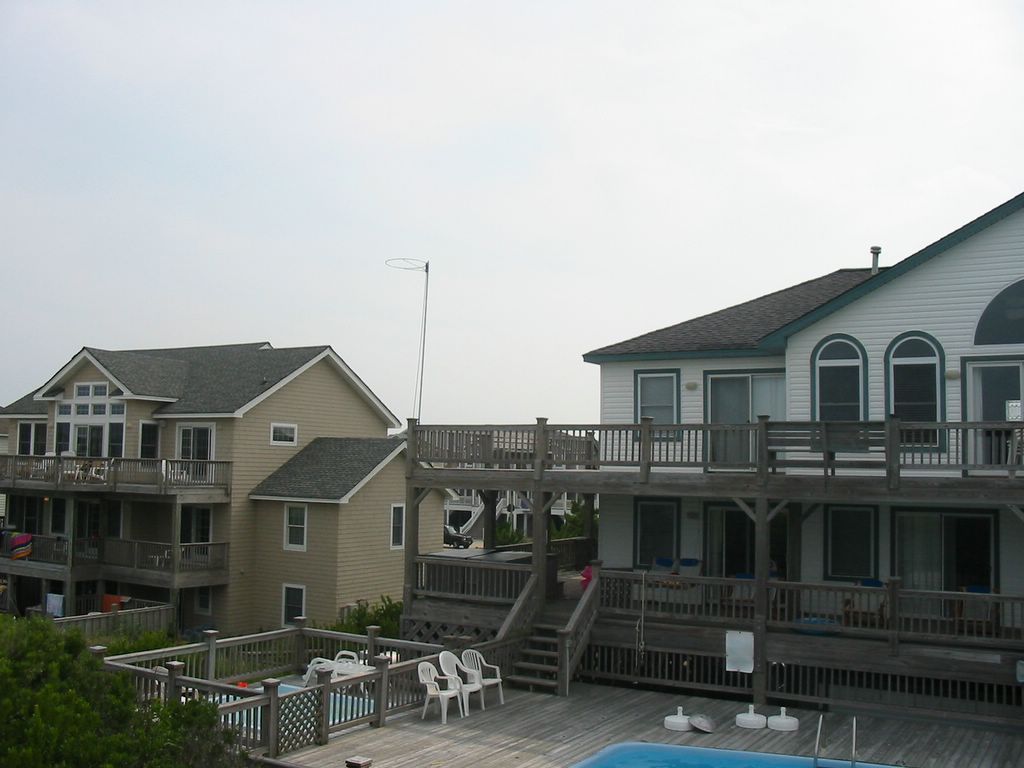
Last week, I was on vacation with Sharon and 3 other couples. We went down the to the Outer Banks in North Carolina (Corolla, to be specific) and rented a house there for the week. When we started planning the trip back in December, I figured I'd bring along my 706MkIIG and maybe spend a little bit of time operating. Since this was a vacation, not a DXpedition (which is, roughly, a trip to some location, typically somewhat off the beaten path, with the primary purpose being to operate ham radio), I figured that I would just get on the air whenever I had a little bit of spare time. At some point over the months that followed, Larry, N4VA, pointed out to me that the location that we were staying in was considered a rare grid for VUCC award purposes. (Basically, the goal of the VUCC award is to "collect" as many grid squares as possible by making contacts with stations in those grid squares using frequencies at 50Mhz [6 meters] and higher. A grid square is a 1 degree latitude x 2 degrees longitude rectangle; the entire planet is divided into these grid squares, which are further subdivided. The grid square page at the ARRL's website gives more detail about this. The official rules from the ARRL for the VUCC award are here.)
I decided that although I'd bring some hamsticks that I could use on a tripod (with radials) and a bunch of wire (in case I really wanted to build a simple dipole) for operating HF, I though that it would be fun to spend most of my time operating on 6m "giving out" the rare FM26 grid. (It's considered rare since most of the grid is over water, and there only seem to be one or two hams who actually have a residence in that grid; I don't know if they get on the air much but it seemed like one more wouldn't hurt.) As luck would have it, I was down at N4VA's place a few weeks before leaving (see the the "Ham's Field of Dreams" story), and he lent me a spare 6m loop antenna to use. (The loop happens to be identical to what's on my roof at home, a loop from KB6KQ that has worked very well for me.)
When I got down to the house, I was originally going to put the mast (3 x 5' sections of Radio Shack mast) up on the dunes, but I realized that I could easily secure it to the upper-level deck of the house where we were staying, which A) Was a LOT easier to set up and take down and B) Was actually higher than it would have been on the dunes anyway. You can see the loop on the mast in the picture above.
It turns out that the loop worked reasonably well from up there, and while the proximity to water (maybe 150 yards to the ocean from the loop) might not have made a huge difference, I'm sure it didn't hurt. The bad news was that unfortunately, 6m didn't feel like being very cooperative during my stay (though things improved a bit during the drive home). I had some brief band openings to the midwest and to Florida which accounted for about half of my contacts, the other half were groundwave contacts to folks in NC, VA, MD, and DE for the most part. It was nice having some folks thank me for getting on the air to give out that rare grid, and I did have one card waiting for me when I got home (and another has come in since). I'm going to make up a special card just for the operation which I'll send to anyone who needs confirmation.
Tuesday, June 28, 2005
A Ham's Field Of Dreams
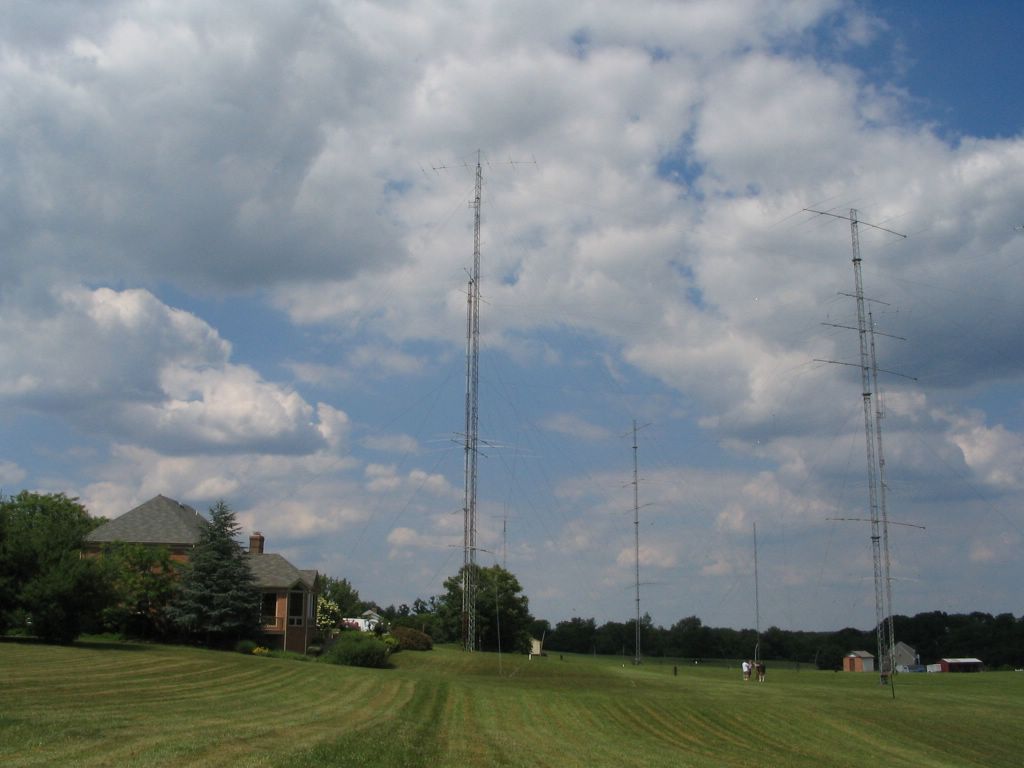
The ham version of "Field of Dreams"

A couple of weekends ago, I went to Virginia along with Justin to visit my friends Larry, N4VA and Coleman, K4RZ. Visiting them is always fun, but the reason behind this trip was to attend the annual open house at W3LPL's contest superstation. Frank's antenna farm is located on what used to be ten acres of cornfield. He was the first person in there, and he put up his tower before the neighbors moved in, so I guess they knew what they were in for. (One of his neighbors is Bernie, W3UR, who apparently has an arrangement where he can use one or two of W3LPL's towers when they aren't in use for contests.) Pretty much like the movie "Field Of Dreams", Frank cut down a cornfield and built something somewhat unusual. I didn't have a chance to ask him if he heard a voice telling him "If you build it, they will come", but contesters (and lots of wanna-be's like me!) certainly do come.
I've uploaded a bunch of pictures for your viewing pleasure. The pictures really don't do the place justice. The big problem is that the place is just so darn big that it's hard to get back far enough to take a single picture that gives a good perspective. The picture on this page was taken from about as far back as I could get while still on W3LPL's property, and it only shows a few of the towers. By the way, it's not at all obvious from the picture here, but that house on the left of this image is a pretty large house (3 car garage and all), it only looks small in the picture.
I figure that if nothing else, these pictures are good for showing to Sharon to explain that I'd never wind up with anything even 1/10th as large as this.
Here's an interesting tidbit: None of the towers is taller than 199' 6". (None seemed to be much shorter than that either.) The reason for that is that apparently after you get to 200', all kinds of of regulations regarding FAA notification, tower lighting, etc. come into play, so they've "settled" (hah!) for the current height.
Monday, June 27, 2005
Getting started in ham radio
As I mentioned previously, I was encouraged to start a blog by a friend (Jim) who, along with his daughter, are looking to get their ham licenses. (Jim previously had a license but let it lapse.) He and I corresponded a bit as he asked me for suggestions about study aids, test information, and so on. This posting will contain an edited version of the email thread between us. Perhaps someday I'll feel inspired enough to really clean this but, but for now, this will have to do. Everything in this post below this point not in italics is part of that thread, I've inserted a bit of explanation here and there in italics to help clarify stuff that was edited out. [28-June-05: I corrected the speed currently used on ARRL code tests, which is still 5 wpm, but sent at 15 wpm character speeds, not 18 wpm.]
Jim had asked me for a recommendation of a program to learn morse code.
I found this link http://c2.com/morse/ in an article in QST (the ARRL magazine) and took a look. While it doesn't simulate the QSOs you'd need for the actual Morse Code test, it does seem to do a nice job of teaching you the individual letters. (In fact, I might play with it a bit to see if I can get my own speed improved a bit.) The speed is adjustable, and you certainly don't need to run very fast. Although the test is given at 5 words per minute, I recommend a speed of around 7.5 wpm to help smooth out any test-day jitters that you (or your daughter) might run into.
Good luck!
This was a discussion about the idiosyncracies of that particular program and about how to learn CW. The text in bold were Jim's comments to me.
The bars seem to move up and down as you make mistakes or get it right, not certain. And it adds additional letters at some point.
Yes, that is correct. I've used other programs similar to this. Basically, what happens is that as the ratio of correct to incorrect tries at a particular letter increases, the bar gets smaller and smaller, eventually almost vanishing. Then, when the program "senses" that you've made "progress", it will add new letters. I guess I'm good enough (at least at the speed that I was running at) that I was able to make some progress. On the other hand, I certainly wasn't good enough to finish the whole thing.
I did read the web page again, and they seem to want to make it more about dahdahdahdahdah and dahditdahdit rather then - - - - - or zero.
Right, that's one of the key things that almost every CW training book, program, etc. says. Don't learn "dots and dashes", learn that a certain sound represents a certain character. What eventually happens is that you'll actually recognize entire words (I didn't believe that when I was told, but there are a few common things that I can "hear" at speeds that I even find surprising.) If you have to "translate" you'll learn well enough to pass a test (and if that's the only goal, then that's fine), but you won't be able to go much faster.
I should probably plan on a test date for tech for her and I, and a date for general. We need a date in the sand to set a goal against.
That's more or less what I did for each of my tests. For the tech and General, I didn't need a lot of lead time (well, I needed more for the CW), but the Extra took me a while, but once I felt that I was getting "close", I picked a test date and worked towards that. Seems to work out well for lots of folks. You can find a list of upcoming tests here: http://www.arrl.org/arrlvec/examsearch.phtml
You know, now comes the other part – can you recommend any of the testing trainers? Be it software or audio? Ha-ha – you had to see this coming.
Of course. :-)
I used 2 programs to learn. The one for learning letters wasn't as good as the one you've been using, (and I can't remember which one it was anyway), but the one I used for doing practice tests was called "NuMorse". I took a look at their website http://www.nu-ware.com/ and they still seem to have the original version (NuMorse) as well as some newer stuff. I could have sworn that it was freeware when I used it, looks it's a "try it and send in $$$ to get a software key to unlock". I'm not sure what the restrictions are without the key, but it's work looking at. The software design of at least NuMorse isn't the greatest, but it does do a good job of generating sample tests that are very close to the actual tests you'll eventually be taking.
One thing that I do want to mention are the tests are given at 5 words per minute, but each character is sent at 1815 wpm, with the spacing between characters increased so that the "net throughput" is still 5WPM. This is known as Farnsworth speeds, and NuMorse (and probably most other trainers) support that. (You'll see 2 sliders, one for character speed and one for word speed; you'll want to adjust for 18WPM characters and at least 5wpm word speed.) If my description isn't clear, play around a bit with the sliders in NuMorse, you'll see what I'm talking about.
Jim asked if I felt that the Nu-ware tests programs were good to use.
Jim had asked me for a recommendation of a program to learn morse code.
I found this link http://c2.com/morse/ in an article in QST (the ARRL magazine) and took a look. While it doesn't simulate the QSOs you'd need for the actual Morse Code test, it does seem to do a nice job of teaching you the individual letters. (In fact, I might play with it a bit to see if I can get my own speed improved a bit.) The speed is adjustable, and you certainly don't need to run very fast. Although the test is given at 5 words per minute, I recommend a speed of around 7.5 wpm to help smooth out any test-day jitters that you (or your daughter) might run into.
Good luck!
This was a discussion about the idiosyncracies of that particular program and about how to learn CW. The text in bold were Jim's comments to me.
The bars seem to move up and down as you make mistakes or get it right, not certain. And it adds additional letters at some point.
Yes, that is correct. I've used other programs similar to this. Basically, what happens is that as the ratio of correct to incorrect tries at a particular letter increases, the bar gets smaller and smaller, eventually almost vanishing. Then, when the program "senses" that you've made "progress", it will add new letters. I guess I'm good enough (at least at the speed that I was running at) that I was able to make some progress. On the other hand, I certainly wasn't good enough to finish the whole thing.
I did read the web page again, and they seem to want to make it more about dahdahdahdahdah and dahditdahdit rather then - - - - - or zero.
Right, that's one of the key things that almost every CW training book, program, etc. says. Don't learn "dots and dashes", learn that a certain sound represents a certain character. What eventually happens is that you'll actually recognize entire words (I didn't believe that when I was told, but there are a few common things that I can "hear" at speeds that I even find surprising.) If you have to "translate" you'll learn well enough to pass a test (and if that's the only goal, then that's fine), but you won't be able to go much faster.
I should probably plan on a test date for tech for her and I, and a date for general. We need a date in the sand to set a goal against.
That's more or less what I did for each of my tests. For the tech and General, I didn't need a lot of lead time (well, I needed more for the CW), but the Extra took me a while, but once I felt that I was getting "close", I picked a test date and worked towards that. Seems to work out well for lots of folks. You can find a list of upcoming tests here: http://www.arrl.org/arrlvec/examsearch.phtml
You know, now comes the other part – can you recommend any of the testing trainers? Be it software or audio? Ha-ha – you had to see this coming.
Of course. :-)
I used 2 programs to learn. The one for learning letters wasn't as good as the one you've been using, (and I can't remember which one it was anyway), but the one I used for doing practice tests was called "NuMorse". I took a look at their website http://www.nu-ware.com/ and they still seem to have the original version (NuMorse) as well as some newer stuff. I could have sworn that it was freeware when I used it, looks it's a "try it and send in $$$ to get a software key to unlock". I'm not sure what the restrictions are without the key, but it's work looking at. The software design of at least NuMorse isn't the greatest, but it does do a good job of generating sample tests that are very close to the actual tests you'll eventually be taking.
One thing that I do want to mention are the tests are given at 5 words per minute, but each character is sent at 1815 wpm, with the spacing between characters increased so that the "net throughput" is still 5WPM. This is known as Farnsworth speeds, and NuMorse (and probably most other trainers) support that. (You'll see 2 sliders, one for character speed and one for word speed; you'll want to adjust for 18WPM characters and at least 5wpm word speed.) If my description isn't clear, play around a bit with the sliders in NuMorse, you'll see what I'm talking about.
Jim asked if I felt that the Nu-ware tests programs were good to use.
I used the ARRL books to study from, and I took practice tests at http://www.qrz.com/p/testing.pl. I'd give you my books, but the question pools have changed and while they'd be a good starting point, you'd be better off investing in your own copy of the books. I recommend "Now You're Talking" for the Technician written, and "The General Class License Manual" for General. As much a fan as I am of free and/or online stuff, I think the books are worthwhile. You can order these books online at the ARRL online store
For taking tests, in addition to the link above, http://www.aa9pw.com/radio/ is very good in that the test there is more like the actual tests. (The qrz.com ones give you immediate feedback, which is fine, but the aa9pw.com one is more like the real test in that you have to take the whole test first. I think it makes you work a bit harder.)
There are also tests at http://www.w8mhb.com/exam/ which at a quick glance looks pretty good too, but I've never really gone though it much.
K2DBK's ham radio blog
Recently, I was exchanging emails with a friend about some things related to helping him (and his daughter) get their ham (amateur) radio licenses. After an number of emails back and forth, he suggest that some of the information might be useful to others, and that I publish it in the form of a blog. After a little thought, I thought that perhaps he was right (and if not, then the only loss was a bit of my own time spent posting), so I thought I'd go ahead and start posting.
As a prelude to posting the information we were discussing, I wanted to just provide a few tidbits of information about ham radio in general, in case someone happens to randomly stumble upon this and wonder what this is all about.
Many of you might remember hearing that your parents or grandparents (realistically more like "father or grandfather"; hams are predominantly, though not exclusively, male) used to use their ham radio to talk all over the world. This is that same ham radio, and although hams still use morse code (we call it CW, which means Continuous Wave) and "phone" (voice), hams continue to innovate and there's some pretty sophisticated digital technologies being used which allow us to communicate when signals are so weak that they can't be heard by a human).
Anyway, there are plenty of places to learn more about ham radio, but I think the best is the American Radio Relay League's site at http://www.arrl.org/hamradio.html. If you don't find what you're looking for there, drop me a line at k2dbk [At] arrl.net and I'll do what I can to help.
As a prelude to posting the information we were discussing, I wanted to just provide a few tidbits of information about ham radio in general, in case someone happens to randomly stumble upon this and wonder what this is all about.
Many of you might remember hearing that your parents or grandparents (realistically more like "father or grandfather"; hams are predominantly, though not exclusively, male) used to use their ham radio to talk all over the world. This is that same ham radio, and although hams still use morse code (we call it CW, which means Continuous Wave) and "phone" (voice), hams continue to innovate and there's some pretty sophisticated digital technologies being used which allow us to communicate when signals are so weak that they can't be heard by a human).
Anyway, there are plenty of places to learn more about ham radio, but I think the best is the American Radio Relay League's site at http://www.arrl.org/hamradio.html. If you don't find what you're looking for there, drop me a line at k2dbk [At] arrl.net and I'll do what I can to help.
Subscribe to:
Comments (Atom)