Yesterday morning, I got a nice surprise. I was working from home in the morning and chatting on the computer with Larry, N4VA. He was also at home and told me that Jimmy, BX5AA was coming in very strong on 20 meters. Jimmy is located in Taiwan, and that's a DXCC entity that I'd never worked before, so I was anxious to try to make a contact. I tuned to the frequency and at first, I only heard a very weak station, which I assumed was Jimmy, and figured that I wasn't going to have a chance to work him. It wasn't surprising that he'd be louder to Larry, since he's got a beam on his tower instead of just a G5RV (wire) up in the air.
However, it turns out that I was hearing a local station that Jimmy was working, and when it was Jimmy's turn to transmit I heard him very well. (I had heard him and tried to work him in the past, but the signals were much weaker.) Although he had a pretty good pileup, he heard part of my callsign (the "BK" part always seems to get through), and he asked just for the "Bravo Kilo" station. It took a few tries, but he was patient and eventually he got the complete and correct callsign, and gave me a 5x5 signal report. (I gave him a 5x9). That was that, and he moved on to working other stations.
I noticed on his website that he uses Logbook of The World, so that night I uploaded my contact with him, and to my surprise I found that he'd already uploaded his contacts and there was a confirmed QSL record generated. The time from contact to confirmation was probably under 12 hours. Not bad for a station from Taiwan!
I'll be sending for a paper card anyway, as while I think LoTW is fantastic, there's nothing like having an old-fashioned QSL card to look at.
Saturday, April 24, 2010


Saturday, April 17, 2010
The new ARRL website is disappointing
I'm going to stray a bit from my normal topics to discuss the newly updated ARRL website which after several attempts finally went live this week. My overall response was one of disappointment. I am well aware that any it's often difficult to get pretty much anything right in Information Technology the first time. (In fact, I was commenting to one of my colleagues at work that if you think you've gotten something right on the first try, you have overlooked something). My fellow bloggers Dan, KB6NU and David, K2DSL have written posts describing some of the flaws, and I suggest you read them for the details.
David in particular enumerated a lot of the different issues, and while I'm not going to add anything to his list, I will mention that in particular, the two things that are particularly annoying are the fact that it seems that even with the "favorites" feature, nearly everything requires a lot more clicks to get to (which is one of the main things you don't want to do if you want people to keep visiting your site) and that you no longer remain logged in for very long. (It looks like they may have adjusted this value since David wrote his blog, but in any case, it should allow you to remain logged in for at least a few weeks minimum; this isn't a banking site.)
I want to make clear that I am a big fan of the ARRL, and that I really appreciate the advocacy they provide for our hobby. I know that an undertaking of this magnitude must have been quite difficult, but I think that they should have allowed ARRL members "preview" access much earlier in the process. (Yes, I'm aware that there was an article in QST, but static images are not the same as actually using the site.) I suspect that the reason for not doing so was a concern over the flood of input that they may would have received, but when you are developing something that is supposed to provide service to your members, you need to take their feedback into account.
I sincerely hope that the ARRL will listen to those of us who have been sending in feedback and will be able to make the changes to make the website at least as useful as it was before the changes. I also hope that we, the members, don't hear that "it's too far along in the process to change things".
David in particular enumerated a lot of the different issues, and while I'm not going to add anything to his list, I will mention that in particular, the two things that are particularly annoying are the fact that it seems that even with the "favorites" feature, nearly everything requires a lot more clicks to get to (which is one of the main things you don't want to do if you want people to keep visiting your site) and that you no longer remain logged in for very long. (It looks like they may have adjusted this value since David wrote his blog, but in any case, it should allow you to remain logged in for at least a few weeks minimum; this isn't a banking site.)
I want to make clear that I am a big fan of the ARRL, and that I really appreciate the advocacy they provide for our hobby. I know that an undertaking of this magnitude must have been quite difficult, but I think that they should have allowed ARRL members "preview" access much earlier in the process. (Yes, I'm aware that there was an article in QST, but static images are not the same as actually using the site.) I suspect that the reason for not doing so was a concern over the flood of input that they may would have received, but when you are developing something that is supposed to provide service to your members, you need to take their feedback into account.
I sincerely hope that the ARRL will listen to those of us who have been sending in feedback and will be able to make the changes to make the website at least as useful as it was before the changes. I also hope that we, the members, don't hear that "it's too far along in the process to change things".
Monday, April 05, 2010
The NA-034 operation that almost wasn't: Epilogue
Well, I was wrong. Or was I?
When I got home after my NA-034 operation, I wanted to try to understand what happened. I was sure that I'd operated solely off a car battery in the past and as long as I was connected directly to the battery I hadn't had any problems. Based on some testing that I did, I discovered that I may have been mistaken. The short version is that I discovered that by using the battery in my car without the engine running, I was able to reproduce the "strange noise in headset" that I recently wrote about, and that by running the car engine, that problem went away. There's a bit more to it though. Read on if you're interested.
I needed to have some way to measure the voltage from the battery and the amount of current that it was drawing while the radio was transmitting. While I could do this with a couple of meters when I was home, based on some recommendations that I got from W3FF, K8EAB, and NE1RD, I picked up a Super Whattmeter from Astroflight for around $50 plus shipping. These devices are used by folks who fly electric model airplanes because you really don't want your battery to die when it's up in the air. As it turns out, they are well-suited for monitoring your power when operating portable. Of course, they work fine too in the home shack, though my power supply has meters so it's not needed. The picture here shows it hooked up that way for testing, and you can see that the Astron supply is supplying 13.8v.
 As a side note, I started using quick-disconnect connectors made by Workman Electronic quite a number of years ago, before Anderson Powerpoles became popular. I was looking for some kind of quick disconnect power connector and found patch cables similar to the ones in the picture at a hamfest. I typically cut them in half and crimp them onto whatever I need to, be it battery clamps, the power cord for a radio, and so on. The good part is that I've been able to find them surplus at hamfests (though I've seen from a number of places online that they are now discontinued) but the bad news is that they don't match what most other folks use. I keep meaning to make myself a set of adapters to connect to Powerpoles.
I crimped a set of the quick disconnects onto the Whattmeter and did a test with the power supply and radio in the shack to ensure that the meter was working and found that it worked perfectly. The shack power supply was putting out just over 13.8 volts with the Icom 756 Pro II drawing around 3 amps while receiving. (Interestingly, this is about 0.6A below what the ARRL reported in their testing, but I've had some repair work done on the radio and it's possible that some of the newer components draw less than the originals.) The next step was to reproduce what I'd set up while in Florida.
As luck would have it, the weather was beautiful this weekend, and as we had no plans on Sunday, I took the 706, the Buddistick, the Whattmeter, the antenna analyzer, and a length of coax outside. I set up the Buddistick on the front lawn (I just had it on the mini-tripod sitting on the lawn, though I did put the radial over a couple of plastic lawn chairs to keep it off the ground) which while not optimal for DX, took me all of 5 minutes to set up with a good match to the radio, as verified by the antenna analyzer. I connected the radio to the antenna then connected the power cables to the car battery, with the Whattmeter in-line. My thoughts were to do a few tests with the engine off, fully expecting that I wouldn't have any issues, then turn the engine on to see what kind of difference it made. I found an empty frequency on 20m and started testing. As soon as I transmitted, without looking at the meter, I knew that, to my surprise, I'd reproduced the problem: That nasty noise in the headphones was back.
What I figured I'd do was to collect data using various levels of transmit power to see the effect on the voltage and current draw. The meter itself also shows power in watts, though of course that's trivial to calculate if you already have current and voltage. (From Ohm's law, P=I×E). I quickly discovered that the car battery wasn't able to supply sufficient voltage unless I was transmitting with about 10 watts or less. The specification for the 706 MkIIG is that it requires 13.8vdc ± 15% meaning the minimum allowable voltage is 11.73vdc. With the car engine turned off, I measured 11.68v with the radio drawing 5.79A when transmitting using 10w. At 40w (the next step I measured; when I was in Florida I was able to "get away" with 40w when testing with KH6ITY), I measured 11.52v while drawing 8.23A. At 60w transmit power and up, the voltage dropped to about 11.4v but the radio was simply unable to draw the current needed.
 With the car running, it was a completely different situation. Even at full transmit power (100w), the voltage supplied to the radio was 13.24volts at 14.77A. (I'm not sure why my current draw measurement at that power was different from the specifications for the radio, which were also pretty close to what the ARRL measured). I took the results and plotted it out in transmit power vs. watts consumed for both the case with the engine on and the engine off, and it's pretty clear that with the engine off, the battery simply isn't able to supply the required power. (You may need to click on that chart to have it display in a readable size. If you're reading this via email and that doesn't work for you, go to the web version of this post at k2dbk.blogspot.com and it should work from there.)
You can see from the chart that not only couldn't the battery supply sufficient power for the transmit needs, it was only able to supply less as the radio tried to use more, presumably because the battery simply couldn't "keep up". So all my empirical testing seemed to prove that with the setup that I was using, I simply couldn't operation at full power using just a car battery with the engine running.
However, similar to bees who simply don't know that they can't fly, so they do, apparently my radio didn't know that it didn't have enough power to operate, at least during my 2004 and 2006 operations from NA-034, so it worked just fine. During those operations I know that I did not have the car running, yet I had no issues with power. The key for me know will be to find out what has changed. I am using the same power cables and the same radio (the antenna was different, but that shouldn't matter), yet something has changed. The next thing I am going to do is to see if perhaps there is a problem with the power cables that may have occurred over the years.
Although I attempted to measure the resistance in the power cables and came up with a measured 0.1 Ohms, my meter is probably fairly inaccurate at such low resistance, so I did a calculation instead assuming that I've got all 12 AWG wire in place. (Part of it is actually 10AWG, but I'm using 12 to account for any losses due to connectors and splices.) Using a 12v supply with a load of 15A (matching what I saw when the engine was running) and a length of 20 feet, the voltage drop calculator that I used shows an estimated voltage drop of around 8%. Allowing a bit of wiggle room for the length, it appears that the voltage drop would be somewhere between around 6% and 10% which corresponds to a voltage at the load (radio) of between 11.3v and 10.8v. Even the highest end of that range is too low for the radio to operate properly. Dropping the transmit power to 40w results in the voltage to the radio of about 11.5v which is a bit below spec but probably would allow operation, with some minor distortion. That seems to match what I had experienced.
The other factor that I haven't played around with much is temperature, and I'll leave that as an exercise for the reader. At this point, I think the best thing to do is to shorten the power cable as much as I reasonably can, replacing the section that is currently 12AWG wire with 10AWG wire. I suspect that will help ensure sufficient current flow while minimizing voltage drop.
I would be very interested in any feedback from anyone who can shed a bit more light on these issues, as I know that there are other factors that may come into play, such as the battery chemistry and perhaps other parts of the car's electrical system.
When I got home after my NA-034 operation, I wanted to try to understand what happened. I was sure that I'd operated solely off a car battery in the past and as long as I was connected directly to the battery I hadn't had any problems. Based on some testing that I did, I discovered that I may have been mistaken. The short version is that I discovered that by using the battery in my car without the engine running, I was able to reproduce the "strange noise in headset" that I recently wrote about, and that by running the car engine, that problem went away. There's a bit more to it though. Read on if you're interested.
I needed to have some way to measure the voltage from the battery and the amount of current
 that it was drawing while the radio was transmitting. While I could do this with a couple of meters when I was home, based on some recommendations that I got from W3FF, K8EAB, and NE1RD, I picked up a Super Whattmeter from Astroflight for around $50 plus shipping. These devices are used by folks who fly electric model airplanes because you really don't want your battery to die when it's up in the air. As it turns out, they are well-suited for monitoring your power when operating portable. Of course, they work fine too in the home shack, though my power supply has meters so it's not needed. The picture here shows it hooked up that way for testing, and you can see that the Astron supply is supplying 13.8v.
 As a side note, I started using quick-disconnect connectors made by Workman Electronic quite a number of years ago, before Anderson Powerpoles became popular. I was looking for some kind of quick disconnect power connector and found patch cables similar to the ones in the picture at a hamfest. I typically cut them in half and crimp them onto whatever I need to, be it battery clamps, the power cord for a radio, and so on. The good part is that I've been able to find them surplus at hamfests (though I've seen from a number of places online that they are now discontinued) but the bad news is that they don't match what most other folks use. I keep meaning to make myself a set of adapters to connect to Powerpoles.
I crimped a set of the quick disconnects onto the Whattmeter and did a test with the power supply and radio in the shack to ensure that the meter was working and found that it worked perfectly. The shack power supply was putting out just over 13.8 volts with the Icom 756 Pro II drawing around 3 amps while receiving. (Interestingly, this is about 0.6A below what the ARRL reported in their testing, but I've had some repair work done on the radio and it's possible that some of the newer components draw less than the originals.) The next step was to reproduce what I'd set up while in Florida.
As luck would have it, the weather was beautiful this weekend, and as we had no plans on Sunday, I took the 706, the Buddistick, the Whattmeter, the antenna analyzer, and a length of coax outside. I set up the Buddistick on the front lawn (I just had it on the mini-tripod sitting on the lawn, though I did put the radial over a couple of plastic lawn chairs to keep it off the ground) which while not optimal for DX, took me all of 5 minutes to set up with a good match to the radio, as verified by the antenna analyzer. I connected the radio to the antenna then connected the power cables to the car battery, with the Whattmeter in-line. My thoughts were to do a few tests with the engine off, fully expecting that I wouldn't have any issues, then turn the engine on to see what kind of difference it made. I found an empty frequency on 20m and started testing. As soon as I transmitted, without looking at the meter, I knew that, to my surprise, I'd reproduced the problem: That nasty noise in the headphones was back.
What I figured I'd do was to collect data using various levels of transmit power to see the effect on the voltage and current draw. The meter itself also shows power in watts, though of course that's trivial to calculate if you already have current and voltage. (From Ohm's law, P=I×E). I quickly discovered that the car battery wasn't able to supply sufficient voltage unless I was transmitting with about 10 watts or less. The specification for the 706 MkIIG is that it requires 13.8vdc ± 15% meaning the minimum allowable voltage is 11.73vdc. With the car engine turned off, I measured 11.68v with the radio drawing 5.79A when transmitting using 10w. At 40w (the next step I measured; when I was in Florida I was able to "get away" with 40w when testing with KH6ITY), I measured 11.52v while drawing 8.23A. At 60w transmit power and up, the voltage dropped to about 11.4v but the radio was simply unable to draw the current needed.
 With the car running, it was a completely different situation. Even at full transmit power (100w), the voltage supplied to the radio was 13.24volts at 14.77A. (I'm not sure why my current draw measurement at that power was different from the specifications for the radio, which were also pretty close to what the ARRL measured). I took the results and plotted it out in transmit power vs. watts consumed for both the case with the engine on and the engine off, and it's pretty clear that with the engine off, the battery simply isn't able to supply the required power. (You may need to click on that chart to have it display in a readable size. If you're reading this via email and that doesn't work for you, go to the web version of this post at k2dbk.blogspot.com and it should work from there.)
You can see from the chart that not only couldn't the battery supply sufficient power for the transmit needs, it was only able to supply less as the radio tried to use more, presumably because the battery simply couldn't "keep up". So all my empirical testing seemed to prove that with the setup that I was using, I simply couldn't operation at full power using just a car battery with the engine running.
However, similar to bees who simply don't know that they can't fly, so they do, apparently my radio didn't know that it didn't have enough power to operate, at least during my 2004 and 2006 operations from NA-034, so it worked just fine. During those operations I know that I did not have the car running, yet I had no issues with power. The key for me know will be to find out what has changed. I am using the same power cables and the same radio (the antenna was different, but that shouldn't matter), yet something has changed. The next thing I am going to do is to see if perhaps there is a problem with the power cables that may have occurred over the years.
Although I attempted to measure the resistance in the power cables and came up with a measured 0.1 Ohms, my meter is probably fairly inaccurate at such low resistance, so I did a calculation instead assuming that I've got all 12 AWG wire in place. (Part of it is actually 10AWG, but I'm using 12 to account for any losses due to connectors and splices.) Using a 12v supply with a load of 15A (matching what I saw when the engine was running) and a length of 20 feet, the voltage drop calculator that I used shows an estimated voltage drop of around 8%. Allowing a bit of wiggle room for the length, it appears that the voltage drop would be somewhere between around 6% and 10% which corresponds to a voltage at the load (radio) of between 11.3v and 10.8v. Even the highest end of that range is too low for the radio to operate properly. Dropping the transmit power to 40w results in the voltage to the radio of about 11.5v which is a bit below spec but probably would allow operation, with some minor distortion. That seems to match what I had experienced.
The other factor that I haven't played around with much is temperature, and I'll leave that as an exercise for the reader. At this point, I think the best thing to do is to shorten the power cable as much as I reasonably can, replacing the section that is currently 12AWG wire with 10AWG wire. I suspect that will help ensure sufficient current flow while minimizing voltage drop.
I would be very interested in any feedback from anyone who can shed a bit more light on these issues, as I know that there are other factors that may come into play, such as the battery chemistry and perhaps other parts of the car's electrical system.
Friday, April 02, 2010
The NA-034 operation that almost wasn't, Part IV
If you haven't read Part I , Part II and Part III first, you might want to do that.
As I mentioned previously, once I got the power problem figured out I was able to easily make contacts with other stations, which is what I'd planned to do in the first place. In the first half-hour of operating, I made contact with about 25 stations. Compared to rare DX stations this is very slow, but my operation was very low-key and I'd often spend a bit of time to briefly chat with the other operators, so this was far from the typical "K2DBK you are 59 thanks QR Zed" that you hear in those operations. I was having a great time working stations, and after a while I started to hear folks in Europe calling me, but they were covered up by the US callers. I figured that I'd try to work as many folks outside North America as I could, so I asked for only stations outside of North America, and worked 9 stations in as many minutes, all outside the US. I worked folks in Italy, Poland, Spain, and Belarus all in fairly quick succession. Thanks very much to the folks in North America who very politely stood by while I worked the other stations. Not one single person from North America called when I was asking for the other folks. (By way of explanation, it is an unfortunate fact of life that all-too-often hams will "call out of turn" and ignore requests from contacts from specific areas. When they do that, it just slows down the process.)
After I had contacted the folks outside North America, I went back to working any station that was calling me, and I picked up a mix of both US stations and some more DX from Italy, Serbia, and Belgium. I had a couple of other chats during a few lulls with Larry, KH6ITY, and finally shut down for the day at around 4:45PM local time to head back to have dinner with the Sharon in St. Armands.
The following day I got somewhat of a later start than expected, but I did want to stop at The Old Salty Dog again, this time to have what is one of the most delicious and presumably most unhealthy foods in existence: Their signature "Salty Dog". A Salty Dog is a jumbo hot dog dipped in beer batter and deep fried. It is indescribably delicious. Of course, it must be washed down with a nice cold bevarage (a Bass Ale for me, thanks).
When I arrived at the park, the parking spot I'd had the first day was taken, and I was having trouble finding a place to park where I could be close enough to be able to set up on a picnic table, but as I was walking around (I'd parked temporarily "out of range") someone left and I was able to pull in close to a different table, this time right out in the sun. The only downside to this location was there there wasn't another table nearby so that I could set up the antenna on a different table, but I was able to set up the antenna on one end of the table and operate from the other without any issues. Well, not at first.
I started off working stations on 20 meters and worked a number of US and Canadian stations, as well as a station from Slovakia and one from Hungary. I'd been trying to set up a contact with Scott, NE1RD, who was now operating from the island of St. Thomas (as KP2/NE1RD) on and off for a while by this point. I emailed Scott from my BlackBerry that I was currently on 14.260Mhz and Scott quickly threw together an antenna for 20m, but by the time he got on the air, I'd lost the frequency that I was using and we didn't make the contact. "Losing" the frequency means that I was using it to make contacts, but due to the way that propagation works, sometimes two (or more) stations will be using the same frequency, both unable to hear each other until the conditions change, then usually one of the stations will wind up "taking over" the frequency. This is what happened in my case, and I "lost".
As it turned out, Scott had already built a 2 element beam for 15 meters using the Buddipole gear that he'd brought, which would provide a much better signal to me. I reconfigured my antenna for 15m (very easy to do), and coordinating once again via email we were able to contact each other. Neither Scott nor I consider ourselves as "rag-chewers", which are folks who prefer to get on the radio and have a nice long chat with someone. I've certainly done that in the past, but most of my current interest is in working DX stations and contesting, both of which require very brief, specific exchanges of information. However, Scott and I found that we had a lot to talk about, so the contact was not a brief one. About 10 or 15 minutes into our conversation, I got another visit from Mr. Murphy.
As we were talking on the radio, I thought that I noticed the odd sound in my headset that I'd heard previously. This didn't make any sense, since the car was still running (as you'll recall, the battery alone was unable to provide sufficient power to transmit at full power). Scott then commented that he could hear my signal starting to distort, so it sounded like the problem was returning. We both tried to figure out what might be going wrong, and while trying to figure out what could have "broken" while operating (nothing had been touched since I originally got on the air that day), I thought that perhaps our relatively long chat had caused the power cables to heat, which in turn would increase the resistance in the cables, reducing the power available to the radio. I felt along the length of the cable but didn't feel any warm spots. I was about to rule out the wire heating up when I realized that I'd closed the hood on the car almost all the way and when I opened it, obviously (in hindsight) the portion of the power cable that was closest to the battery, and under the hood, was quite warm. It hadn't heated up solely from transmitting, but also because it was a warm day and with the engine running and the hood closed, the engine compartment was quite hot. The solution to the problem was now quite simple: Leave the hood of the car open.
After just a minute or two, the power cables cooled enough to allow enough power to flow so that my radio was again transmitting normally. Scott and I finished our chat, and I decided to stay on 15m where I worked stations from Puerto Rico, Italy, Portugal, and the US, finally finishing up with a nice chat with Andy, AE6Y who was operating from Aruba as P49Y, having just arrived there prior to the WPX Contest that was coming up. When I finished with Andy, it was time to shut the station down to head back for a final family dinner, since we were leaving for home the next day.
In all, despite losing a day of operating due to the power problem, I would rate this as a successful operation for a number of reasons. First, I did finally get on the air and made contact with 16 different DXCC entities (countries) and at least 10 different states. (It was almost certainly more than that, but I didn't always get the name of the state for the station that I was talking to.) Second, I was able to give back a bit to the hobby by talking to, and with Larry, KH6ITY's class. If even one of his students goes on to get his ham license that would really be a wonderful extra benefit. Third, I've made a number of new friends both as the result of both my operation on the air and the attempts to troubleshoot with the wonderful folks from the Buddipole Users Group. Fourth, I've learned a bit more than I already knew about troubleshooting this type of problem. Finally, and perhaps most important, despite the issues that I ran into, I had a really good time doing this.
I have really enjoyed writing this series, and I want to thank those of you who've commented about how you've enjoyed it as well. There is a bit more information that I want to share that I'm going to write as an epilogue to this series, please look for that soon.
Until then,
73,
David, K2DBK
Update: I've posted the epilogue.
As I mentioned previously, once I got the power problem figured out I was able to easily make contacts with other stations, which is what I'd planned to do in the first place. In the first half-hour of operating, I made contact with about 25 stations. Compared to rare DX stations this is very slow, but my operation was very low-key and I'd often spend a bit of time to briefly chat with the other operators, so this was far from the typical "K2DBK you are 59 thanks QR Zed" that you hear in those operations. I was having a great time working stations, and after a while I started to hear folks in Europe calling me, but they were covered up by the US callers. I figured that I'd try to work as many folks outside North America as I could, so I asked for only stations outside of North America, and worked 9 stations in as many minutes, all outside the US. I worked folks in Italy, Poland, Spain, and Belarus all in fairly quick succession. Thanks very much to the folks in North America who very politely stood by while I worked the other stations. Not one single person from North America called when I was asking for the other folks. (By way of explanation, it is an unfortunate fact of life that all-too-often hams will "call out of turn" and ignore requests from contacts from specific areas. When they do that, it just slows down the process.)
After I had contacted the folks outside North America, I went back to working any station that was calling me, and I picked up a mix of both US stations and some more DX from Italy, Serbia, and Belgium. I had a couple of other chats during a few lulls with Larry, KH6ITY, and finally shut down for the day at around 4:45PM local time to head back to have dinner with the Sharon in St. Armands.
 |
| The Legendary Salty Dog |
When I arrived at the park, the parking spot I'd had the first day was taken, and I was having trouble finding a place to park where I could be close enough to be able to set up on a picnic table, but as I was walking around (I'd parked temporarily "out of range") someone left and I was able to pull in close to a different table, this time right out in the sun. The only downside to this location was there there wasn't another table nearby so that I could set up the antenna on a different table, but I was able to set up the antenna on one end of the table and operate from the other without any issues. Well, not at first.
 |
| Buddistick set up for 20m with counterpoise thrown over a tree branch |
As it turned out, Scott had already built a 2 element beam for 15 meters using the Buddipole gear that he'd brought, which would provide a much better signal to me. I reconfigured my antenna for 15m (very easy to do), and coordinating once again via email we were able to contact each other. Neither Scott nor I consider ourselves as "rag-chewers", which are folks who prefer to get on the radio and have a nice long chat with someone. I've certainly done that in the past, but most of my current interest is in working DX stations and contesting, both of which require very brief, specific exchanges of information. However, Scott and I found that we had a lot to talk about, so the contact was not a brief one. About 10 or 15 minutes into our conversation, I got another visit from Mr. Murphy.
As we were talking on the radio, I thought that I noticed the odd sound in my headset that I'd heard previously. This didn't make any sense, since the car was still running (as you'll recall, the battery alone was unable to provide sufficient power to transmit at full power). Scott then commented that he could hear my signal starting to distort, so it sounded like the problem was returning. We both tried to figure out what might be going wrong, and while trying to figure out what could have "broken" while operating (nothing had been touched since I originally got on the air that day), I thought that perhaps our relatively long chat had caused the power cables to heat, which in turn would increase the resistance in the cables, reducing the power available to the radio. I felt along the length of the cable but didn't feel any warm spots. I was about to rule out the wire heating up when I realized that I'd closed the hood on the car almost all the way and when I opened it, obviously (in hindsight) the portion of the power cable that was closest to the battery, and under the hood, was quite warm. It hadn't heated up solely from transmitting, but also because it was a warm day and with the engine running and the hood closed, the engine compartment was quite hot. The solution to the problem was now quite simple: Leave the hood of the car open.
After just a minute or two, the power cables cooled enough to allow enough power to flow so that my radio was again transmitting normally. Scott and I finished our chat, and I decided to stay on 15m where I worked stations from Puerto Rico, Italy, Portugal, and the US, finally finishing up with a nice chat with Andy, AE6Y who was operating from Aruba as P49Y, having just arrived there prior to the WPX Contest that was coming up. When I finished with Andy, it was time to shut the station down to head back for a final family dinner, since we were leaving for home the next day.
In all, despite losing a day of operating due to the power problem, I would rate this as a successful operation for a number of reasons. First, I did finally get on the air and made contact with 16 different DXCC entities (countries) and at least 10 different states. (It was almost certainly more than that, but I didn't always get the name of the state for the station that I was talking to.) Second, I was able to give back a bit to the hobby by talking to, and with Larry, KH6ITY's class. If even one of his students goes on to get his ham license that would really be a wonderful extra benefit. Third, I've made a number of new friends both as the result of both my operation on the air and the attempts to troubleshoot with the wonderful folks from the Buddipole Users Group. Fourth, I've learned a bit more than I already knew about troubleshooting this type of problem. Finally, and perhaps most important, despite the issues that I ran into, I had a really good time doing this.
I have really enjoyed writing this series, and I want to thank those of you who've commented about how you've enjoyed it as well. There is a bit more information that I want to share that I'm going to write as an epilogue to this series, please look for that soon.
Until then,
73,
David, K2DBK
Update: I've posted the epilogue.
Tuesday, March 30, 2010
The NA-034 operation that almost wasn't, Part III
If you haven't read Part I and Part II first, you might want to do that.
As I mentioned previously, meeting Larry, KH6ITY on the air turned out to be a great stroke of luck for me, and the contact proved to be beneficial for both of us. Larry is a technology teacher at a high school in Texas, and when he responded to my call on the air, he was looking for a contact to speak with his class via ham radio as a demonstration. I was more than happy to do so, but what Larry told me was that while he could hear me, my audio was very distorted and I was extremely difficult to understand. Somehow, I managed to convey to him enough that he understood that I'd done some pretty extensive troubleshooting on the antenna system, so he suggested that I try to reduce the transmitter power to see if that would help. Since I'd connected the radio directly to the car battery, I figured that power wouldn't likely be the source of the problem, but given that nothing else I'd tried had worked, I figured I'd give it a shot.
I turned the power down to about 40% of the maximum and transmitted, asking Larry if my signal was any better. Before he even answered, I knew what the answer was: I was no longer hearing that odd noise in my headset, and Larry confirmed that indeed my signal had no issues. Although the signal strength was somewhat reduced, Larry was able to report that the audio artifacts were completely gone. He then asked me about what kind of radio I was using (an Icom 706 MKIIG), and when I told him that, I think that both he and I figured out the problem, both from similar past experiences. First, a little bit of background.
All electronic equipment requires a power supply that is capable of supplying a certain amount of electrical current at a voltage within a specified range. According to the manual, the 706 MKIIG draws up to 20 amps at 13.8 volts DC+/- 15%. Although the electrical system in a car is rated at 12 volts DC, it turns out that a charged car battery will provide somewhat more than 12 volts, and the battery is charged at somewhere between 13.2 to 14.4 volts. A running engine which is charging the battery should provide enough power for the radio, but what happens if the car isn't running? It turns out that in practice, there is some "give" in these numbers, but at some point, the radio doesn't function properly.
For those of you who have forgotten (or never knew), one of the most basic formulas in electricity is known as Ohm's Law. It states the relationship between voltage, current, and resistance. In order to try to keep my readers awake, I'll skip all the details and say that Ohms law explains that the length of the power cord, among other factors, affects the amount of actual power that the car battery is able to deliver to the radio. I'd used this exact same setup previously from at least two different vehicles without any issue. However, it seems that the battery in the rental car (a Mazda 5) that I had was a bit weaker than the others that I'd previously used and it just wasn't capable of delivering enough power to the radio.
The Icom 706 MkIIG is probably one of the most popular radios made in recent years. It is very portable, capable of transmitting on all the HF radio bands, (10m through 160m) and can also transmit on VHF (6m and 2m) and UHF bands (70 cm). This was the first HF radio that I ever bought, and it has served me very well for the almost 10 years that I've owned it. However, it does have one problem (perhaps common to other similar radios): When it doesn't get enough power to transmit properly, instead of simply shutting down or refusing to transmit, the transmitted audio gets distorted.
Both Larry and I had previous experiences where the radio wasn't supplied enough power and exhibited this problem. In my case, the very first time that I ever tried to operate from a car, I was parked outside a friend's vacation home in upstate New York, and figured that the accessory adapter (we called them cigarette lighters back then) looked like an easy way to hook up the radio. It turns out that the wiring for the lighter plug wasn't capable of carrying the 20amps at 13.8vdc that the radio requires to transmit at full power. My audio was distorted, and a helpful ham in Italy (I wish I'd made a note of his call) helped me to troubleshoot the problem. At the time, the solution was to simply connect the radio directly to the car battery, which did the trick.
Since I was already connected directly to the battery, the only other thing that I could do was to start the engine, hoping that the charging current provided by the car's alternator would provide enough power to the radio when transmitting at full power. I adjusted the transmitter output back to 100%, and Larry verified that my audio was still clear. Finally, I was on the air, and could start making contacts.
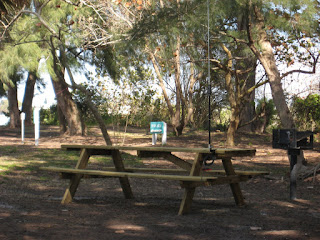 The antenna was mounted on a picnic table about 15 meters away, I was sitting underneath some trees, and I was able to make contact with other stations all around the world. This was what I'd planned to do.
However, Murphy still had one surprise in store for me, which didn't crop up until the next day.
The sage concludes with Part IV.
As I mentioned previously, meeting Larry, KH6ITY on the air turned out to be a great stroke of luck for me, and the contact proved to be beneficial for both of us. Larry is a technology teacher at a high school in Texas, and when he responded to my call on the air, he was looking for a contact to speak with his class via ham radio as a demonstration. I was more than happy to do so, but what Larry told me was that while he could hear me, my audio was very distorted and I was extremely difficult to understand. Somehow, I managed to convey to him enough that he understood that I'd done some pretty extensive
 troubleshooting on the antenna system, so he suggested that I try to reduce the transmitter power to see if that would help. Since I'd connected the radio directly to the car battery, I figured that power wouldn't likely be the source of the problem, but given that nothing else I'd tried had worked, I figured I'd give it a shot.
 I turned the power down to about 40% of the maximum and transmitted, asking Larry if my signal was any better. Before he even answered, I knew what the answer was: I was no longer hearing that odd noise in my headset, and Larry confirmed that indeed my signal had no issues. Although the signal strength was somewhat reduced, Larry was able to report that the audio artifacts were completely gone. He then asked me about what kind of radio I was using (an Icom 706 MKIIG), and when I told him that, I think that both he and I figured out the problem, both from similar past experiences. First, a little bit of background.
All electronic equipment requires a power supply that is capable of supplying a certain amount of electrical current at a voltage within a specified range. According to the manual, the 706 MKIIG draws up to 20 amps at 13.8 volts DC+/- 15%. Although the electrical system in a car is rated at 12 volts DC, it turns out that a charged car battery will provide somewhat more than 12 volts, and the battery is charged at somewhere between 13.2 to 14.4 volts. A running engine which is charging the battery should provide enough power for the radio, but what happens if the car isn't running? It turns out that in practice, there is some "give" in these numbers, but at some point, the radio doesn't function properly.
For those of you who have forgotten (or never knew), one of the most basic formulas in electricity is known as Ohm's Law. It states the relationship between voltage, current, and resistance. In order to try to keep my readers awake, I'll skip all the details and say that Ohms law explains that the length of the power cord, among other factors, affects the amount of actual power that the car battery is able to deliver to the radio. I'd used this exact same setup previously from at least two different vehicles without any issue. However, it seems that the battery in the rental car (a Mazda 5) that I had was a bit weaker than the others that I'd previously used and it just wasn't capable of delivering enough power to the radio.
The Icom 706 MkIIG is probably one of the most popular radios made in recent years. It is very portable, capable of transmitting on all the HF radio bands, (10m through 160m) and can also transmit on VHF (6m and 2m) and UHF bands (70 cm). This was the first HF radio that I ever bought, and it has served me very well for the almost 10 years that I've owned it. However, it does have one problem (perhaps common to other similar radios): When it doesn't get enough power to transmit properly, instead of simply shutting down or refusing to transmit, the transmitted audio gets distorted.
Both Larry and I had previous experiences where the radio wasn't supplied enough power and exhibited this problem. In my case, the very first time that I ever tried to operate from a car, I was parked outside a friend's vacation home in upstate New York, and figured that the accessory adapter (we called them cigarette lighters back then) looked like an easy way to hook up the radio. It turns out that the wiring for the lighter plug wasn't capable of carrying the 20amps at 13.8vdc that the radio requires to transmit at full power. My audio was distorted, and a helpful ham in Italy (I wish I'd made a note of his call) helped me to troubleshoot the problem. At the time, the solution was to simply connect the radio directly to the car battery, which did the trick.
Since I was already connected directly to the battery, the only other thing that I could do was to start the engine, hoping that the charging current provided by the car's alternator would provide enough power to the radio when transmitting at full power. I adjusted the transmitter output back to 100%, and Larry verified that my audio was still clear. Finally, I was on the air, and could start making contacts.

However, Murphy still had one surprise in store for me, which didn't crop up until the next day.
The sage concludes with Part IV.
Sunday, March 28, 2010
The NA-034 operation that almost wasn't, Part II
If you haven't read Part I of this series already, you might want to do that first.


During these tests, in addition to just hearing the odd noise in my headset, and on the radio speaker when I disconnected the headset, I was attempting to call some stations that I had been hearing all afternoon. The location that I had now moved
to was even better than my previous location, as there was water on 3 sides, which means I had an especially good path to Europe, South America, and the southwest US. Some of the stations that I'd tried to contact were extremely strong and should not have been difficult at all to contact. I was finally able to make a contact with S55OO so I knew that the radio was actually transmitting, though he was in the middle of working many other stations so I didn't have a chance to ask him for a signal report. At that point, I was confused and frustrated at not being able to locate the source of the problem, and given that it was getting late in the afternoon, I decided to break down and shut down for the evening.
After heading back home (well, not to NJ, to where we were saying), I sent an email the Buddipole Users Group to see if anyone there had any ideas what the problem might be. I got back responses from a number of folks within a few hours, most of them suggesting that I try most of the things I'd already tried (which of course they didn't know I'd done). A couple of folks suggested trying to use some ferrite beads in various places on power cable, microphone cable, and power cables. Unfortunately, I didn't have any with me, and they aren't the kind of thing that are stocked in a local hardware store or even Radio Shack. Budd, W3FF, and Scott, NE1RD pointed out that since I'd made one contact that the radio must be transmitting, but it did seem that there was still some problem.

When I arrived at South Lido Park, I found an even better location than on the previous day, where the operating position was under trees for shade and I was able to set up the antenna on a different table from the operating position, putting even more distance between the antenna, the radio, and the car. I made sure to have the RF choke in place as close as possible to the feedpoint, and wound up as much of the excess feedline into that choke to try to eliminate as much of the unwanted RF on the outside of the feedline as possible.
I was still hearing what I thought was RF in my headset (or from the radio speaker when I switched to the hand microphone), but I decided to call CQ anyway, hoping that perhaps someone would be able to hear me and perhaps let me know what my on-air signal sounded like. I finally got an answer back from Larry, KH6ITY who, as it turns out, was a technology teacher in Texas and was in the middle of demonstrating ham radio to his class. As it turned out, meeting Larry on the air was a wonderful stroke of luck.
Click here for Part III.
Friday, March 26, 2010
The NA-034 operation that almost wasn't, Part I
As I mentioned in my posting from last week, I spent a few days in Florida recently. I was down there visiting family, but had free time in the afternoons and had planned on operating for a few hours each day from Lido Key, which is IOTA designator NA-034. Briefly, IOTA (Islands On The Air) is a program where hams operate from various islands all over the world and make contacts with other hams. There's an awards program for contacting various numbers of islands. The rules (link goes to a PDF file) for what qualifies as an island for IOTA purposes are a bit complex, but Lido Key, just west of Sarasota, Florida, qualifies. I've made a couple of trips down there in the past and had a lot of fun operating from that location.
My plan was to head out to the parking lot of Lido Beach and set up there, as I've done in the past.This location is very easy to get to, and the parking lot has never been full when I've been there, so I can take up as much space as I need. For this portable operation, instead of using hamsticks (which are very straightforward to use but since they are nearly 2 meters long, are hard to ship), I decided to use my Buddistick vertical antenna. I've written about the Buddistick quite a bit here before, you can do a search from the search box on the right of the blog home page for "buddistick" to see all the references. Because Sharon and I didn't want to have to check baggage, I shipped the radio (my trusty Icom 706MkIIG), feedline, power cables, and Buddistick down to a relative a couple of days before we left NJ.
I set up the radio and initially mounted the antenna on the rear of the rental car, a Mazda 5, which seemed to be a good way to get it up fairly high and also allowed me to toss the counterpoise wire over a low tree branch. (It's a bit difficult to see, but you can view the counterpose wire just above the bottom of the picture, it's the very thin wire.) I set up the antenna, configured it for 20m, and checked it with the antenna analyzer, where I found that I had excellent SWR at my intended operating frequency of 14.260Mhz (one of the standard IOTA frequencies). I connected the antenna to the feedline, and used the built-in SWR testing in the radio to ensure that the SWR was still good (it was), found that my intended frequency was unoccupied, and started to call CQ. That's when I discovered that I had a pretty serious problem.
The problem was that when I keyed the radio and called CQ, I could hear a lot of what sounded like RF feedback in the headset. My assumption was that for some reason, the transmitted signal from the transmitted signal from the radio was being fed back into the radio, and causing the noise that I was hearing in my headset. As it turned out, I was wrong about the source of the problem, but I didn't find that out for another 24 hours. Working on that initial assumption, I tried to move the antenna to a slightly different location on the car, and even tried to use the very small Buddistick tripod to place the antenna on the ground much farther away from the car, but had no success. (By the way, that's a wonderful little tripod, but it's really not designed to work on a concrete parking lot surface where you can neither dig the legs in nor secure it to anything. All it took was a tiny breeze to knock over the antenna. Fortunately, no damage was done to the whip antenna, but I'll be a bit more careful about trying that again.)
At that point, I had to take a break from troubleshooting to join a conference call at work. (Yes, even though I was on vacation.) After the call and a follow-up call, about 90 minutes had passed. I tried a few more attempts to play with the radial height, move the location of the radio, and to create an RF choke by coiling some feedline at the feedpoint of the antenna, but was still having no success. I decided to try to find another operating location, hoping to find a park where I could mount the antenna on a picnic table much farther away from the radio, hoping that any RF problems coming from the antenna would be significantly reduced by the distance. I looked at the GPS I'd brought with me and it appear to show a park farther south on the island, so I put all the gear in the car, and headed south.
The saga continues in Part II.
My plan was to head out to the parking lot of Lido Beach and set up there, as I've done in the past.This location is very easy to get to, and the parking lot has never been full when I've been there, so I can take up as much space as I need. For this portable operation, instead of using hamsticks (which are very straightforward to use but since they are nearly 2 meters long, are hard to ship), I decided to use my Buddistick vertical antenna. I've written about the Buddistick quite a bit here before, you can do a search from the search box on the right of the blog home page for "buddistick" to see all the references. Because Sharon and I didn't want to have to check baggage, I shipped the radio (my trusty Icom 706MkIIG), feedline, power cables, and Buddistick down to a relative a couple of days before we left NJ.
I set up the radio and initially mounted the antenna on the rear of the rental car, a Mazda 5, which seemed to be a good way to get it up fairly high and also allowed me to toss the counterpoise wire over a low tree branch.
(It's a bit difficult to see, but you can view the counterpose wire just above the bottom of the picture, it's the very thin wire.) I set up the antenna, configured it for 20m, and checked it with the antenna analyzer, where I found that I had excellent SWR at my intended operating frequency of 14.260Mhz (one of the standard IOTA frequencies). I connected the antenna to the feedline, and used the built-in SWR testing in the radio to ensure that the SWR was still good (it was), found that my intended frequency was unoccupied, and started to call CQ. That's when I discovered that I had a pretty serious problem.The problem was that when I keyed the radio and called CQ, I could hear a lot of what sounded like RF feedback in the headset. My assumption was that for some reason, the transmitted signal from the transmitted signal from the radio was being fed back into the radio, and causing the noise that I was hearing in my headset. As it turned out, I was wrong about the source of the problem, but I didn't find that out for another 24 hours. Working on that initial assumption, I tried to move the antenna to a slightly different location on the car, and even tried to use the very small Buddistick tripod to place the antenna on the ground much farther away from the car, but had no success. (By the way, that's a wonderful little tripod, but it's really not designed to work on a concrete parking lot surface where you can neither dig the legs in nor secure it to anything. All it took was a tiny breeze to knock over the antenna. Fortunately, no damage was done to the whip antenna, but I'll be a bit more careful about trying that again.)
At that point, I had to take a break from troubleshooting to join a conference call at work. (Yes, even though I was on vacation.) After the call and a follow-up call, about 90 minutes had passed. I tried a few more attempts to play with the radial height, move the location of the radio, and to create an RF choke by coiling some feedline at the feedpoint of the antenna, but was still having no success. I decided to try to find another operating location, hoping to find a park where I could mount the antenna on a picnic table much farther away from the radio, hoping that any RF problems coming from the antenna would be significantly reduced by the distance. I looked at the GPS I'd brought with me and it appear to show a park farther south on the island, so I put all the gear in the car, and headed south.
The saga continues in Part II.
Thursday, March 18, 2010
Another operation from Lido Key, NA-034
I just wanted to put up a quick note to say that I expect to be active from IOTA NA-034, Lido Key from March 22-24, 2010. I'll be down there visiting family but I expect to have a few hours each day (probably between about 15:00-20:00 GMT) to operate. Instead of using hamsticks as I have in the past, I'm going to be using my Buddistick which gives me a bit more flexibility as to the bands I'll be using (and was a lot easier to ship; I didn't want to have to deal with checking a 6-foot long hamstick for the flight). It should perform reasonably well since my normal operating position is from a parking lot that's just a few dozen meters from the Gulf of Mexico, and the saltwater should help with propagation, particularly to the south and west.
Most likely I'll only be on SSB for this short trip, and I'll stay close to the standard IOTA frequencies, primarily on 20m (14.260) and 15m (21.260), though I may move around if the bands cooperate.
If anyone is in the area (Sarasota, FL) and wants to get together during one of those afternoons, please drop me line.
Most likely I'll only be on SSB for this short trip, and I'll stay close to the standard IOTA frequencies, primarily on 20m (14.260) and 15m (21.260), though I may move around if the bands cooperate.
If anyone is in the area (Sarasota, FL) and wants to get together during one of those afternoons, please drop me line.
Saturday, March 13, 2010
Help Support The Amateur Radio Emergency Communications Enhancement Act of 2009
Please help support The Amateur Radio Emergency Communications Enhancement Act of 2009. I'm going to quote from the ARRL's Government Relations page to explain what it will do:
Thanks for helping.
(Apologies to those of you outside the US for this US-specific posting).
To support this bill, the ARRL says:What S 1755 Does
If enacted into law, S 1755 - the Amateur Radio Emergency Communications Enhancement Act of 2009 - would instruct the Secretary of Homeland Security to undertake a study, and report its findings to Congress within 180 days, on the uses and capabilities of Amateur Radio communications in emergencies and disaster relief.
The study shall:
- Include recommendations for enhancements in the voluntary deployment of Amateur Radio licensees in disaster and emergency communications and disaster relief efforts;
- Include recommendations for improved integration of Amateur Radio operators in planning and in furtherance of the Department of Homeland Security initiatives;
- Identify unreasonable or unnecessary impediments to enhanced Amateur Radio communications, such as the effects of private land use regulations on residential antenna installations, and make recommendations regarding such impediments;
- Include an evaluation of section 207 of the Telecommunications Act of 1996 (Public Law 104-104, 110 Stat. 56 (1996)); and
- Recommend whether section 207 should be modified to prevent unreasonable private land use restrictions that impair the ability of amateurs to conduct, or prepare to conduct, emergency communications by means of effective outdoor antennas and support structures at reasonable heights and dimensions for the purpose, in residential areas.
Please contact Committee Chairman Henry Waxman (D-CA-30) and Ranking Member Joe Barton (R-TX-6), urging them to send this bipartisan bill to the House floor for adoption. A sample letter can be found here. Send your letters urging consideration of S 1755 by the House Committee on Energy and Commerce to Rep Waxman via fax at 202-225-2525, and to Rep Barton via fax at 202-225-1919. Also, please fax a copy of your letters to the ARRL's Washington representative, Chwat & Co at 703-684-7594.If you're like many of us and have free dialing to anywhere in the US and have a fax machine, this is a very easy and very inexpensive way to support amateur radio. Make sure that you sign the letter (which proves that this isn't just some kind of automated system sending it) and if you can, customize the letter or, better still, hand-write a letter which will draw even more attention. If you aren't able to edit the letter from the link, please post a comment to my blog and I can convert it to pretty much any format that you need.
Thanks for helping.
(Apologies to those of you outside the US for this US-specific posting).
Monday, March 01, 2010
Happy hamiversary to me

Today is the 10th anniversary of me getting my first ham radio license, which was officially issued by the FCC on March 1, 2000. My original callsign as issued was KC2FZT, though I changed to the current vanity callsign (K2DBK) later that year, just before I upgraded to my General license. At the time I was licensed, I had to take both the old Novice and Technician written tests to receive a Technician class license. (Major license restructuring occurred on April 15, 2000, when they reduced the number of license classes from 6 to 3 (Technician, General, and Amateur Extra). I didn't take a Morse code test at the time (which would have given me "Technician Plus" privileges), but I did take a 5wpm test later that year as part of the General Exam. And no, I didn't have to go to the FCC office in New York City as used to be the process, I took my exams in Joyce, KA2ANF's basement from a dedicated group of Volunteer Examiners.
I first got interested in getting onto the HF bands after participating in Field Day that year. Alan, KG2MV, helped me work the 15m phone tent (and yes, the bands were a whole lot better then, so we were pretty busy) and I got hooked. In addition to friends in my radio club (the 10-70 Repeater Association), I also had a lot of encouragement from a co-worker Jim, WK8G, and of course from my good friend Larry, N4VA, who continues to encourage me today.
Reflecting back on 10 years as a ham, there are a number of things that I've come to realize are why I so enjoy the hobby. There is always something new to try, be it a new digital mode, a new contest, or operating from a new location, although you can always go back on something you already know well and with which you are comfortable. The hobby is there when I'm ready for it; I don't have to depend on good weather or some particular location. And of course, there are good friends and good times for those of us drawn together by a common avocation.
Sunday, February 14, 2010
Sunspots are back ... and so am I
Those of you who are regular readers here know that I normally try to publish something around once every week or so. I've had some unplanned downtime in the past, and that's the case with my recent 2 month absence. For the most part, I have been trying to get on the radio, but I've been dealing with some things for a while and I haven't really felt up to writing. I'm going to to try to change that and get back on a somewhat regular schedule again.
The good news is that there is something to write about. As I indicated in the title of this post, solar cycle 24 finally seems to have taken hold. For weeks or even months at a time, the sunspot number had been a miserable zero. Now and then there would be a single brief spot over the past few months, but typically they wouldn't last very long or be large enough to have any positive effect on the ionosphere. That seems to be changing, at long last.
For the past couple of weeks, the sunspot number has been in the 30-50 range. The number itself is a little confusing: as I write this, the Boulder sunspot number is 37, but that doesn't mean that there are 37 sunspots. This explanation from spaceweather.com gives a general overview, and there are many others (ask your favorite search engine for "sunspot number), but a really simplified explanation is that the number represents both the number of groups of sunspots as well as the actual count of spots. For hams, higher is better, as it causes more ionization to occur, which in turn means that we've got a better "surface" to use to bounce our signals.
In addition to the sunspot number, one of the other important indicators is the solar flux index. This number had been stuck at around 69 or 70 (the minimum) for many months. Finally, it's started to move up the scale and has been in the mid-90s for most of the week. Again, this is an indication that propagation will be good.
My recent on-air experience has shown that things have improved significantly. Increased propagation means that bands like 10m and 12m become useful. This has happened recently, and I took a look at my log to try to see just how good things have gotten.
I've made 8 contacts in the last two days on 12m, including working into South Africa and Nigeria. That doesn't sound like much until you consider the following: In 2009, I had 2 contacts on 12m, and one of those was with 4U1UN, the United Nations station, which is only about 20 miles or so from me. (That was ground wave propagation, not bounced off the ionosphere.) In 2008, I had 4 contacts, 7 in 2007, 8 in 2006, and so on, I hadn't made a significant number of contacts since 2002 and earlier on 12m.
The point is that things are finally starting to turn around. The bands are improving, and I am having a tremendous amount of fun being able to pick up some new bands for a bunch of countries again.
As I've told a few hams who weren't around for solar cycle 23, You ain't seen nothin' yet.
The good news is that there is something to write about. As I indicated in the title of this post, solar cycle 24 finally seems to have taken hold. For weeks or even months at a time, the sunspot number had been a miserable zero. Now and then there would be a single brief spot over the past few months, but typically they wouldn't last very long or be large enough to have any positive effect on the ionosphere. That seems to be changing, at long last.
For the past couple of weeks, the sunspot number has been in the 30-50 range. The number itself is a little confusing: as I write this, the Boulder sunspot number is 37, but that doesn't mean that there are 37 sunspots. This explanation from spaceweather.com gives a general overview, and there are many others (ask your favorite search engine for "sunspot number), but a really simplified explanation is that the number represents both the number of groups of sunspots as well as the actual count of spots. For hams, higher is better, as it causes more ionization to occur, which in turn means that we've got a better "surface" to use to bounce our signals.
In addition to the sunspot number, one of the other important indicators is the solar flux index. This number had been stuck at around 69 or 70 (the minimum) for many months. Finally, it's started to move up the scale and has been in the mid-90s for most of the week. Again, this is an indication that propagation will be good.
My recent on-air experience has shown that things have improved significantly. Increased propagation means that bands like 10m and 12m become useful. This has happened recently, and I took a look at my log to try to see just how good things have gotten.
I've made 8 contacts in the last two days on 12m, including working into South Africa and Nigeria. That doesn't sound like much until you consider the following: In 2009, I had 2 contacts on 12m, and one of those was with 4U1UN, the United Nations station, which is only about 20 miles or so from me. (That was ground wave propagation, not bounced off the ionosphere.) In 2008, I had 4 contacts, 7 in 2007, 8 in 2006, and so on, I hadn't made a significant number of contacts since 2002 and earlier on 12m.
The point is that things are finally starting to turn around. The bands are improving, and I am having a tremendous amount of fun being able to pick up some new bands for a bunch of countries again.
As I've told a few hams who weren't around for solar cycle 23, You ain't seen nothin' yet.
Sunday, December 06, 2009
My first 160m contest
If you asked me a couple of years ago whether I'd ever participate in a contest on 160 meters I'm sure I would have said no. If you'd asked me two weeks ago, I would have said no. In fact, I did say no, answering the weekly ARRL website survey. It turns out that I was mistaken.
The main reason why I never expected to participate in a contest on 160m is because I really don't use the 160m band very much. The two reasons why I tend to stay away are because I don't really have a very good antenna for that band, and because the relatively few times that I've been on it's always been horribly noisy (mostly from atmospheric noise, though perhaps there's some man-made electronic noise there as well.) The reason for the lack of a decent antenna is that antennas for that band tend to be very, very long. As a reminder, 160 meters is about 525 feet. Although you don't need an antenna that long to transmit on the band, what I do have in place (my G5RV antenna) is really too short to operate properly on that band. I can use the antenna tuner in my radio to cause the radio to think that the antenna is suitable for use on that band, but in reality there's a lot of loss and my signal just isn't very strong. Despite the relatively short antenna length, I do manage to pick up an awful lot of noise.
160m is primarily a nighttime band. Although you can make groundwave (those that don't bounce off the ionosphere) contacts during the day, the band is even noiser during the day and it's just not practical to try to make a lot of contacts. (That's not to say that the hardcore contesters aren't out there trying.) The fact that it's a late-night band worked to my benefit, since I'm a nightowl.
The 160m contest starts at 5PM local time on a Friday and ends at 11AM local Sunday morning. I was chatting with my friend Larry, N4VA Friday afternoon, and he suggested that I try to make a few contacts in the contest. I was going to be home anyway (my son was recovering from a minor surgical procedure) so I figured that I'd at least listen and see if I could hear anything other than static.
By the time I started to listen, it was around 5:30PM local time, which is after dark at this time of the year and 30 minutes past the contest starting time. I was surprised to hear that not only were there a lot of strong signals, but where nobody was transmiting, the band was actually relatively quiet. I figured that I'd see if I could get the antenna to tune and maybe make a few contacts, "giving out points" to others in the contest.
I was surprised that for the first hour, I made around 20 contacts (and that includes a break for dinner; as I mentioned, I wasn't really expecting to spend a lot of time in the contest.) What was even more surprising was that for the 4th hour of the contest, I was up to 33 contacts for that hour and 30 the next hour. (All those contacts were "search & pounce", I wasn't going to attempt to run stations.) While this isn't "super-station rate", those 63 contacts are 3 more contacts than I'd made in total on the 160m band prior to the contest. I continued to operate for a while, taking a few breaks and turned in relatively early Friday night. (I'd been up since 6:30 AM for my son's procedure).
Late Saturday afternoon, I made another handful of contacts, and then, after we came back from dinner with friends, I got back on the air at 1AM (now Sunday morning) and picked up another 17 stations in that hour. At that point, tuning up and down the band all I was hearing for the most part were stations that I'd already worked, which meant it was tough to find "fresh meat" to work. I figured that I'd try to find a frequency to "run" stations, which means that instead of me trying to find stations who are calling CQ, I'd find a frequency and call CQ myself.
If you're not a contester yourself, I should explain that in most contests, it's generally the "big guns" (more powerful stations) that "run" other stations. For one thing, it's generally easier to hear their signals, and for another, it's a lot tougher for another station to just jump on top of them and start CQing, "stealing" their frequency. Having your frequency "stolen" is unethical and could theoretically be illegal. For US hams, the FCC says that you cannot intentionally interfere with another station, but in a contest, it's very difficult to prove (especially for a weak station) since when a stronger station "takes over" your frequency they can simply say they never heard you. That might or might not be true, but it's hard to prove. The simple thing to do, for a "little pistol" station like me, is to simply move elsewhere.
Fortunately me for me, for the 2AM (local time) hour, I was lucky enough to get a frequency pretty low in the band (1808 mHz) and actually keep that frequency for over an hour. (Lower in the frequency is better, usually, since other operators who get on the band to make a few contacts typically start at the lower end of the band and work their way up.) Remember that his is now 2AM local, and most of the stations that I was working were relatively local, within a timezone or two of me. While I didn't set any rate records, over the next hour I worked almost 30 stations, which was just for me a lot of fun. I probably could have kept going, but at about 3:15 AM I decided that I'd had enough fun and shut down the radio.
Overall, I wound up working 251 stations (plus 2 "dupes" who I'd previously worked but who called me when I was "running"). Most of the stations that I worked were in the US or Canada, but I did work stations in Jamaica (6Y), the Bahamas (C6), Netherlands Anitilles (PJ), Turks and Caico (VP6) and possibly (the contact was a little "iffy", hopefully I am in his log) Martinique (FM). In total, I worked stations in 43 ARRL or RAC sections pluss the 5 other countries), which I thought was pretty respectable.
My final claimed score looks like this:
The main reason why I never expected to participate in a contest on 160m is because I really don't use the 160m band very much. The two reasons why I tend to stay away are because I don't really have a very good antenna for that band, and because the relatively few times that I've been on it's always been horribly noisy (mostly from atmospheric noise, though perhaps there's some man-made electronic noise there as well.) The reason for the lack of a decent antenna is that antennas for that band tend to be very, very long. As a reminder, 160 meters is about 525 feet. Although you don't need an antenna that long to transmit on the band, what I do have in place (my G5RV antenna) is really too short to operate properly on that band. I can use the antenna tuner in my radio to cause the radio to think that the antenna is suitable for use on that band, but in reality there's a lot of loss and my signal just isn't very strong. Despite the relatively short antenna length, I do manage to pick up an awful lot of noise.
160m is primarily a nighttime band. Although you can make groundwave (those that don't bounce off the ionosphere) contacts during the day, the band is even noiser during the day and it's just not practical to try to make a lot of contacts. (That's not to say that the hardcore contesters aren't out there trying.) The fact that it's a late-night band worked to my benefit, since I'm a nightowl.
The 160m contest starts at 5PM local time on a Friday and ends at 11AM local Sunday morning. I was chatting with my friend Larry, N4VA Friday afternoon, and he suggested that I try to make a few contacts in the contest. I was going to be home anyway (my son was recovering from a minor surgical procedure) so I figured that I'd at least listen and see if I could hear anything other than static.
By the time I started to listen, it was around 5:30PM local time, which is after dark at this time of the year and 30 minutes past the contest starting time. I was surprised to hear that not only were there a lot of strong signals, but where nobody was transmiting, the band was actually relatively quiet. I figured that I'd see if I could get the antenna to tune and maybe make a few contacts, "giving out points" to others in the contest.
I was surprised that for the first hour, I made around 20 contacts (and that includes a break for dinner; as I mentioned, I wasn't really expecting to spend a lot of time in the contest.) What was even more surprising was that for the 4th hour of the contest, I was up to 33 contacts for that hour and 30 the next hour. (All those contacts were "search & pounce", I wasn't going to attempt to run stations.) While this isn't "super-station rate", those 63 contacts are 3 more contacts than I'd made in total on the 160m band prior to the contest. I continued to operate for a while, taking a few breaks and turned in relatively early Friday night. (I'd been up since 6:30 AM for my son's procedure).
Late Saturday afternoon, I made another handful of contacts, and then, after we came back from dinner with friends, I got back on the air at 1AM (now Sunday morning) and picked up another 17 stations in that hour. At that point, tuning up and down the band all I was hearing for the most part were stations that I'd already worked, which meant it was tough to find "fresh meat" to work. I figured that I'd try to find a frequency to "run" stations, which means that instead of me trying to find stations who are calling CQ, I'd find a frequency and call CQ myself.
If you're not a contester yourself, I should explain that in most contests, it's generally the "big guns" (more powerful stations) that "run" other stations. For one thing, it's generally easier to hear their signals, and for another, it's a lot tougher for another station to just jump on top of them and start CQing, "stealing" their frequency. Having your frequency "stolen" is unethical and could theoretically be illegal. For US hams, the FCC says that you cannot intentionally interfere with another station, but in a contest, it's very difficult to prove (especially for a weak station) since when a stronger station "takes over" your frequency they can simply say they never heard you. That might or might not be true, but it's hard to prove. The simple thing to do, for a "little pistol" station like me, is to simply move elsewhere.
Fortunately me for me, for the 2AM (local time) hour, I was lucky enough to get a frequency pretty low in the band (1808 mHz) and actually keep that frequency for over an hour. (Lower in the frequency is better, usually, since other operators who get on the band to make a few contacts typically start at the lower end of the band and work their way up.) Remember that his is now 2AM local, and most of the stations that I was working were relatively local, within a timezone or two of me. While I didn't set any rate records, over the next hour I worked almost 30 stations, which was just for me a lot of fun. I probably could have kept going, but at about 3:15 AM I decided that I'd had enough fun and shut down the radio.
Overall, I wound up working 251 stations (plus 2 "dupes" who I'd previously worked but who called me when I was "running"). Most of the stations that I worked were in the US or Canada, but I did work stations in Jamaica (6Y), the Bahamas (C6), Netherlands Anitilles (PJ), Turks and Caico (VP6) and possibly (the contact was a little "iffy", hopefully I am in his log) Martinique (FM). In total, I worked stations in 43 ARRL or RAC sections pluss the 5 other countries), which I thought was pretty respectable.
My final claimed score looks like this:
Band QSOs Pts SecI don't think I'm going to win any awards, but I've very pleased with my results. And, as I've said in the past, the most important thing is that I had a lot of fun.
1.8 251 517 48
Score : 24,816
Tuesday, November 10, 2009
Reciprocity sometimes isn't reciprocal; Why I didn't operate from Mexico
I recently returned from a vacation in Mexico. We stayed at a beautiful resort in Nuevo Vallarta, just north of better-known Puerto Vallarta, and although there was plenty to do there (including doing nothing but lying around the pool sipping a cold drink), one thing that I was unable to do was to bring along my ham radio gear and operate. Although weight restrictions and the cost for additional bags are a concern, that wasn't the issue. As with my trip to Grand Cayman a couple of years ago, I can fit most everything into either a backpack (to be used as a carry-on) or in between the bathing suits and t-shirts. The issue was that while there is a "bilateral reciprocal operating agreement" with Mexico, in this case the rules for Mexican amateurs operating within the US are very different than the rules for American amateurs operating in Mexico.
Here's what the ARRL says (in part) about foreign amateurs operating in the US:
Unfortunately, for a US amateur to operate in Mexico a lot more paperwork, time, and money are involved. The detailed process has been explained very nicely on a page on DL6KAC's web site and there is a lot of additional information available on WD9EWK's site as well. To try to summarize the process briefly (and I'm glossing over a lot of the details), you need to fill out some forms, send in a bunch of documentation, including the application itself, a copy of your passport, a copy of your visa (which is issued when you enter the country as a tourist, which means you can't really apply before you get there), a copy of your ham radio license, and information that proves that you have paid for the license. (You do this through a bank in Mexico). The current fee is 1025 pesos, which at the present time is about US$75. Of course, all the forms are in Spanish and translated copies are not acceptable, except if the particular official decides otherwise. (To be fair, this is reasonable, since Spanish is the official language in Mexico). Fortunately, US hams do not have to get a letter of invitation from a Mexican ham (non-US hams do), although I think that would be a relatively easy thing to get.
After you get all of that together, you either mail it or hand deliver it to the proper address (which is especially challenging if you don't happen to be located in Mexico City), and then you wait.
As best I can tell, it can then take around 60 days to get your license, which is mailed to you at your address in Mexico. All of this makes it rather difficult for a casual tourist such as myself to operate from Mexico. To even have a chance of getting a license I'd have to find someone located within Mexico who'd be willing to handle some of these details for me, and I still can't quite figure out how I'd get a visa in advance of actually being in the country. I suppose that if you spend a signficant amount of time there (a lot of Americans and Canadians have homes in and around Puerto Vallarta, and I'm sure elsewhere), then it would probably be worth the effort to do this.
By the way, once you get your license, you have the privileges of a Mexican Class I license (their highest-level license), but there are some restrictions: Unless you specifically ask for permission, you can't operate from any Mexican Island, you cannot operate in a contest, nor can you be part of a DXpedition. (I'm not quite sure how simply visiting is different from a DXpedition.) Also, you must use your callsign as provided on that permit with an additional suffix if you travel outside of the callsign area for which it was issued. For instance, if I was issued XE2/K2DBK it would be fine to operate from Puerto Vallerta, but if I decided to visit Cancun, I'd have to identify as XE2/K2DBK/XE3. (Good thing you can't operate in contests, that's quite a mouthful!)
Clearly every country is going to have different rules governing their amateur radio service. It would be nicer if the processes were truly reciprocal.
Here's what the ARRL says (in part) about foreign amateurs operating in the US:
...if your country of citizenship and amateur license share a bilateral Reciprocal Operating Agreement with the US, the FCC allows foreign amateurs to operate with no permit. Simply carry your foreign amateur license and proof of your citizenship in that country. Identify using "W" and the number of the FCC call letter district in which you are operating followed by a slash and your non-US call sign, e.g. W3/G1ABC).So this means that if XE9ZZ comes to the US and wishes to operate from my home state of New Jersey, he could get on the air and simply identify as W2/XE9ZZ. There are no forms to fill out, no visits to the FCC, no copies of passport pages or visas, and assuming that you are a Class I licensee in Mexico, you'll have all the operating privileges of a US Amateur Extra license. I think that this is how things should work.
Unfortunately, for a US amateur to operate in Mexico a lot more paperwork, time, and money are involved. The detailed process has been explained very nicely on a page on DL6KAC's web site and there is a lot of additional information available on WD9EWK's site as well. To try to summarize the process briefly (and I'm glossing over a lot of the details), you need to fill out some forms, send in a bunch of documentation, including the application itself, a copy of your passport, a copy of your visa (which is issued when you enter the country as a tourist, which means you can't really apply before you get there), a copy of your ham radio license, and information that proves that you have paid for the license. (You do this through a bank in Mexico). The current fee is 1025 pesos, which at the present time is about US$75. Of course, all the forms are in Spanish and translated copies are not acceptable, except if the particular official decides otherwise. (To be fair, this is reasonable, since Spanish is the official language in Mexico). Fortunately, US hams do not have to get a letter of invitation from a Mexican ham (non-US hams do), although I think that would be a relatively easy thing to get.
After you get all of that together, you either mail it or hand deliver it to the proper address (which is especially challenging if you don't happen to be located in Mexico City), and then you wait.
As best I can tell, it can then take around 60 days to get your license, which is mailed to you at your address in Mexico. All of this makes it rather difficult for a casual tourist such as myself to operate from Mexico. To even have a chance of getting a license I'd have to find someone located within Mexico who'd be willing to handle some of these details for me, and I still can't quite figure out how I'd get a visa in advance of actually being in the country. I suppose that if you spend a signficant amount of time there (a lot of Americans and Canadians have homes in and around Puerto Vallarta, and I'm sure elsewhere), then it would probably be worth the effort to do this.
By the way, once you get your license, you have the privileges of a Mexican Class I license (their highest-level license), but there are some restrictions: Unless you specifically ask for permission, you can't operate from any Mexican Island, you cannot operate in a contest, nor can you be part of a DXpedition. (I'm not quite sure how simply visiting is different from a DXpedition.) Also, you must use your callsign as provided on that permit with an additional suffix if you travel outside of the callsign area for which it was issued. For instance, if I was issued XE2/K2DBK it would be fine to operate from Puerto Vallerta, but if I decided to visit Cancun, I'd have to identify as XE2/K2DBK/XE3. (Good thing you can't operate in contests, that's quite a mouthful!)
Clearly every country is going to have different rules governing their amateur radio service. It would be nicer if the processes were truly reciprocal.
Friday, October 30, 2009
What is Amateur Radio?
Not long ago, I added a feature to my Facebook page that automatically posted these blog updates there. While many of my friends know that amateur radio is a hobby for me, I do get asked "so exactly what does that mean?" fairly often. Although there are a number of sites that explain it, Julian, G4ILO, wrote up what I think is a terrific primer on the subject that I hope will help some of you get an answer to that question. Here's a link to his site: http://www.g4ilo.com/ham-radio-faq.html
Friday, October 23, 2009
Remembering the C6APR team
In case you haven't already heard, four of the operators of the C6APR station were tragically killed this week in a plane crash on their way to the station. Ward Silver, N0AX posted the following message to the CQ-CONTEST reflector, which I'm going to reprint here.
There have been several suggestions for on-the-air actions to remember the four ops lost on their way to C6APR yesterday. Perhaps a moment of radio silence - at the beginning of the contest or perhaps around the time of their flight. Or look back in your log to find the time of your most recent contact with them and take that moment out then. Maybe call C6APR at some appropriate time and wait for their signal. Putting a C6APR QSO in your log with a zone of 00 is another idea - I know that K7RA used show up in logs from the Pac NW for years after Homer's untimely demise. Whatever seems appropriate to you, take some time out during the contest to not only remember the team, but to appreciate the other competitors. Let's try to treat each other with a little extra respect this coming weekend as we've all just been reminded of how quickly a log can close.
73, Ward N0AX
Saturday, October 10, 2009
More DX during the solar minimum
Despite the poor propagation conditions occurring during the current solar minimum (which I, and practically every other ham has written about ad nauseam), I continue to make some good, and sometimes outstanding DX contacts. A couple of weeks ago, I had a CW contact with Richard, 9M2CNC in West Malaysia on 20m at around 8pm local time. While I'd worked West Malaysia before (in fact with Richard as well, then operating as 9M2/G4ZFE during an RTTY contest), that was the first CW contact that I had with that DXCC entity. I'm happy to say that the contact has been confirmed via Logbook of the World already.
Yesterday afternoon, I was working from home and took and saw a spot for Bill, E51NOU on 17m CW. The interesting thing was that it was the middle of the afternoon (not normally a good time for propagation to that part of the world), but I was easily able to make the contact.
Best of all, early this afternoon, I saw some spots for Wim, XU7TZG in Cambodia on 20m phone. The time was around 1PM local time, which means it was around midnight in Cambodia, late for this type of contact. I tuned to the frequency and was surprised to hear Wim working a (surprisingly small) pileup. I needed a contact with Cambodia as an "all-time new one" for DXCC purposes, so I figured that I might as well try to call him. Wim slowly worked the pile down (presumably getting the stronger stations out of the way), and after 30 minutes or so, I was very pleased him respond to my call, and the contact was completed.
All three of the contacts I've just discussed were made under fairly poor solar conditions. The solar conditions when I worked Wim in Cambodia were about as bad as you can get. The solar flux number was 69, which I believe is the minimum value possible (I'll have to go read up and see why it doesn't go to zero) and there were no sunspots at all. Both of those values indicate poor propagation. Fortunately, like the urban legend (check out that link, it's a good explanation of that legend) that says that it's aerodynamically impossible for bees to fly, radio waves don't bother to listen to scientists nor do they study physics.
As I've said before: Stop complaining about how poor the conditions are. Turn on your radio. Listen around and if you don't hear anything, call CQ. You might be surprised at the kind of wonderful contacts you can make.
Yesterday afternoon, I was working from home and took and saw a spot for Bill, E51NOU on 17m CW. The interesting thing was that it was the middle of the afternoon (not normally a good time for propagation to that part of the world), but I was easily able to make the contact.
Best of all, early this afternoon, I saw some spots for Wim, XU7TZG in Cambodia on 20m phone. The time was around 1PM local time, which means it was around midnight in Cambodia, late for this type of contact. I tuned to the frequency and was surprised to hear Wim working a (surprisingly small) pileup. I needed a contact with Cambodia as an "all-time new one" for DXCC purposes, so I figured that I might as well try to call him. Wim slowly worked the pile down (presumably getting the stronger stations out of the way), and after 30 minutes or so, I was very pleased him respond to my call, and the contact was completed.
All three of the contacts I've just discussed were made under fairly poor solar conditions. The solar conditions when I worked Wim in Cambodia were about as bad as you can get. The solar flux number was 69, which I believe is the minimum value possible (I'll have to go read up and see why it doesn't go to zero) and there were no sunspots at all. Both of those values indicate poor propagation. Fortunately, like the urban legend (check out that link, it's a good explanation of that legend) that says that it's aerodynamically impossible for bees to fly, radio waves don't bother to listen to scientists nor do they study physics.
As I've said before: Stop complaining about how poor the conditions are. Turn on your radio. Listen around and if you don't hear anything, call CQ. You might be surprised at the kind of wonderful contacts you can make.
Sunday, September 27, 2009
Scandinavian Activity Contest
After an unusually stressful week at work, I thought that I might try to find some time to participate in the CQ WW DX RTTY contest between taking care of some errands and other "weekend things". As it turns out, I didn't do that, but I made around 40 contacts in the Scandinavian Activity Contest. The folks participating in that contest were very friendly, with a few occasionally stopping to briefly chat, inquire about how their signal sounded, and even tell me that I had a good signal. (That's always nice to hear.) Since I hadn't planned on participating in the contest, I looked only briefly at the rules and had to check their website to see how to submit my log. For folks submitting a Cabrillo format log (which most contesters using an electronic log will do), they provide a simple form where you can upload your log. The r
eally slick thing is that as soon as you upload it, they do an immediate syntax check (so you'll know if there are any errors), then post your claimed score on their website along with everyone else in your category.

I submitted as Outside Europe, Single Operator, Multi-band, low power and I guess I'm kind of in the middle of the pack at the moment. Of course, this is subject to log checking (I may have made an error logging a station or two) and it will change as others submit their logs, but it's nice to get immediate feedback. Another excellent use of technology by the contest organizers.
One nice side-effect of just "playing around" in the contest was that I did not only work OH0Z on Aland Island on 75m, but as soon as I uploaded my log to Logbook of The World this afternoon I got a confirmation of that contact, bringing me to 97 countries confirmed on that band. I'm getting pretty close to being able to submit for the 5 Band DXCC award.

Wednesday, September 09, 2009
Here's why you should use Logbook of The World
I've been a fan of Logbook of The World (LoTW) since it was announced by the ARRL, and have written about it in previous posts. I've gotten a lot of stations confirmed by the use of this electronic QSL method, but today was, I think, the first time that I've gotten a confirmation for an all-time new entity via LoTW prior to receiving a physical card. By way of explanation, for new entities, I always send out a card to the station that I worked. At this point that's a relatively rare occurrence, so I normally mail my QSL card to the other station pretty quickly. Under the best of circumstances, I'm thrilled to hear back from the other station in 2 or 3 weeks. It's not unusual to wait 3 months or even longer (sometimes a lot longer; I'm still getting cards back from stations that I contacted in 2000), but in this case, I got confirmation via LoTW today for a contact made just 3 days ago. In fact, the total elapsed time between me "sending" my QSL record to LoTW and the confirmation being made was a grand total of 36 hours. (This information is available within the system.) You can't beat that kind of turnaround time.
It's not that unusual to get a confirmation from a domestic US station within minutes of a contact (especially at the end of a contest, where many stations all upload their log information at once), but this is a confirmation of a contact that I made with a station located in the Solomon Islands. Wow.

It's not that unusual to get a confirmation from a domestic US station within minutes of a contact (especially at the end of a contest, where many stations all upload their log information at once), but this is a confirmation of a contact that I made with a station located in the Solomon Islands. Wow.
And yes, I will send for a physical card for this contact as well, just because it's fun to have the cards.
Sunday, September 06, 2009
A Rosetta Stone
As I mentioned in my post earlier today, I'm using a new service that allows me to post to multiple locations at once. As I mentioned, I'm still "tuning" that service a bit, so some of you saw my post about ham radio who hadn't seen any of my previous posts.
For a while now, I've been posting to a blog about my ham radio activities. If you care to read it, it's located at http://k2dbk.blogspot.com. In many of the posts, I'll either directly post an explanation about an unfamiliar term, or at least provide a link to a place where you can learn more information about that term. In the post earlier today which many of you saw via Facebook, I used a fair amount of jargon without explanation. So far I've gotten one "Huh??" (sorry Mona) and I suspect that there are a bunch of you who were thinking the same thing. In an attempt to provide at least a vague idea of what the heck I was talking about, I'd like to try to explain a few of the terms that I used.
DX - DX is ham radio shorthand for "distant station". In the context of the subject of my last post ("Finally, some new DX"), it means that I have made contact with a station relatively far away, and in this case, as the posting goes on to explain, I contacted a station in a new country.
Country isn't actually accurate. I participate in a program where you can earn awards for contacting stations in different locations. For the most part, a "location" is a country, but because of distance and other rules that I won't go into here, Alaska and Hawaii, although both states, count separately from the continental US. These locations are referred to as DXCC Entities, because DXCC is the name of the awards program. (If you're still interested, drop me a note and I can explain further.)
20m - That's short for 20 meters, which refers to the general radio frequency that I was using. It's a shorthand way to tell fellow hams where the contact was made. 20 meters is pretty much the same as saying 14 megahertz, and megahertz (abbreviated Mhz)is a term that you might be a little more familiar with. For instance, in the US, broadcast FM stations transmit between around 88 to 108 Mhz. (e.g., in the NY City area, a popular Classic Rock station is Q1043, which broadcasts on 104.3 Mhz.
CW - Most people know this as Morse Code. The abbreviation of CW stands for "Continuous Wave", which is a description of how morse code is actually transmitted most of the time on the radio.
Split up 2 - I'm going to gloss over this (because I'm trying not to write War and Peace - The Amateur Radio Years), but it has to do with where the operator running the remote station is listening for people calling him versus where he is transmitting.
K2DBK vs. K2DB - Ham radio operators (or hams) are licensed by their country governments. (In the US, the FCC issues licenses). By international convention, each station licensee receives a callsign, just like a commercial radio station. In the example above, the station known as Q1043 is actually licensed as WXRK, and if you listen, even though the DJs refer to the station as Q104 or Q1043, they will "ID" using the WXRK callsign periodically, as required by law. Callsigns for all types of radio stations (including amateur, or ham stations) are determined by international convention. Part of that convention says what a callsign can look like, including numbers, letters, and so on. Skimming over a lot of things, in the US, most callsigns start with W, N, K, or A, and there are rules that specify that there must be so many letters and where the number goes. (For any fellow hams reading this, yes, I am oversimplifying this.) My personal callsign is K2DBK. In this particular case, it's what's known as a vanity call (very much like a vanity license plate) with the "DBK" at the end being my initials. It turns out that K2DB is also a valid call, which is assigned to a nice guy named Paul.
599 - When two stations make a contact with each other, each station has to make sure that they have received the other station's callsign correctly, and generally there is an exchange of a report of signal strength. (How well can the other station hear me, and how well do I hear him.) 599 is a shorthand that basically says "I hear your loud and clear". As it turns out, quite often, a 599 report is sent even if you don't hear the other station that well, but it fills the requirement.
Solar Flux, A and K index and solar conditions - Solar Flux, A and K are numbers used by those interested in propagation. For long distance communications, we bounce our radio signals off the ionosphere. In very simple terms, the more sunspots there are, the easier it is to bounce our signals. You may have read that we are at a point of very low solar activity (virtually no sunspots), which makes communicating via radio over these long distances much more difficult. A simple way to understand this is to imagine someone holding a mirror 10 feet above you at night. If the mirror is dirty (bad solar conditions), a flashlight beam will bounce off of it, but not very well. On the other hand, if the mirror is nice and shiny, the beam will travel better.
So I hope this is helpful to some of you. If you're interested in more information, please don't hesitate to ask.
Finally, some new DX!
It's been quite a while since I've updated my blog, but I did have something worthwhile happen this afternoon, so I thought I'd do a quick post about it. (As an aside, I'm testing a service called "Posterous" which will auto-post this update to several places, including Facebook, my blog, and others. I'll tune the postings as I learn how this works, but you may see this post multiple times until then.) Sharon and I were out doing a little shopping and running a few errands, then I came home and figured out how to fix the leaking toilet (the washer connecting the fill line seems to have dried out), then sat down at the radio to see what was on. It turns out that the conditions to the South Pacific in generally were pretty good, and I saw a spot for H44MY in the Solomon Islands on 20m CW. I tuned there, and sure enough, I could hear them surprisingly well. They were working split up 2, so I figured I might as well give them a call, despite the relatively large pileup. After only about 5 minutes of trying, the operator returned my call (or part of it, he initially only came back with K2DB, and while Paul (K2DB) is a nice enough guy I wanted that contact!) so I resent my call a couple of times, he "rogered" and sent the call back along with the pro-forma 599 report, and we were done. My rather loud "Yahoo!" surprised Sharon who was sitting next to me, since to her, CW is just "beepy stuff". In any case, this is yet another example of being able to work some surprisingly good DX even when the solar conditions are awful. (As I write this, there are no sunspots, the solar flux number is 69, which is pretty much where it's been for the last year or so, the A index is 4, and K is 0.) At the moment, there a lot of stations on from that general part of the world, operating in the All-Asia DX contest, so I'll see if I can get double-lucky and perhaps pick up another new one.
Subscribe to:
Comments (Atom)