I haven't published an update in a few weeks, and I can only plead a mild case of writer's block. There are a few things that I though about, but I couldn't seem to get around to actually writing an entry. I figured that I'd just mention a few things quickly for now.
As a follow-up to my QSL Followup posting, I'm sad to report that my emails had a fairly poor result. I sent out about a dozen emails reminding folks of the cards that I'd sent and asking if they'd received my card. Of the dozen, a little more than half of those "bounced" because of an invalid email address. (For the most part, the addresses I found were from qrz.com, though quite a number of people didn't have any email listed at all.) From the remaining half, I got exactly three replies: I got two from folks in the US, who both pleaded "busy life" (perfectly understandable) and who did indeed have my card (and SASE) and promised to send out a card in reply promptly. I've gotten one back from those two. The other response was from a fairly well-known Italian DXer to whom I'd requested cards from two DX entities (TY, Benin, and ZP, Paraguy) for new band or mode contacts. He did confirm that he'd received my card and said he would send the requested cards out promptly. I received those two a week or so later, though interestingly they weren't in the Self-Addressed envelope that I'd sent. That's OK, at least he followed though.
I had hoped for a better response, and I must say that I'm pretty disappointed about the lack of response. I don't know if some of the recipients just don't QSL or perhaps have lost interest in the hobby, but I've always felt that even if for whatever reason you don't want to respond with a QSL card, it would be courteous to at least return my card (which won't cost anything; I've already paid the postage) and tell me why.
On another note, I still have not gotten my 6m beam up on the roof yet. I did do a bit more preliminary work, which involved getting some extra feedline up to the attic from my shack on the ground floor of my house, and making sure that I had all the parts and cables that I need. I just sort of never seem to get around to actually getting up on the roof. Hopefully I'll get around to it before it actually starts getting cold.
As for actually using the radio, I haven't made many contacts lately, but despite the just plain awful band conditions, I have managed to pick up some countries on new bands or modes. The most notable is my CW contact with Bruce, XW1B. Bruce and I chat fairly often via an instant messenger on the Internet, and as I mentioned a while back we'd been trying to work on CW for quite some time. Finally, a couple of weeks ago there was some good morning (my time) propagation to that part of the world, and we were able to make a (somewhat shaky, but definitely "good") CW contact. I'll finally get my CW and RTTY confirmation from Laos via Bruce, and I want to say publicly that I really appreciate his patience and help in making those contacts work.
In addition to working Bruce, the only really notable contact was A71A which I worked this afternoon on 20m CW, with CW being a new mode for Qatar for me.
One final note for today: I've had a few folks ask how my son Justin was doing with his recovery from spinal fusion surgery about six weeks ago. I'm happy to say that he's continued to improved, and now no longer needs the cane that he'd been using for almost two years to help him walk. He's got about another six weeks to go until he can stop wearing his back brace, but he's now walking around the neighborhood on a regular basis, which is something that the doctor said was the most important thing he could do for now. Thanks to those of you who've been asking.
Sunday, August 31, 2008


Sunday, August 10, 2008
More QSL followup
Last week, I received a really amazing card from VP6DX. As I mentioned in a post last March, the primary way that cards were to be requested was via an online system where the postage was paid for via PayPal. This worked out very well, and one of the nice things was that I got confirmation via Logbook of The World several months ago. But as nice as that was, it paled in comparison to receiving the QSL book from VP6DX. Calling it a card really doesn't make sense. This publication is a total of 36 (thirty-six!) pages (eighteen pages printed on two sides), and in addition to all the pictures, there's a lot of information about the dxpedition itself, about the equipment they used, what life was like on the island, and so on. The contacts with VP6DX were not the only ones I'd had with Ducie Island, and I initialy debated whether to actually sent for the card, since I knew that eventually I'd get confirmation via LoTW, but I'm really glad that I got the actual card for this.
While looking back at the post I mentioned, I saw that I'd given an update on the QSLing that I'd done at the end of December 2007. I thought that it might be a good time to do another update.
Unfortunately, things have changed very little. In March, I reported that I had received 67% of the cards back, which translated to 74 cards. Now, after about 32 weeks, I've received back 72%, or 80 cards. I haven't receive anything from that batch since the beginning of July. I did receive a few cards that had notes apologizing for the delay (one person had moved, one found a batch of cards behind a desk, etc.) and I never expected an instantaneous response.
However, as I mentioned previously, it's really disappointing to not get at least the domestic cards back, since I'd send an SASE with those, and generally the mail in the US is pretty reliable. What I decided to do was to write a note to those folks who I sent cards to but never received anything back, asking if they'd received my card and if so, would they mind taking a minute to just send me a return. I tried to be as nice as possible, mentioning that there are all kinds of good reasons why they might have never received or had a chance to respond to my card. I wasn't able to send emails to everyone, since probably 20% didn't have any email address that I could find, and of the ones that did, I got immediate email bounces from a few, and expect to get a few others back as well. I hope that by this time next week, I will have heard back from at least the majority of those, and I'll provide an update.
While looking back at the post I mentioned, I saw that I'd given an update on the QSLing that I'd done at the end of December 2007. I thought that it might be a good time to do another update.
Unfortunately, things have changed very little. In March, I reported that I had received 67% of the cards back, which translated to 74 cards. Now, after about 32 weeks, I've received back 72%, or 80 cards. I haven't receive anything from that batch since the beginning of July. I did receive a few cards that had notes apologizing for the delay (one person had moved, one found a batch of cards behind a desk, etc.) and I never expected an instantaneous response.
However, as I mentioned previously, it's really disappointing to not get at least the domestic cards back, since I'd send an SASE with those, and generally the mail in the US is pretty reliable. What I decided to do was to write a note to those folks who I sent cards to but never received anything back, asking if they'd received my card and if so, would they mind taking a minute to just send me a return. I tried to be as nice as possible, mentioning that there are all kinds of good reasons why they might have never received or had a chance to respond to my card. I wasn't able to send emails to everyone, since probably 20% didn't have any email address that I could find, and of the ones that did, I got immediate email bounces from a few, and expect to get a few others back as well. I hope that by this time next week, I will have heard back from at least the majority of those, and I'll provide an update.
Sunday, July 27, 2008
My first beam - Part 3
If you haven't already seen them, you might want to read Part 1 and Part 2 of this series first.


The next trick was to connect the feedline to my radio which involved putting a couple of sections of coax together and feeding them through the back door and into my shack. This worked just fine, but wasn't exactly ideal considering the outside temperature. Since the 756 Pro II has two different antenna inputs, it enabled me to perform a comparison with the 6m loop on the roof. For reference, that loop is at about 30 or 35 feet (around 10m) so it's at least twice as high as the beam on the ground. Although the 6m contest was still on, there wasn't a lot of activity, but using the loop, I did hear a few stations from New England, so I aimed the beam roughly in that direction. Sure enough, the stations were noticeably stronger as compared to the loop. I also noticed that many of the "birdies" (constant signals in fixed locations) were gone. I later realized that this was because at the time the beam was pointing roughly north-northeast, which was directly away from the house. When I pointed in the other direction, the birdies came back, which means that the cause of the birdies is most likely something inside my house. (On my "one of these days" list is to run the radio from a battery and to start shutting off circuit breakers in the house until the birdies go away, which should help me to figure out the source of the problem.)
Since it was getting late, I'd only made a couple of quick contacts, so I took the beam down and found a place in the garage to place it. I still need to order a rotor, then K2NUD has offered to stop by and help get the beam up on the rooftop mast. For now, I'll normally use the loop, but if I have time, I'll try to set up the beam temporarily.

Now that I'd gotten the beam, including the puzzling-to-connect-the-right-way mast plate assembled, it was time to take it outside to check the SWR and to make a couple of test contacts. As I mentioned in Part 1, I assembled the antenna indoors because it was extremely hot an humid out. There was plenty of room on the flood of our "great room", and the sliding door that went outside seemed like an idea way to get the beam outside once finished. Unfortunately, I failed to measure the height of the door before making the assumption about using it to take the beam outside. It turns out that the door opening is 6' 7" high (2.01m) while the beam (for those of you who weren't paying attention) is 6' 9" (2.06m) long. Oops. I remember that when the room was being built, with the door in place, they had to remove both sides of the sliding door in order to get the big-screen TV inside. While comtemplating doing that, or thinking about removing the elements temporarily, Sharon suggested that if I twisted the beam through the door that it might fit. Fortunately, she was right, and the screwdrivers and wrenches remained safely in the toolbox.
Now that the beam was outside, I wanted to put it up in the air and check the SWR with my antenna analyzer. I have three five foot (1.54m) sections of TV mast from Radio Shack that I've used over the years, plus a stake that is made to fit into the bottom mast section. The idea is that you pound the stake into the ground, put a plate (that came with the stake) over the stake, then the mast onto the stake, resting on the plate. It's definitely not for permanent use, but for a lightweight antenna for temporary use when there's no wind, it works fine. If I needed to leave it up a little longer, I have a collar that fits onto the mast with holes for ropes to uses as guys, but for what I was going to do, the stake was just fine. Unfortunately, I've now used the stake enough to that the top part (which you hit with a small sledge) has flared out, making it impossible to fit the plate over (which isn't a big deal), but also making it more difficult for the mast to slide on. (By the way, the stake that I got was the last one in a closeout bin at Radio Shack a couple of years ago. If anyone knows of another source for these, please let me know, I'd like to pick up another one or two.)
Now that the beam was outside, I wanted to put it up in the air and check the SWR with my antenna analyzer. I have three five foot (1.54m) sections of TV mast from Radio Shack that I've used over the years, plus a stake that is made to fit into the bottom mast section. The idea is that you pound the stake into the ground, put a plate (that came with the stake) over the stake, then the mast onto the stake, resting on the plate. It's definitely not for permanent use, but for a lightweight antenna for temporary use when there's no wind, it works fine. If I needed to leave it up a little longer, I have a collar that fits onto the mast with holes for ropes to uses as guys, but for what I was going to do, the stake was just fine. Unfortunately, I've now used the stake enough to that the top part (which you hit with a small sledge) has flared out, making it impossible to fit the plate over (which isn't a big deal), but also making it more difficult for the mast to slide on. (By the way, the stake that I got was the last one in a closeout bin at Radio Shack a couple of years ago. If anyone knows of another source for these, please let me know, I'd like to pick up another one or two.)

I did manage to get the stake into the ground and put the bottom section on the mast on it. I then started to attach the beam to the mast, figuring that I'd walk up the mast and lift it on top of the section already in the ground. The beam itself only weighs 6 pounds (2.7kg), and even though the mast sections probably weigh more than that, I figured that I could lift it myself. That wasn't the problem, but what I'd forgotten was that with the mast attached, I still had to attach and temporarily secure the feedline, but could no longer lay the whole combination on the ground. I used a trick I learned at Field Day which is to rest the mast on a ladder, which keeps the antenna off the ground and allows you to work on attaching the feedline. Fortunately, since the beam was small and the mast was short, I was able to use a pretty small stepladder that we had in the garage, attached the feedling to the feedpoint and secured the cable to the boom and mast with a few tie-wraps.
Walking the mast and antenna up to vertical position wasn't difficult to do by myself, though it certainly would have been easier had I had a helper. (I certainly will have help when I get this up  onto the roof.) Of course, what I failed to realize was that the 15 foot height put the beam right into some low-hanging branches from a tree, so I took everything down, moved a bit away from the tree, and repeated the exercise. Now the beam was free to rotate and clear of the leaves. Before connecting the radio, I used my antenna analyzer to check the SWR and impedance. While I'd hoped that I got everything put together well, I expected to have to adjust the shorting bars or some other component. I was very pleasantly surprised to discover that the SWR at 50.1Mhz was 1.0:1, and the impedance was 51 ohms. (By way of explanation, "perfect" would be 1.0:1 and 50 ohms; I suspect that the error inherent in the analyzer is more than one ohm, so this was, for all practical purposes a perfect match.)
 onto the roof.) Of course, what I failed to realize was that the 15 foot height put the beam right into some low-hanging branches from a tree, so I took everything down, moved a bit away from the tree, and repeated the exercise. Now the beam was free to rotate and clear of the leaves. Before connecting the radio, I used my antenna analyzer to check the SWR and impedance. While I'd hoped that I got everything put together well, I expected to have to adjust the shorting bars or some other component. I was very pleasantly surprised to discover that the SWR at 50.1Mhz was 1.0:1, and the impedance was 51 ohms. (By way of explanation, "perfect" would be 1.0:1 and 50 ohms; I suspect that the error inherent in the analyzer is more than one ohm, so this was, for all practical purposes a perfect match.)
The next trick was to connect the feedline to my radio which involved putting a couple of sections of coax together and feeding them through the back door and into my shack. This worked just fine, but wasn't exactly ideal considering the outside temperature. Since the 756 Pro II has two different antenna inputs, it enabled me to perform a comparison with the 6m loop on the roof. For reference, that loop is at about 30 or 35 feet (around 10m) so it's at least twice as high as the beam on the ground. Although the 6m contest was still on, there wasn't a lot of activity, but using the loop, I did hear a few stations from New England, so I aimed the beam roughly in that direction. Sure enough, the stations were noticeably stronger as compared to the loop. I also noticed that many of the "birdies" (constant signals in fixed locations) were gone. I later realized that this was because at the time the beam was pointing roughly north-northeast, which was directly away from the house. When I pointed in the other direction, the birdies came back, which means that the cause of the birdies is most likely something inside my house. (On my "one of these days" list is to run the radio from a battery and to start shutting off circuit breakers in the house until the birdies go away, which should help me to figure out the source of the problem.)
Since it was getting late, I'd only made a couple of quick contacts, so I took the beam down and found a place in the garage to place it. I still need to order a rotor, then K2NUD has offered to stop by and help get the beam up on the rooftop mast. For now, I'll normally use the loop, but if I have time, I'll try to set up the beam temporarily.
Thursday, July 24, 2008
My first beam - Part 2
In case you missed it, click here to read Part 1.
Now that I had all the parts laid out, I re-re-re-re-read the instructions. First things first: I took out the tools that I needed (listed at the beginning of the instructions) which consisted of a couple of difference sized wrenches, one socket wrench, a screwdriver (oops, grabbed a flat blade instead of the Phillips head; I had a 50-50 chance and guessed wrong), and a tape measure. Amazingly, I actually had the right sized wrenches and socket. (Well, not so amazingly, they were common sizes.)
I wanted to be very careful before tightening any of the locknuts, since I didn't want to have to undo any mistakes, which might have affected the "holding power" of the locknuts. I knew I couldn't mess up the first step, which was connecting the two boom sections together. There really only was one way to do it, since the screw holes on both halves only lined up one way.
The next step was to mount the reflector element on the back of the beam. By way of explanation, the 6m3 antenna is a three element Yagi antenna, a very common type of directional antenna. The link gives a more in-depth explanation, but in a three element yagi there is an element in the middle which is actually connected to the transmitter called a driver, a slightly longer element located electrically "behind" the driver called a reflector, and a slightly smaller element in front called a director. It's important to get these in these set up in the right order or else the antenna just won't work right.
The instructions say "Mount the longest element ... to the hole at the rear end of the boom...". Ok, so, um, which is the "rear" end? The diagram does show spacing between the elements, but I took a quick look at the diagram, figured that the drawing showed the rear of the beam at the bottom of the page "pointing" upward. Of course, had I actually looked a little more carefully I would have noticed that the longest element was at the top of the page, not the bottom. So, I promptly proceeded to put the reflector element on the wrong end of the boom. Fortunately, I intentionally didn't tighten it up all the way, and when I figured out what I'd done wrong, I was able to move it pretty easily. By that point, I'd put on the driver element, which didn't need to be moved, so I only had to move the one element. No harm done.
The rest of the assembly went pretty smoothly. I put on the other components, and attached the balun to the T-match as instructed. In this case, the balun is in the form of a quarter-wavelength of coaxial cable that you're supposed to loop and attach to some connectors then secure it to the boom with the supplied black tie-wraps. (Black tie-wraps are UV-resistant,so they don't break down in sunlight as quickly as regular tie-wraps.) The only problem is that when I did the initial unpacking on the antenna, I must have unpacked the tie-wraps (I'm pretty sure I saw them) and put them down somewhere. Unfortunately, that "somewhere" must be the same place as where missing socks go when put in the laundry; that is, in "never-to-be-seen-again" land. Amazingly enough, I actually had the exactly type of tie-wraps called for in my toolbox, so I used my own. Another bullet dodged. (Ok, another trip to the hardware store avoided.)
Now that I'd gotten all the parts attached and carefully checked the that the shorting bars (used to tune the antenna among other things) were where they are supposed to be, I re-read the instructions to make sure that I hadn't missed anything. The only thing remaining was to attach the boom plate to the boom The boom plate is used to attach the antenna to the mast. There are a couple of U-bolts plus nuts and lockwashers that you first attach to the boom, along with what's basically an adapter to allow you to connect the flat mast plate to the round boom. I will admit that it was a little confusing. There are a lot of holes on the plate, and it's almost like a puzzle: The smaller U-Bolts, used for attaching the plate to the antenna boom, and the larger U-bolts, used for attaching the mast plate to the mast, will fit into the plate in several different ways, but there's only one way that everything will fit in correctly. I have to admit that I probably tried pretty much every possible combination (unsuccessfully, of course) before figuring out the magic combination. One assembled, the solution is obvious, needless to say.
To be continued...
Now that I had all the parts laid out, I re-re-re-re-read the instructions. First things first: I took out the tools that I needed (listed at the beginning of the instructions) which consisted of a couple of difference sized wrenches, one socket wrench, a screwdriver (oops, grabbed a flat blade instead of the Phillips head; I had a 50-50 chance and guessed wrong), and a tape measure. Amazingly, I actually had the right sized wrenches and socket. (Well, not so amazingly, they were common sizes.)
I wanted to be very careful before tightening any of the locknuts, since I didn't want to have to undo any mistakes, which might have affected the "holding power" of the locknuts. I knew I couldn't mess up the first step, which was connecting the two boom sections together. There really only was one way to do it, since the screw holes on both halves only lined up one way.
The next step was to mount the reflector element on the back of the beam. By way of explanation, the 6m3 antenna is a three element Yagi antenna, a very common type of directional antenna. The link gives a more in-depth explanation, but in a three element yagi there is an element in the middle which is actually connected to the transmitter called a driver, a slightly longer element located electrically "behind" the driver called a reflector, and a slightly smaller element in front called a director. It's important to get these in these set up in the right order or else the antenna just won't work right.
The instructions say "Mount the longest element ... to the hole at the rear end of the boom...". Ok, so, um, which is the "rear" end? The diagram does show spacing between the elements, but I took a quick look at the diagram, figured that the drawing showed the rear of the beam at the bottom of the page "pointing" upward. Of course, had I actually looked a little more carefully I would have noticed that the longest element was at the top of the page, not the bottom. So, I promptly proceeded to put the reflector element on the wrong end of the boom. Fortunately, I intentionally didn't tighten it up all the way, and when I figured out what I'd done wrong, I was able to move it pretty easily. By that point, I'd put on the driver element, which didn't need to be moved, so I only had to move the one element. No harm done.
The rest of the assembly went pretty smoothly. I put on the other components, and attached the balun to the T-match as instructed. In this case, the balun is
 in the form of a quarter-wavelength of coaxial cable that you're supposed to loop and attach to some connectors then secure it to the boom with the supplied black tie-wraps. (Black tie-wraps are UV-resistant,so they don't break down in sunlight as quickly as regular tie-wraps.) The only problem is that when I did the initial unpacking on the antenna, I must have unpacked the tie-wraps (I'm pretty sure I saw them) and put them down somewhere. Unfortunately, that "somewhere" must be the same place as where missing socks go when put in the laundry; that is, in "never-to-be-seen-again" land. Amazingly enough, I actually had the exactly type of tie-wraps called for in my toolbox, so I used my own. Another bullet dodged. (Ok, another trip to the hardware store avoided.)
Now that I'd gotten all the parts attached and carefully checked the that the shorting bars (used to
 tune the antenna among other things) were where they are supposed to be, I re-read the instructions to make sure that I hadn't missed anything. The only thing remaining was to attach the boom plate to the boom The boom plate is used to attach the antenna to the mast. There are a couple of U-bolts plus nuts and lockwashers that you first attach to the boom, along with what's basically an adapter to allow you to connect the flat mast plate to the round boom. I will admit that it was a little confusing. There are a lot of holes on the plate, and it's almost like a puzzle: The smaller U-Bolts, used for attaching the plate to the antenna boom, and the larger U-bolts, used for attaching the mast plate to the mast, will fit into the plate in several different ways, but there's only one way that everything will fit in correctly. I have to admit that I probably tried pretty much every possible combination (unsuccessfully, of course) before figuring out the magic combination. One assembled, the solution is obvious, needless to say.
To be continued...
Sunday, July 20, 2008
My first beam - Part 1
It finally happened. I finally have an antenna that can be pointed (where pointing actually has an effect on the radiation pattern.)
Until now, all the antennas that I've had have been (more-or-less) omnidirectional, which means that they work equally well (or equally badly, depending on your point of view) in all directions. After several years ofbegging discussions with Sharon, she's agreed that it'd be OK if I put a small beam up on the roof. I felt that even a relatively small HF beam was a bit bigger than what I wanted to start with, so I figured that I'd go with a small 6 meter beam. I chose the M2 6M3 (a 3 element beam) based on the specifications compared with similar beams and on recommendations from friends. I really would have liked the 6M5X, a 5 element beam which has better gain, but the 18 foot (5.5 meter) boom seemed a bit much for what I wanted to do. (The boom on the 6M3 is 6.75 feet [2.06 meters]).
I did some price shopping, and found that Gigaparts had it listed for about $30 less than I could find it elsewhere, with the caveat that it was out of stock and the discount only applied while it was out of stock. It turns out that the out of stock condition lasted a lot longer than I (or they) expected, so instead of the antenna arriving in June (I ordered it on May 31), it finally showed up on July 11. Sharon and I were out of town taking a mini-vacation then, and with Justin's surgery coming up when I got home I was very busy, both at home and at work, trying to cram a week's worth of things into about three days. As a result, about all I had time to do was to open the box and take a look at the instructions.
The first thing that I noticed in the instructions was that it referred to the "N" connector on the T-Match. (The T-Match is where the antenna connects to the feedline.) "N" connectors are normally used at ultra high frequencies and above (they were originally designed to be used at microwave frequencies) or sometimes at VHF frequencies when it's critical minimize any signal loss. Normally though, antennas of this type use the more common UHF (or SO-239/PL-259) type of connectors. All of my feedline terminates in PL-259 connectors, so I needed to either obtain a male "N" connector and fabricate a cable, or use an adapter. The adapter route seemed easiest, and fortunately, my friend Matthew, K2NUD, had a spare that he was able to lend me until I could purchase my own.
As it turns out, the instructions were wrong; the connector on the T-match was indeed an SO-239. I didn't discover this until after I finally started building the antenna. So, I'll return the adapter to Matthew, and figure out to do with the other four adapters that I got from ebay when they get here. (Fortunately, they were relatively inexpensive.)
As I mentioned, Justin had his surgery this week on Thursday. I worked Monday through Wednesday trying to cram all my regular weekly activities into three days, and that, along with other "family matters" kept me from looking at the antenna again for the remainder of the week. The really good news is that Justin's surgery appears to have been successful. His back and leg pain have been significantly reduced, and while he's got a fair amount of physical therapy ahead of him, all of us are happy with the results so far.
We brough Justin home from the hospital on Saturday afternoon, and got him settled with his laptop (of course) in front of the TV. After spending a while catching up on some of my emails, I decided that I'd take a crack at putting the antenna together and making making a few QSOs. As it happened, this weekend was the CQ WW VHF Contest, but because I knew I'd be tied up with Justin, I figured that I wouldn't really participate at all anyway, so putting the antenna together seemed like a good idea. If it had been a nice comfortable summer day, I would have gone outside and used the backyard table as a workbench. Unfortunately, it wasn't exactly comfortable. It was about 95+ degrees F (about 35 C) and humid outside. It seemed to me that indoor assembly made a whole lot more sense.
The first problem was finding enough space in the house, and making sure that once I got the antenna assembled, that I'd be able to get it out of the house. The assembled antenna is about 6.75 feet (2m) long and over 9.5 feet (almost 3m) wide with the elements attached. Fortunately, a few years ago we put an addition on the house which we call the "great room" that had a good amount of space, and a sliding door directly to the outside. The first order of business was to roll the area rug up since when I handled the aluminum tubing I realized that my hands were covered with what looked like aluminum powder, presumably from the manufacturing process. Getting that on the area rug would have been A Bad Thing.

The smaller parts (the various nuts, bolts, and washers) all come in sealed plastic bags, and I've had enough experience putting things like furniture from Ikea and kids toys together to know that I need a place to keep the parts after I've opened the bag. Without that, there's some law of physics that comes into play that says something like "any unsecured small part will roll to the most unreachable location possible, assuming that it is not possible for the part to be lost entirely". A set of Tupperware bowls served double duty to not only keep the parts handy, but to the antenna off the floor. I got all the parts together, re-read the instructions, and got started.
To be continued ...
Until now, all the antennas that I've had have been (more-or-less) omnidirectional, which means that they work equally well (or equally badly, depending on your point of view) in all directions. After several years of
I did some price shopping, and found that Gigaparts had it listed for about $30 less than I could find it elsewhere, with the caveat that it was out of stock and the discount only applied while it was out of stock. It turns out that the out of stock condition lasted a lot longer than I (or they) expected, so instead of the antenna arriving in June (I ordered it on May 31), it finally showed up on July 11. Sharon and I were out of town taking a mini-vacation then, and with Justin's surgery coming up when I got home I was very busy, both at home and at work, trying to cram a week's worth of things into about three days. As a result, about all I had time to do was to open the box and take a look at the instructions.
The first thing that I noticed in the instructions was that it referred to the "N" connector on the T-Match. (The T-Match is where the antenna connects to the feedline.) "N" connectors are normally used at ultra high frequencies and above (they were originally designed to be used at microwave frequencies) or sometimes at VHF frequencies when it's critical minimize any signal loss. Normally though, antennas of this type use the more common UHF (or SO-239/PL-259) type of connectors. All of my feedline terminates in PL-259 connectors, so I needed to either obtain a male "N" connector and fabricate a cable, or use an adapter. The adapter route seemed easiest, and fortunately, my friend Matthew, K2NUD, had a spare that he was able to lend me until I could purchase my own.
As it turns out, the instructions were wrong; the connector on the T-match was indeed an SO-239. I didn't discover this until after I finally started building the antenna. So, I'll return the adapter to Matthew, and figure out to do with the other four adapters that I got from ebay when they get here. (Fortunately, they were relatively inexpensive.)
As I mentioned, Justin had his surgery this week on Thursday. I worked Monday through Wednesday trying to cram all my regular weekly activities into three days, and that, along with other "family matters" kept me from looking at the antenna again for the remainder of the week. The really good news is that Justin's surgery appears to have been successful. His back and leg pain have been significantly reduced, and while he's got a fair amount of physical therapy ahead of him, all of us are happy with the results so far.
We brough Justin home from the hospital on Saturday afternoon, and got him settled with his laptop (of course) in front of the TV. After spending a while catching up on some of my emails, I decided that I'd take a crack at putting the antenna together and making making a few QSOs. As it happened, this weekend was the CQ WW VHF Contest, but because I knew I'd be tied up with Justin, I figured that I wouldn't really participate at all anyway, so putting the antenna together seemed like a good idea. If it had been a nice comfortable summer day, I would have gone outside and used the backyard table as a workbench. Unfortunately, it wasn't exactly comfortable. It was about 95+ degrees F (about 35 C) and humid outside. It seemed to me that indoor assembly made a whole lot more sense.
The first problem was finding enough space in the house, and making sure that once I got the antenna assembled, that I'd be able to get it out of the house. The assembled antenna is about 6.75 feet (2m) long and over 9.5 feet (almost 3m) wide with the elements attached. Fortunately, a few years ago we put an addition on the house which we call the "great room" that had a good amount of space, and a sliding door directly to the outside. The first order of business was to roll the area rug up since when I handled the aluminum tubing I realized that my hands were covered with what looked like aluminum powder, presumably from the manufacturing process. Getting that on the area rug would have been A Bad Thing.

The smaller parts (the various nuts, bolts, and washers) all come in sealed plastic bags, and I've had enough experience putting things like furniture from Ikea and kids toys together to know that I need a place to keep the parts after I've opened the bag. Without that, there's some law of physics that comes into play that says something like "any unsecured small part will roll to the most unreachable location possible, assuming that it is not possible for the part to be lost entirely". A set of Tupperware bowls served double duty to not only keep the parts handy, but to the antenna off the floor. I got all the parts together, re-read the instructions, and got started.
To be continued ...
Sunday, July 13, 2008
And sometimes you do get lucky
In my last post, I said:
Unfortunately, unless a miracle happens at some point over the next few hours, I won't be able to work CY0X on Sable Island.
Perhaps calling it a miracle is a bit much, but I did get very lucky. Every couple of weeks, I have a conference call that starts at 7AM local time. One of the not-so-fun things about working for a global organization is that sometimes calls need to be at a "compromise" time so that folks from various parts of the world can get on. Sounds kind of like ham radio, doesn't it? Some DX paths are only open very early or very late (depending on where you're located) and sometimes you need to stay up late, and sometimes you need to get up early. As I believe that I've said in the past, I am not a "morning person". I will happily stay up into the early morning hours, but I really don't like getting up early in the morning.
However, as they say, "ya gotta do what you gotta do", so on the morning of July 9th I dialed into the conference call from a speakerphone in my office at home and put the call on mute, as much of the conversation was between the other participants and didn't involve me. From reading CY0X's website, I found that they'd been forced to extend their stay due to fog that was keeping them from leaving the island. I tuned to 50.108 MHz, which is the frequency where they've been operating on 6 meters, heard nothing, and turned the volume back down. (Remember, I was on a conference call.) I then figured that I'd bring up ON4KST's 6m chat site.
I'm going to digress for a second to give a plug for Alain's site: If you're interested in making contacts on 6 meters, you'll want to have this chat running when you're near your radio (and even when you aren't.) A lot of the "big gun" 6m folks hang out there, and just eavesdropping on their conversations can be extremely educational. Not only that, but, being hams, they tend to be fairly friendly and love to share their expertise. (Of course, as with many topics, if you ask a question you may well get back 10 or 20 different answers, but you will get an answer.) I can't say that I know many of the regulars there well at all, but I've had a few conversations and they've been really helpful. In addition to the chat room, there are windows for 6m packet spots, a dynamically updating customizable map that shows the paths between the spots, and other information about propagation. All the windows are customizable; you can see an example of what can be done at this link (opens in a new window). By the way, for those of you in North America (more specifically IARU Region II) or those of you interested in making contacts in that radio (if you're from outside Region II) make sure that you select "Enter into the 50 MHz IARU Region 2 chat here". Alain has done a terrific job, I can't recommend this site highly enough.

Back to the topic at hand. As I was listening to my conference call, I was reading the chatter in the chat room, and it seemed that there was a very good 6m opening to a large part of the US. In particular, the chat room folks were talking about the fact that CY0X was coming in all along the east coast very well, not only amongst themselves, but also with the crew at CY0X, who apparently have pretty good Internet connectivity out there on Sable Island. Right about then, my friend Larry, N4VA, sent me an instant message telling me that he was hearing CY0X with a very strong signal and that should try to listen for them. With the speakerphone still on mute, I turned up the volume on the radio, and sure enough, there was CY0X, CQing on CW and "lonely". (Which is, I suppose, a euphemism for "they are calling buy nobody is answering them.) I fired back my call a couple of times in answer to their CQ, and initially they I just heard them kept CQing, then I thought I heard a partial reply to someone (couldn't tell if they were responding to me), and then nothing at all. That's the nature of 6 meters, the "magic band". I figured that I'd blown my one and only chance to work CY0X, since I figured that the one brief opening was going to be it. Fortunately, I was wrong.
Don't forget, I was still on the conference call, and in fact, right about then, I had to provide some information to the group myself. (As an aside, it's too bad there's not an aware for "telephone DX", as today we had folks from the US, the UK, Vietnam, China, Singapore, Mexico, Spain, and I think two or three others that I can't remember now.) As I was talking I glanced at the 6m chat page and saw that one of the CY0X operators, Dick, K5AND, was chatting with some of the folks in the room. I finished my bit on the call and sent a note to Dick saying that I could hear them OK but apparently they weren't hearing me. As a reminder, I'm running 100w into a loop, and while in theory things should be somewhat reciprocal, I wasn't sure if they were running a lot of power, etc. Dick answered back that in fact he'd heard me and given me a single report, but since I never heard that I didn't consider it a valid QSO.
The conference call continued and after a while, topics that didn't require my full attention came up, so I glanced over at the bandscope on the radio ... and sure enough, there was a strong signal again right on 50.108MHz, the CY0X frequency. I turned up the volume (good thing I remember to put the conference call back on mute!) and sure enough, there was CY0X again, stronger than the last time. Again, I sent my call, and this time, they came right back to me, clear as a bell, and we completed the QSO. Within about 30 seconds of the contact, I once again had to return my full attention to the conference call, but CY0X continue to remain strong to my location for quite some time.
One of the really interesting things is that the guys in the chat room were talking about the particular mode of propagation that enabled the contacts all up and down the east coast of the US to take place. From what I understand about "magic band" propagation, most long distance (around 1000km or more ) contacts are made using a form of propagation known as "Sporadic E", or Es. However, the discussion taking place suggested that a more unusual form of propagation known as "tropospheric ducting" (or "tropo ducting") was responsible for the unusual characteristics of the opening.
Tropo ducting can produce some pretty interesting contacts. Several years ago I was running a 2m net on a local repeater when a station checked in from Virginia Beach, Virginia. That was well beyond the normal range for the repeater (by several hundred miles) yet he had a very clear signal into the repeater and told us he could hear the repeater quite well. I believe that a number of us made direct QSOs with the station (not through the repeater), and a number of folks that I spoke with after that said that because of the conditions at the time and the locations of both stations, it was very likely that tropo ducting was responsible.
Unfortunately, there's no way to predict tropo ducting or even the more common Es with any kind of precision. Yes, certain times of the year (such as July) are known to have a greatly enhanced probability of Es showing up, but figuring out when there's good Es or trop ducting still means that you not only have to listen to your radio, but also have to occasionally call CQ. As has been said before, if you have 500 people all listening and nobody transmitting, how can you know if the band is open?
Monday, July 07, 2008
Catching up, again
I've gotten a bit behind after my burst with the three-part series about the ARRL June VHF QSO party. Things have been a bit quiet in radioland for me, and in fact, a quick look at my log shows very few contacts at all after the aforementioned contest. The most exciting contact I had was with TO5E in St. Bart's on July 3, which was a new DXCC entity on 6m for me. Unfortunately, unless a miracle happens at some point over the next few hours, I won't be able to work CY0X on Sable Island. St. Bart's is a relatively new DXCC entity, and I'd previously worked them on some other bands so working them on 6m is nice, but folks live there and it's pretty easy to get to and operate from. I was a little disappointed about missing CY0X on 6m, since although it's existed as a DXCC entity for a long time, I've never managed to work it on 6m. This time, I only heard it once, very weakly, when I was at the radio, so I'll have to wait for the next time.
As I'm sure most of you know, last weekend was ARRL Field Day, but for the first time since I became a ham, I didn't participate at all. We were in Florida to celebrate my mother-in-law's upcoming 90th birthday, and while I did consider taking the small radio with me and attempting to make a few contacts, I realized that we weren't going to have much spare time (I did have about 90 minutes free, which I spent getting a little bit of a suntan while lying around the hotel pool) but more importantly, since we were trying to avoid checking our bags (our trip to Florida was Friday to Sunday), I realized that there was just no way that I'd get the radio and even the smallest antenna I have (the Buddistick) into the carry-on bag I was taking. The past two trips that I've gone down I've taking the radio and operated from Lido Key, which is IOTA NA-034, but unfortunately it didn't work out this time. The closest I got to operating was when I happened to drive past what I realized was the Sarasota Emergency Radio Club's Field Day site. I'd looked it up prior to going to Florida, but never had a chance to stop by. By pure chance, a route back to the hotel from one of the family functions took me right by there. The next morning, there was a blurb about them on TV, and I'm really sorry that I didn't have a little more spare time to at least stop by.
Despite the fact that I've managed to get a five-day weekend out of the Fourth of July holiday (with the holiday falling on a Friday and my company giving me Monday off as well, I took Thursday the third off to give myself even more time), I haven't really gotten much done on the radio. 6m has been open to at least somewhere every day, but I've had enough things to do that I never seemed to have managed to gotten on the radio as much as I'd like.
As a follow-up, about a month ago I posted a poll asking how folks read this blog. I got 25 responses of which 11 were via an RSS feed and the rest were pretty evenly split between those of you who visit here directly, people who get the feed via email (if you'd like to do that, there's a link right on the main page at the blog website where you can sign up), people who read this via another website (I'd be curious to hear from those of you who do that rather than come here directly; either leave a comment or email me directly) and those of you who read it via the N0HR tool bar. Thanks to those of you who participated.
On a personal note, some of you know that my son, Justin (KC2MCS) has been suffering with a rather serious back problem for well over 2 years. After trying everything else, he's scheduled to have spinal fusion surgery in a little over a week. We are, as they say, cautiously optimistic that this will allow him to get back to a normal life.
As I'm sure most of you know, last weekend was ARRL Field Day, but for the first time since I became a ham, I didn't participate at all. We were in Florida to celebrate my mother-in-law's upcoming 90th birthday, and while I did consider taking the small radio with me and attempting to make a few contacts, I realized that we weren't going to have much spare time (I did have about 90 minutes free, which I spent getting a little bit of a suntan while lying around the hotel pool) but more importantly, since we were trying to avoid checking our bags (our trip to Florida was Friday to Sunday), I realized that there was just no way that I'd get the radio and even the smallest antenna I have (the Buddistick) into the carry-on bag I was taking. The past two trips that I've gone down I've taking the radio and operated from Lido Key, which is IOTA NA-034, but unfortunately it didn't work out this time. The closest I got to operating was when I happened to drive past what I realized was the Sarasota Emergency Radio Club's Field Day site. I'd looked it up prior to going to Florida, but never had a chance to stop by. By pure chance, a route back to the hotel from one of the family functions took me right by there. The next morning, there was a blurb about them on TV, and I'm really sorry that I didn't have a little more spare time to at least stop by.
Despite the fact that I've managed to get a five-day weekend out of the Fourth of July holiday (with the holiday falling on a Friday and my company giving me Monday off as well, I took Thursday the third off to give myself even more time), I haven't really gotten much done on the radio. 6m has been open to at least somewhere every day, but I've had enough things to do that I never seemed to have managed to gotten on the radio as much as I'd like.
As a follow-up, about a month ago I posted a poll asking how folks read this blog. I got 25 responses of which 11 were via an RSS feed and the rest were pretty evenly split between those of you who visit here directly, people who get the feed via email (if you'd like to do that, there's a link right on the main page at the blog website where you can sign up), people who read this via another website (I'd be curious to hear from those of you who do that rather than come here directly; either leave a comment or email me directly) and those of you who read it via the N0HR tool bar. Thanks to those of you who participated.
On a personal note, some of you know that my son, Justin (KC2MCS) has been suffering with a rather serious back problem for well over 2 years. After trying everything else, he's scheduled to have spinal fusion surgery in a little over a week. We are, as they say, cautiously optimistic that this will allow him to get back to a normal life.
Tuesday, June 24, 2008
The 2008 ARRL VHF QSO Party - Part III
In case you haven't read them already, you might want to check out Parts I and II of this series of posts. Incidentally, if you receive this post via email or from a website other than my actual blog website (such as www.planetham.org), you may not be able to see the videos in the previous posts. You can access them by visiting my blog website directly.
As I mentioned previously, the problem with the generator appeared to have been resolved, but there were a couple of other issues to deal with. I wasn't up at the site when this all took place, but K2KIB, who for years has been a strong contender during VHF contests in our area, had also received a permit to use the parking lot at High Point. (I should explain that although as a New Jersey State Park High Point is open to the public, overnight camping requires special arrangements to be made in advance.) For some reason, when he first set up his station, he'd parked his van away from the N2SE crew, but before actually operating, he moved his van and parked right next to Mike's truck, as you can see in the second video clip in the previous post. He was asked to move, but replied that he "couldn't" (no real explanation), and stayed right there. I don't really understand why he did that, since the interference that resulted impacted both stations. The parking lot was empty, and he easily could have parked elsewhere, but chose not to. I just have to wonder about some people.
The other issue was that although we had power, we still didn't have a workable laptop to use for the 6m station. Worse, we didn't know if the log was damaged. If we couldn't immediately recover the log, we'd be able to operate on 6m, but we'd probably have to stick strictly to CQing and hope that the stations who called us had their logs intact and didn't make a duplicate contact with us. Initially, it looked like we'd have to do that, and probably use log by hand on paper. Fortunately, I'd grabbed my laptop bag on the way out of the house in the morning as I was leaving to drive up to High Point. In my laptop are some software tools that I use when doing network and other troubleshooting. One of these tools was what's known as a Linux Live CD, which is a CD-ROM that you can use to boot a computer right into Linux without having to install anything to the hard drive. By using this, I was able to boot into a copy of Linux and access the data on the hard drive. Fortunately, it appeared that the log was intact, and we were able to copy the log onto a USB thumb drive to preserve it. As it turned out, Matthew had brought a spare laptop with him, and they were able to move the logs onto that computer and use it for logging for the rest of the contest.
Because the park is not normally open at night, and because I wasn't planning on staying overnight, it was necessary for me to get going, since they close the park gates at around 8PM. The ride home was uneventful, and while I'd intended to do a little 6m contesting myself that evening, there were strong thunderstorms in the area and I left the antennas disconnected and just relaxed a bit.
It turns out that the band conditions were much better on the second day of the contest, with a very good opening on Sunday morning. The N2SE guys took advantage of that and did quite well with some very significant runs during the opening. I operated a little bit from home that day, only making 76 contacts in 36 different grids. I knew that I wasn't going to make a serious effort given that I wasn't on the air at all (as K2DBK, that is) on the first day of the contest, so I just operated casually for about 4 1/2 hours all told over the course of the day. (It was Father's Day, so in addition to the kids making me brunch, we had dinner with my Dad at his place, so I didn't have all that much time.) I didn't even bother to set up to work 2m and 70cm this time as I usually do, so my total was lower, but I didn't really mind since I enjoyed the contacts I did make.
For those of you who might want to check out the other short videos that I took while up at High Point, you can click here to view the YouTube Playlist that I created. I also have a few still pictures as well that I've posted on Picasa that you can take a look at.
As I mentioned previously, the problem with the generator appeared to have been resolved, but there were a couple of other issues to deal with. I wasn't up at the site when this all took place, but K2KIB, who for years has been a strong contender during VHF contests in our area, had also received a permit to use the parking lot at High Point. (I should explain that although as a New Jersey State Park High Point is open to the public, overnight camping requires special arrangements to be made in advance.) For some reason, when he first set up his station, he'd parked his van away from the N2SE crew, but before actually operating, he moved his van and parked right next to Mike's truck, as you can see in the second video clip in the previous post. He was asked to move, but replied that he "couldn't" (no real explanation), and stayed right there. I don't really understand why he did that, since the interference that resulted impacted both stations. The parking lot was empty, and he easily could have parked elsewhere, but chose not to. I just have to wonder about some people.
The other issue was that although we had power, we still didn't have a workable laptop to use for the 6m station. Worse, we didn't know if the log was damaged. If we couldn't immediately recover the log, we'd be able to operate on 6m, but we'd probably have to stick strictly to CQing and hope that the stations who called us had their logs intact and didn't make a duplicate contact with us. Initially, it looked like we'd have to do that, and probably use log by hand on paper. Fortunately, I'd grabbed my laptop bag on the way out of the house in the morning as I was leaving to drive up to High Point. In my laptop are some software tools that I use when doing network and other troubleshooting. One of these tools was what's known as a Linux Live CD, which is a CD-ROM that you can use to boot a computer right into Linux without having to install anything to the hard drive. By using this, I was able to boot into a copy of Linux and access the data on the hard drive. Fortunately, it appeared that the log was intact, and we were able to copy the log onto a USB thumb drive to preserve it. As it turned out, Matthew had brought a spare laptop with him, and they were able to move the logs onto that computer and use it for logging for the rest of the contest.
Because the park is not normally open at night, and because I wasn't planning on staying overnight, it was necessary for me to get going, since they close the park gates at around 8PM. The ride home was uneventful, and while I'd intended to do a little 6m contesting myself that evening, there were strong thunderstorms in the area and I left the antennas disconnected and just relaxed a bit.
It turns out that the band conditions were much better on the second day of the contest, with a very good opening on Sunday morning. The N2SE guys took advantage of that and did quite well with some very significant runs during the opening. I operated a little bit from home that day, only making 76 contacts in 36 different grids. I knew that I wasn't going to make a serious effort given that I wasn't on the air at all (as K2DBK, that is) on the first day of the contest, so I just operated casually for about 4 1/2 hours all told over the course of the day. (It was Father's Day, so in addition to the kids making me brunch, we had dinner with my Dad at his place, so I didn't have all that much time.) I didn't even bother to set up to work 2m and 70cm this time as I usually do, so my total was lower, but I didn't really mind since I enjoyed the contacts I did make.
For those of you who might want to check out the other short videos that I took while up at High Point, you can click here to view the YouTube Playlist that I created. I also have a few still pictures as well that I've posted on Picasa that you can take a look at.
Saturday, June 21, 2008
The 2008 ARRL VHF QSO Party - Part II
In case you haven't read it already, you might want to check out Part I of this series of posts. Incidentally, if you receive this post via email or from a website other than my actual blog website, you may not be able to see the videos in this post or in the previous post. You can access them by visiting my blog website directly.
So there I was, back at the microphone at the 6m station for N2SE after taking a break for a while. The band was not in very good shape, though I seem to recall that at the time, I had the antenna pointed towards New England and was slowly but steadily making contacts. All of a sudden, the radio went dead. Worse, the laptop we were using for logging went dead. One of the advantages to using a laptop for logging, rather than a desktop computer, is that usually the battery in a laptop will keep the computer running should the power go out. However, for some reason, the battery in this laptop decided that it just plain didn't feel like working, so the laptop shut down. More about that later. The first order of business was to figure out what happened to the power. Peter, K1VDH went out to the generator and found that it had stopped, so he restarted it -- and then it stopped again. After checking for obvious problems (yes, there was gas, and in fact it had been filled less than an hour earlier), we realized that this probably wasn't going to be a quick fix. In the video here, you can see Peter, K1VDH and Mike, W2MLS (who owned the generator), trying to figure out what the problem was.
In the meantime, Matthew, K2NUD, who had organized the club effort, pulled an extension cord from the other generator into the pop-up camper where the 2m and 6m stations were located. That generator didn't have enough power to run everything in the camper (including the air conditioning) but it was enough to power the two radios and laptops. We figured that we could get back on the air on the smaller generator and operate while the other guys worked on the generator. Now that we had power again, all we had to do was the fire up the laptop and radio and get back on the air. Well, that was the plan.
For some reason, there was a problem with the license on the laptop and it failed to realize that it had been activated. (The laptop was running Windows Vista, and there have been some issues with the license activation being a little on the flakey side.) Matthew, K2NUD, and Rocky, KC2HRG, both worked for quite a while trying to get the laptop to behave itself without success. I should note that both Matthew and Rocky deal with this kind of thing as part of their "day jobs" routinely, but sometimes technology just does not want to cooperate. At this point, while Mike and Peter kept working on the generator, Rocky kept working on the laptop, and I did the only sensible thing left: I went to work at the barbecue. Matthew had brought up sirloin burgers and homemade hot dogs from a local butcher, and asked me to do the honors on the grill. (In Matthew's words: "A man has to know his limitations. I can't grill.")
After a break for dinner, it appeared that the big generator was once again up and running, the apparent problem being that something was rubbing on the clutch and was causing enough friction that the generator shut itself down to protect itself from damage. Peter used a little good old fashioned Yankee know-how and wedged a branch under the generator to make the rubbing (apparently) stop, and sure enough the generator once again seemed fine. Well, we thought it was fine. It turned out that the actual problem was that the gas cap was failing to allow air into the tank so after running for a while, a vacuum was created in the gas tank that was enough to keep the gas from flowing. The simple solution was to just loosen the gas tank cap a bunch. Problem solved.
Stay tuned for Part III.
So there I was, back at the microphone at the 6m station for N2SE after taking a
 break for a while. The band was not in very good shape, though I seem to recall that at the time, I had the antenna pointed towards New England and was slowly but steadily making contacts. All of a sudden, the radio went dead. Worse, the laptop we were using for logging went dead. One of the advantages to using a laptop for logging, rather than a desktop computer, is that usually the battery in a laptop will keep the computer running should the power go out. However, for some reason, the battery in this laptop decided that it just plain didn't feel like working, so the laptop shut down. More about that later. The first order of business was to figure out what happened to the power. Peter, K1VDH went out to the generator and found that it had stopped, so he restarted it -- and then it stopped again. After checking for obvious problems (yes, there was gas, and in fact it had been filled less than an hour earlier), we realized that this probably wasn't going to be a quick fix. In the video here, you can see Peter, K1VDH and Mike, W2MLS (who owned the generator), trying to figure out what the problem was.
In the meantime, Matthew, K2NUD, who had organized the club effort, pulled an extension cord from the other generator into the pop-up camper where the 2m and 6m stations were located. That generator didn't have enough power to run everything in the camper (including the air conditioning) but it was enough to power the two radios and laptops. We figured that we could get back on the air on the smaller generator and operate while the other guys worked on the generator. Now that we had power again, all we had to do was the fire up the laptop and radio and get back on the air. Well, that was the plan.
For some reason, there was a problem with the license on the laptop and it failed to realize that it had been activated. (The laptop was running Windows Vista, and there have been some issues with the license activation being a little on the flakey side.) Matthew, K2NUD, and Rocky, KC2HRG, both worked for quite a while trying to get the laptop to behave itself without success. I should note that both Matthew and Rocky deal with this kind of thing as part of their "day jobs" routinely, but sometimes technology just does not want to cooperate. At this point, while Mike and Peter kept working on the generator, Rocky kept working on the laptop, and I did the only sensible thing left: I went to work at the barbecue. Matthew had brought up sirloin burgers and homemade hot dogs from a local butcher, and asked me to do the honors on the grill. (In Matthew's words: "A man has to know his limitations. I can't grill.")
After a break for dinner, it appeared that the big generator was once again up and running, the apparent problem being that something was rubbing on the clutch and was causing enough friction that the generator shut itself down to protect itself from damage. Peter used a little good old fashioned Yankee know-how and wedged a branch under the generator to make the rubbing (apparently) stop, and sure enough the generator once again seemed fine. Well, we thought it was fine. It turned out that the actual problem was that the gas cap was failing to allow air into the tank so after running for a while, a vacuum was created in the gas tank that was enough to keep the gas from flowing. The simple solution was to just loosen the gas tank cap a bunch. Problem solved.
Stay tuned for Part III.
Sunday, June 15, 2008
The 2008 ARRL VHF QSO Party - Part I
This past weekend was the 2008 ARRL VHF QSO Party. (I don't know why it's called a QSO Party, it's a contest.) This is one of my favorite contests, since while I am far from a "big gun" station, I can still do decently for what I'm using, which makes it fun. When I can, I like to work at least some time on both days of the contest, since band conditions can (and do) change significantly between the two days of that contest. (Of course, since the "main" band for this contest is 6 meters, the conditions can change on a minute by minute basis too, but there are often significant variations between the two days.)
This year, I did things a bit differently. On the first day, I went to High Point State Park in Sussex, NJ, to operate with a group from my club, the 10-70 Repeater Association as N2SE. They've been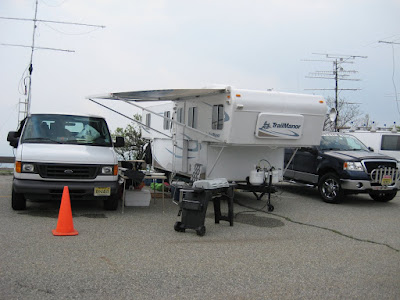 going up there for the past few years, and this is the first time that I had a chance to get up there with them. They do a very nice configuration, and this year they had a van set up for the 432Mhz and the 1.296 Ghz bands, and a really nice pop-up camper (courtesy of W2MLS) for 6m and 2m. The 5500 watt generator (just for the pop-up; the van had it's own 2000w generator) provided not only enough electricity for the radios and computers, but also enough to keep the air conditioner going! Hey, you might as well be comfortable. If you click on the picture you'll be taken to my photo gallery from the trip which has some descriptions of what was up there.
I got to spend some time operating on 6m. My first shift (we didn't have organized shifts, we just operated) was right at the beginning of the contest, and I was lucky enough to be able to grab a frequency right at the start of the contest and start calling CQ. For those not familiar with why this is A Good Thing, there are basically two ways to make contacts in a contest. The way that I usually wind up doing it for many contests is called "Search and Pounce" (or S&P for short). What you do is to tune up and down the band, find someone calling CQ, and calling them. In many contests, this is pretty much the only way that a small station (like mine at home) can make contacts, since it can be tough to "hold" a frequency in a highly contested contest when there are lots of strong stations on the air. This brings me to the better way to make contacts in a contest, which is to call CQ and "run" stations.
It should be pretty obvious that if some stations are S&P'ing, others have to be sitting in one place calling CQ. Stations who make one contact right after another, with a minimal delay between the contacts are said to be "running" stations. This is what you want to to do in a contest, because it allows you to make contacts much more quickly. The speed with which you make contacts is called your "rate", and the higher your rate, generally speaking, the higher your score in a contest. So, back to how I started off during the contest.
As I said, I was lucky enough to be able to hold onto a frequency at the beginning of the contest. I started calling CQ, and very soon after the contest started, one station after another answered my call. According to the computer log, at one point, I was actually running stations at the rate of about 150 per hour, although that was for a relatively short period of time. I worked stations for around 90 minutes and had around 65 or so contacts in the log before turning the microphone over to Bob, N2SU, for a while. From what I've read, that kind of rate is excellent for a VHF contest, especially when there is no enhanced propagation. Basically, it means that most of the contacts aren't being made by bouncing signals off of the E or F layers of the atmosphere, but rather are made by "ground wave", which is sort of line of sight. (I say sort of because it's a lot more complex than that, and many of the stations contacted certainly aren't line of sight; I've contacted stations in Maine from home on ground wave signals and I don't think I can "see" Maine from here.) That's me CQing in the video above, which, as luck would have it, was shot right at one of the first lulls. Most of what you hear is Tim, KA2A, making a contact on 2m at the station just behind where the video was taken.
I had a great time operating, and after a break, I operated for around another hour later in the afternoon ... until the generator died.
Stay tuned for part II.
This year, I did things a bit differently. On the first day, I went to High Point State Park in Sussex, NJ, to operate with a group from my club, the 10-70 Repeater Association as N2SE. They've been
 going up there for the past few years, and this is the first time that I had a chance to get up there with them. They do a very nice configuration, and this year they had a van set up for the 432Mhz and the 1.296 Ghz bands, and a really nice pop-up camper (courtesy of W2MLS) for 6m and 2m. The 5500 watt generator (just for the pop-up; the van had it's own 2000w generator) provided not only enough electricity for the radios and computers, but also enough to keep the air conditioner going! Hey, you might as well be comfortable. If you click on the picture you'll be taken to my photo gallery from the trip which has some descriptions of what was up there.
I got to spend some time operating on 6m. My first shift (we didn't have organized shifts, we just operated) was right at the beginning of the contest, and I was lucky enough to be able to grab a frequency right at the start of the contest and start calling CQ. For those not familiar with why this is A Good Thing, there are basically two ways to make contacts in a contest. The way that I usually wind up doing it for many contests is called "Search and Pounce" (or S&P for short). What you do is to tune up and down the band, find someone calling CQ, and calling them. In many contests, this is pretty much the only way that a small station (like mine at home) can make contacts, since it can be tough to "hold" a frequency in a highly contested contest when there are lots of strong stations on the air. This brings me to the better way to make contacts in a contest, which is to call CQ and "run" stations.
It should be pretty obvious that if some stations are S&P'ing, others have to be sitting in one place calling CQ. Stations who make one contact right after another, with a minimal delay between the contacts are said to be "running" stations. This is what you want to to do in a contest, because it allows you to make contacts much more quickly. The speed with which you make contacts is called your "rate", and the higher your rate, generally speaking, the higher your score in a contest. So, back to how I started off during the contest.
As I said, I was lucky enough to be able to hold onto a frequency at the beginning of the contest. I started calling CQ, and very soon after the contest started, one station after another answered my call. According to the computer log, at one point, I was actually running stations at the rate of about 150 per hour, although that was for a relatively short period of time. I worked stations for around 90 minutes and had around 65 or so contacts in the log before turning the microphone over to Bob, N2SU, for a while. From what I've read, that kind of rate is excellent for a VHF contest, especially when there is no enhanced propagation. Basically, it means that most of the contacts aren't being made by bouncing signals off of the E or F layers of the atmosphere, but rather are made by "ground wave", which is sort of line of sight. (I say sort of because it's a lot more complex than that, and many of the stations contacted certainly aren't line of sight; I've contacted stations in Maine from home on ground wave signals and I don't think I can "see" Maine from here.) That's me CQing in the video above, which, as luck would have it, was shot right at one of the first lulls. Most of what you hear is Tim, KA2A, making a contact on 2m at the station just behind where the video was taken.
I had a great time operating, and after a break, I operated for around another hour later in the afternoon ... until the generator died.
Stay tuned for part II.
Saturday, June 07, 2008
Getting the word out for your DXpedition
Last September, I posted a summary with some tips about how to operate from Grand Cayman (ZF). Part of that post gave a list of contacts that I found were useful to "get the word out". The list was by no means complete, but I did discover that by contacting just that list, news of my trip made it out to all the major DX-related lists and sites, and even a bunch that I'd never hard of before.
Recently, Scot, K9JY, and I were discussing the idea of a "press kit" for DXpeditions in response to a post in his blog, and Scot encouraged me to post my list. I'd forgotten that I'd actually had it posted here on my blog, but I've gone ahead and made a permanent page on my non-blog website at k2dbk.com. The direct link to the "press kit" page is http://www.k2dbk.com/dx-publicity.html.
As I mentioned, this is by no means a complete list of all possible contacts, and I'm sure that there are some important contacts that I've left out. If you are one of those sources, please be assured that it's simply due to my not realizing that you are out there.
Eventually, I'd like to grow that page to include more than just DX list contacts, but I think what I've got is a good starting point. If you've got any additions, corrections or deletions, please let me know either via email, a comment to this post or, perhaps, a contact on the air! (Hey, this is all about amateur radio, right?)
Recently, Scot, K9JY, and I were discussing the idea of a "press kit" for DXpeditions in response to a post in his blog, and Scot encouraged me to post my list. I'd forgotten that I'd actually had it posted here on my blog, but I've gone ahead and made a permanent page on my non-blog website at k2dbk.com. The direct link to the "press kit" page is http://www.k2dbk.com/dx-publicity.html.
As I mentioned, this is by no means a complete list of all possible contacts, and I'm sure that there are some important contacts that I've left out. If you are one of those sources, please be assured that it's simply due to my not realizing that you are out there.
Eventually, I'd like to grow that page to include more than just DX list contacts, but I think what I've got is a good starting point. If you've got any additions, corrections or deletions, please let me know either via email, a comment to this post or, perhaps, a contact on the air! (Hey, this is all about amateur radio, right?)
Friday, June 06, 2008
Survey says ...
I'm trying to get a little information about how folks actually read this blog. I know that I've got some folks who read via RSS, some who read it on the web, and others who access it through N0HR's Ham Radio toolbar, but it's difficult to tell exactly where folks are coming from.
If you've got a minute (it doesn't even take long), I'd appreciate it if you'd take the time to visit my blog on the web at http://k2dbk.blogspot.com and answer the simple survey that appears a little bit down on the right side. I'll keep it running until the end of this month. Thanks!
(By the way, some of you may be wondering about the origins of the phrase that makes up the title of this post, particular if you're not located in the United States. The Wikipedia article about "Family Feud" explains it all!)
If you've got a minute (it doesn't even take long), I'd appreciate it if you'd take the time to visit my blog on the web at http://k2dbk.blogspot.com and answer the simple survey that appears a little bit down on the right side. I'll keep it running until the end of this month. Thanks!
(By the way, some of you may be wondering about the origins of the phrase that makes up the title of this post, particular if you're not located in the United States. The Wikipedia article about "Family Feud" explains it all!)
Thursday, May 29, 2008
Catching up
One of the hardest things about blogging is to keep going on a regular basis. For folks like me who aren't doing this to make a living (thank goodness!), I think it's important to post on some kind of a regular basis (daily, weekly, monthly, whatever) so that your audience knows roughly when to expect an update. Using an RSS reader can help, since the updates are "pushed", but even with that technology I believe that without regular updates you'll loose your audience. I'd been doing pretty well for quite a while, with my (normally) weekly updates, but I started slipping a bit and it's now been around 3 weeks or so since my last posting.
What I've found hard is to get myself back on track, feeling that I need to have something really outstanding to post about, since I've been "off duty" for so long. Tonight, I realized that I'd rather post a few miscellaneous items that post nothing at all, so here's a few items of interest (to me, anyway).
The Dayton Hamvention ® took place a few weeks ago, and I continued my 8 year streak as a ham by not attending again. For anyone who doesn't know, this is a kind of mega-hamfest/conference that takes place annually just outside of Dayton, OH. Most of the major commercial vendors are there, there are hundreds of flea market spots, and various conference tracks dealing with different aspects of ham radio. There's a lot that goes on that isn't officially part of the event, but has become a part of the experience, like gatherings of DXers, contesters, QRPers, etc. Long before I finally became a ham I'd heard about "Dayton", and it seemed like it was the place to go. However, from what I've read online and heard first hand from a few folks who were there this year, it seems that this really is a case of this no longer being "the good old days". Since I've never been there, I can't give a first-hand account, but the best writeup that I've seen that really gave me a good feeling for what it was like to be there was written by Steve, K9ZW in his blog post entitled "Dayton Hamvention 2008 Follow-Up Report No. 21 - Dayton the Unwashed". Be sure to read not only his post, but the comments that follow. There's some really good stuff in there that talks about why it might be time for this event to "move on".
A few weeks ago, I was inducted as a life member of the Ramsey Office of Emergency Management. I was recruited to join the organization shortly after I became a ham by Mike, WA2MWT, who is the coordinator there. At the time Mike was specifically looking for hams to join the staff, and a number of us all joined at the same time. Although I don't live in Ramsey, Mike's idea was that it made sense to have folks from outside of town to help out during events where folks who lived in-town would be busy dealing with their own problems likes localized flooding. Although I've helped out with numerous localized events that mostly just affected Ramsey, it's also where I went on 9/11 to help out on the radios. My proudest memories of amateur radio service is when I was able to relay a number of messages received at the Ramsey Emergency Operations Center to family members to let them know that their loved ones, who were in the affected areas, were safe. Ramsey OEM is the first place where I really learned the value of the public service side of Amateur Radio, and I'm proud to be associated with that organization, and truly honored to have been inducted as a life member there.
On a final note, I turned 50 last week, and my wife Sharon threw a surprise birthday party for me. Sharon not only expertly planned and executed the party, but she also came up with an idea for a group present: She somehow managed to not only explain to my friends (who, with very few exceptions, aren't hams) what a DXpedition is, but also figured out that an amazing present would be a "DXpedition trip fund", and got lots of the folks to contribute to that. It's not quite to the scale where I'll be heading off to someplace like Scarborough Reef (not that I'd actually want to go there myself), but it's a great start towards something a bit less exotic, but perhaps a lot more fun. I'm just starting to figure out where I can go, and you can be sure that you'll hear more about it here.
What I've found hard is to get myself back on track, feeling that I need to have something really outstanding to post about, since I've been "off duty" for so long. Tonight, I realized that I'd rather post a few miscellaneous items that post nothing at all, so here's a few items of interest (to me, anyway).
The Dayton Hamvention ® took place a few weeks ago, and I continued my 8 year streak as a ham by not attending again. For anyone who doesn't know, this is a kind of mega-hamfest/conference that takes place annually just outside of Dayton, OH. Most of the major commercial vendors are there, there are hundreds of flea market spots, and various conference tracks dealing with different aspects of ham radio. There's a lot that goes on that isn't officially part of the event, but has become a part of the experience, like gatherings of DXers, contesters, QRPers, etc. Long before I finally became a ham I'd heard about "Dayton", and it seemed like it was the place to go. However, from what I've read online and heard first hand from a few folks who were there this year, it seems that this really is a case of this no longer being "the good old days". Since I've never been there, I can't give a first-hand account, but the best writeup that I've seen that really gave me a good feeling for what it was like to be there was written by Steve, K9ZW in his blog post entitled "Dayton Hamvention 2008 Follow-Up Report No. 21 - Dayton the Unwashed". Be sure to read not only his post, but the comments that follow. There's some really good stuff in there that talks about why it might be time for this event to "move on".
A few weeks ago, I was inducted as a life member of the Ramsey Office of Emergency Management. I was recruited to join the organization shortly after I became a ham by Mike, WA2MWT, who is the coordinator there. At the time Mike was specifically looking for hams to join the staff, and a number of us all joined at the same time. Although I don't live in Ramsey, Mike's idea was that it made sense to have folks from outside of town to help out during events where folks who lived in-town would be busy dealing with their own problems likes localized flooding. Although I've helped out with numerous localized events that mostly just affected Ramsey, it's also where I went on 9/11 to help out on the radios. My proudest memories of amateur radio service is when I was able to relay a number of messages received at the Ramsey Emergency Operations Center to family members to let them know that their loved ones, who were in the affected areas, were safe. Ramsey OEM is the first place where I really learned the value of the public service side of Amateur Radio, and I'm proud to be associated with that organization, and truly honored to have been inducted as a life member there.
On a final note, I turned 50 last week, and my wife Sharon threw a surprise birthday party for me. Sharon not only expertly planned and executed the party, but she also came up with an idea for a group present: She somehow managed to not only explain to my friends (who, with very few exceptions, aren't hams) what a DXpedition is, but also figured out that an amazing present would be a "DXpedition trip fund", and got lots of the folks to contribute to that. It's not quite to the scale where I'll be heading off to someplace like Scarborough Reef (not that I'd actually want to go there myself), but it's a great start towards something a bit less exotic, but perhaps a lot more fun. I'm just starting to figure out where I can go, and you can be sure that you'll hear more about it here.
Sunday, May 11, 2008
Ah, that's better
As noted a couple of weeks ago, my "big" radio, the Icom 756 Pro II, has been repaired by Icom (replaced the final transistors and aligned the radio), and arrived back at home this past Thursday. All is working just great now, with power output definitely up to spec. When I got home Thursday night, I disconnected the 706MkIIG that I'd been using for the past month, and hooked up the 756 again. This takes a few minutes, since in addition to just the power and antenna, I've got a different microphone, a different Rigblaster (for digital modes), and somewhat different audio and keying methods. I think I only managed to hook one cable up (harmlessly) to the wrong place, but it was a reminder that I really need to finish labeling all the cables. (I'd started a very long time ago, getting all the antenna cables labeled, but not getting much farther.) Seems like that's something to put on my list for one of the spring or summer nights when there are storms in the area and I can't operate.
Anyway, as soon as I got hooked up on Thursday night, I spun the dial around a bit to see if I could find some DX to work, and I came upon CO6LC on 20m phone. Hardly rare DX, but a non-local ham, and I was able to easily work him. Whew, that was a relief. A few minutes later, I worked Alex, A45WD on 30m, which was a new band for me for Oman. Thanks to Alex for being so patient. The conditions weren't very good, and it took a few minutes for him to get my callsign correct, but he stuck with me and made the contact work.
As luck would have it, I had planned to work from home the following day anyway, so I had the possibility of making a few contacts here and there during the day. One of the things that I was looking forward to was to work Bruce, XW1B in Laos. I'd heard Bruce one morning maybe a month or so ago quite strong, and we started emailing back and forth and have wound up chatting on the computer fairly often. It turns out that after living and DXing from Florida for a long time, Bruce has moved to Laos and has been very actively DXing from there. He's been on most mornings (my time) at around 1200Z and then again around 12 hours late, and works mostly CW and RTTY. Judging from what he's told me, and from what I've seen on the packet clusters, he's been making a lot of folks very happy, since Laos is still relatively rare. In fact, Bruce, and his boss Larry, XW1A, are two of only 3 hams who live full-time in Laos.
On Friday morning (my time) Bruce was running US stations on RTTY, and doing a great job. We'd previously worked out arrangements so that if I could hear him OK, we'd try to make a contact. (Although I have Laos confirmed on phone, I still needed it on RTTY and CW). We'd tried a couple of times before, but without success. Fortunately for me, things worked out a whole lot better this time. Initially, I tried calling along with the rest of the pileup, but Bruce wasn't able to hear my 100 watts in the midst of the folks who were running more power and better antennas. At that point, Bruce called me, and after I responded a couple of times (and the pileup finally stood by), we were able to make a valid contact, with Bruce giving me a 559. I'm really grateful to Bruce for his patience, and frankly, it's just plain fun having a new "ham radio friend" (as my wife calls them) who is located on the other side of the world.
That contact definitely started my day off right, and although an attempt to work CW a bit later in the morning didn't work, I feel pretty confident that we'll make this work soon. It really does go to show you what's possible even during a solar minimum, with fairly poor propagation. I'm hoping that a few more of the Cycle 24 spots start popping up, along with improved propagation soon.
Anyway, as soon as I got hooked up on Thursday night, I spun the dial around a bit to see if I could find some DX to work, and I came upon CO6LC on 20m phone. Hardly rare DX, but a non-local ham, and I was able to easily work him. Whew, that was a relief. A few minutes later, I worked Alex, A45WD on 30m, which was a new band for me for Oman. Thanks to Alex for being so patient. The conditions weren't very good, and it took a few minutes for him to get my callsign correct, but he stuck with me and made the contact work.
As luck would have it, I had planned to work from home the following day anyway, so I had the possibility of making a few contacts here and there during the day. One of the things that I was looking forward to was to work Bruce, XW1B in Laos. I'd heard Bruce one morning maybe a month or so ago quite strong, and we started emailing back and forth and have wound up chatting on the computer fairly often. It turns out that after living and DXing from Florida for a long time, Bruce has moved to Laos and has been very actively DXing from there. He's been on most mornings (my time) at around 1200Z and then again around 12 hours late, and works mostly CW and RTTY. Judging from what he's told me, and from what I've seen on the packet clusters, he's been making a lot of folks very happy, since Laos is still relatively rare. In fact, Bruce, and his boss Larry, XW1A, are two of only 3 hams who live full-time in Laos.
On Friday morning (my time) Bruce was running US stations on RTTY, and doing a great job. We'd previously worked out arrangements so that if I could hear him OK, we'd try to make a contact. (Although I have Laos confirmed on phone, I still needed it on RTTY and CW). We'd tried a couple of times before, but without success. Fortunately for me, things worked out a whole lot better this time. Initially, I tried calling along with the rest of the pileup, but Bruce wasn't able to hear my 100 watts in the midst of the folks who were running more power and better antennas. At that point, Bruce called me, and after I responded a couple of times (and the pileup finally stood by), we were able to make a valid contact, with Bruce giving me a 559. I'm really grateful to Bruce for his patience, and frankly, it's just plain fun having a new "ham radio friend" (as my wife calls them) who is located on the other side of the world.
That contact definitely started my day off right, and although an attempt to work CW a bit later in the morning didn't work, I feel pretty confident that we'll make this work soon. It really does go to show you what's possible even during a solar minimum, with fairly poor propagation. I'm hoping that a few more of the Cycle 24 spots start popping up, along with improved propagation soon.
Saturday, April 26, 2008
Not so bad news
Icom called me on Friday to tell me that they'd finished the work on my radio. It was, indeed, shorted final transistors. They've been replaced, and, as I requested, Icom also did a little work to correct a bit of error in the frequency on 6 meters. (It consistently read 200Hz low, so when the display said 50.124.80 Hz it was actually on 50.125.00 Hz). I asked the technician who called how much it was going to cost, and the total, with shipping back to me, will be around $250 or so. I had authorized them to charge significantly more to my credit card if necessary, so I'm happy that it wasn't more. They ship the radio back via ground shipment, and apparently after they finish the actual work on the radio it takes another business day or two to go through their systems to be shipped, so I was told that I should expect delivery to me early the week of May 5. While my 706 has been working just fine, I do miss my "big" radio. I'm looking forward to getting it back.
Earlier this week, I took my son Brett up to look at some colleges in Ithaca and Syracuse New York. I still haven't gotten around to permanently mounting either my VHF/UHF rig or the 706 in the car, but I figured it'd be nice to have a radio along for the drive. Fortunately, the battery in my car is located in the trunk, and it's really easy to get wiring from the trunk into the car, so I just hooked the power cables directly to the battery, mounted my Diamond K400-3/8C trunk mount on the trunk, used the separation kit for the 706 to put the radio in the back of the car and mounted the head on the dash using the windshield mount that I'd bought a couple of years ago but never used. I'd intended to listen in on the 40m County Hunters Net but although I'd gotten the Hamstick tuned before I left, I had a lot of trouble getting a decent SWR once I started driving. When I initially tuned the "stinger" (the upper, adjustable part of the antenna), the car was parked close to the house, and I think that might have thrown the tuning off. I did pull off into a rest stop shortly after leaving and try to re-tune the antenna, but after spending about 10 minutes, I decided to just give up and get going. I suspect that part of the problem was that the mount may not have been making a good enough ground connection, which I believe becomes more necessary as you go lower in frequency.
For the trip back down (we spent the first night in Ithaca, did the tour there, then headed up to Syracuse, toured there the next day and returned from there), I used a 20m hamstick which tuned up very well. Although I didn't work anything terribly unusual, I did work about 10 stations during the ride, include a few stations from Italy, a few from Germany, one from Slovenia, and a few others. I got surprisingly good signal reports, and it helped to pass the time. Brett was working on schoolwork part of the time that I was on the radio, but helped log the stations (yes, on paper) which I entered into my main logger when I returned home. This was really the first long (relatively speaking) trip I'd made in a while, and I really did enjoy having the radio to keep my company while Brett was otherwise occupied.
Finally, I got a nice surprise this week from the nice folks at the Northern California Contest Club, who run the California QSO Party. I got a certificate for placing 3rd in New Jersey for the 2007 CQP. I was very pleased to have placed decently, and it was nice of the folks from the NCCC to send out a certificate. I think that the CQP is an excellent example of a well-run QSO Party contest, and doing little things like sending out certificates will definitely act as an incentive to keep me coming back.
Earlier this week, I took my son Brett up to look at some colleges in Ithaca and Syracuse New York. I still haven't gotten around to permanently mounting either my VHF/UHF rig or the 706 in the car, but I figured it'd be nice to have a radio along for the drive. Fortunately, the battery in my car is located in the trunk, and it's really easy to get wiring from the trunk into the car, so I just hooked the power cables directly to the battery, mounted my Diamond K400-3/8C trunk mount on the trunk, used the separation kit for the 706 to put the radio in the back of the car and mounted the head on the dash using the windshield mount that I'd bought a couple of years ago but never used. I'd intended to listen in on the 40m County Hunters Net but although I'd gotten the Hamstick tuned before I left, I had a lot of trouble getting a decent SWR once I started driving. When I initially tuned the "stinger" (the upper, adjustable part of the antenna), the car was parked close to the house, and I think that might have thrown the tuning off. I did pull off into a rest stop shortly after leaving and try to re-tune the antenna, but after spending about 10 minutes, I decided to just give up and get going. I suspect that part of the problem was that the mount may not have been making a good enough ground connection, which I believe becomes more necessary as you go lower in frequency.
For the trip back down (we spent the first night in Ithaca, did the tour there, then headed up to Syracuse, toured there the next day and returned from there), I used a 20m hamstick which tuned up very well. Although I didn't work anything terribly unusual, I did work about 10 stations during the ride, include a few stations from Italy, a few from Germany, one from Slovenia, and a few others. I got surprisingly good signal reports, and it helped to pass the time. Brett was working on
 schoolwork part of the time that I was on the radio, but helped log the stations (yes, on paper) which I entered into my main logger when I returned home. This was really the first long (relatively speaking) trip I'd made in a while, and I really did enjoy having the radio to keep my company while Brett was otherwise occupied.
Finally, I got a nice surprise this week from the nice folks at the Northern California Contest Club, who run the California QSO Party. I got a certificate for placing 3rd in New Jersey for the 2007 CQP. I was very pleased to have placed decently, and it was nice of the folks from the NCCC to send out a certificate. I think that the CQP is an excellent example of a well-run QSO Party contest, and doing little things like sending out certificates will definitely act as an incentive to keep me coming back.
Monday, April 21, 2008
Totally off topic
Ok, this posting has absolutely nothing whatsoever to do with ham radio.
I just had to point folks to the story that I just got posted on The Consumerist. Here's there article which has all the details, but the short version is that it's a posting about how silly it was for Dell to package a small USB thumb drive in a fairly large box. By the way, the reason I bought a thumb drive from Dell was because they happened to have a really good deal on it; normally Amazon, Egghead, or scores of other places have better prices.
I just had to point folks to the story that I just got posted on The Consumerist. Here's there article which has all the details, but the short version is that it's a posting about how silly it was for Dell to package a small USB thumb drive in a fairly large box. By the way, the reason I bought a thumb drive from Dell was because they happened to have a really good deal on it; normally Amazon, Egghead, or scores of other places have better prices.
Tuesday, April 15, 2008
Good News, Bad News
Last week, I worked VK6DXI, located in western Australia, on 40m CW. This was a nice contact for a couple of reasons. First, it meant that I'd worked a new country on 40m for DXCC purposes. That's always nice. But more important to me is that I'd finally worked a "real" zone 29 station.
By way of explanation, CQ Magazine offers an award to amateur stations that have contacted other stations in each of 40 global zones. As you can see from the map, some zones will be more difficult to contact than others, depending on where you are located. I'm located in CQ Zone 5, which covers the eastern seaboard of North America and the Caribbean. Some zones are pretty easy to contact (like Zones 14 and 15, covering much of Europe), but others are a lot harder. From my location, I'd have to say that Zone 29 was just about the hardest, although there's one catch that makes it a bit easier: All the most southern zones actually converge at the South Pole. Because of this, any station worked located at the actual South Pole (not just on Antartica), counts for any of the zones that converge there, including Zone 29.
By using that rule, I'd actually worked all 40 zones a while ago which would qualify me for the Worked All Zones (WAZ) award previously mentioned. I'd never gotten around to submitting the required cards for the award, kind of thinking that I'd like to finally work that 40th zone "for real". In fact, just a couple of days before working VK6DXI, I'd commented to a friend at a club meeting about how that zone was still something that I was trying to contact. So when I heard the station on the air, with surprisingly good conditions, I called him and finally was able to make a contact with him. I sent for his QSL card the next day.
Here's the bad news: Instead of using my Icom 756 Pro II to make the contact, I had to use my Icom 706 MkIIG, sending CW without computer assistance (I freely admit that my CW "fist" is terrible) and struggling a bit to hear the VK6 station without the benefit of the terrific DSP filtering on the 756. Why, you may ask? Gee, thanks for asking ...
A day or so before that contact, I'd come home after work and was tuning around trying to find some interesting DX to work. There was YO22NATO on 40m CW, so I figured I'd give him a call. As soon as the first dit was sent, the fan on the 756 came on at high speed, and stayed on. I'd rarely heard the fan at high speed (if I heard it at all, it was after operating RTTY for a relatively extended period), but certainly never after having the radio sitting in receive all day. (The radio had been on since the morning; I'll sometimes turn it on before work and I just don't bother to turn it off.)
I felt around toward the rear of the radio to see if it felt hot, and indeed it did. Normally, after sitting in receive, the radio might be a little warm, but not hot. However, this time it was hot. I actually did make the contact with the YO22 station to see if the meters on the radio indicated if it was putting out full power. The meters did indicate that, but later, after looking at the schematic [PDF] and with some help from a 756 theory of operation manual [PDF], I realized that the power meter was basically feeding off the drive circuit, not the power amplifier. That meant that without an external power meter, I couldn't really tell if the radio was putting out 100w or whatever the drive power is, which would be quite a bit less.
Then things got really weird. I turned off the radio, but not the power supply, and realized that the radio, while turned off, was drawing around 4.5 amps from the power supply. That is most definitely not normal. I tried disconnecting the fan on the theory that maybe somehow the problem was there, but that didn't have any effect.
I posted a question to the 756 Pro users reflector, and most comments seemed to indicate that it was likely to be something wrong with the power transistors. The suggestion was to send the radio to Icom for repair. I sent a note to Icom explaining the symptoms, and the technician who responded said he thought that most likely it was a shorted final power transistor, which would explain the heat and the power draw when powered off, and recommended that I send the radio in for repair.
So I've got the radio all packed up, double-boxed as instructed, and it'll go off to Icom tomorrow. Here's hoping that the repairs don't cost as much as the radio.
One final unrelated note: Next month is the annual Dayton Hamvention®. I still haven't had a chance to go, but I've read plenty about it, given that it's arguable the largest hamfest in the world. If you find you have a chance to go, Scot, K9JY has posted a "Preparing for Dayton" entry to his blog that has a bunch of great tips. If you haven't seen it already, be sure to check it out, even if you aren't going.
By way of explanation, CQ Magazine offers an award to amateur stations that have contacted other stations in each of 40 global zones. As you can see from the map, some zones will be more difficult to contact than others, depending on where you are located. I'm located in CQ Zone 5, which covers the eastern seaboard of North America and the Caribbean. Some zones are pretty easy to contact (like Zones 14 and 15, covering much of Europe), but others are a lot harder. From my location, I'd have to say that Zone 29 was just about the hardest, although there's one catch that makes it a bit easier: All the most southern zones actually converge at the South Pole. Because of this, any station worked located at the actual South Pole (not just on Antartica), counts for any of the zones that converge there, including Zone 29.
By using that rule, I'd actually worked all 40 zones a while ago which would qualify me for the Worked All Zones (WAZ) award previously mentioned. I'd never gotten around to submitting the required cards for the award, kind of thinking that I'd like to finally work that 40th zone "for real". In fact, just a couple of days before working VK6DXI, I'd commented to a friend at a club meeting about how that zone was still something that I was trying to contact. So when I heard the station on the air, with surprisingly good conditions, I called him and finally was able to make a contact with him. I sent for his QSL card the next day.
Here's the bad news: Instead of using my Icom 756 Pro II to make the contact, I had to use my Icom 706 MkIIG, sending CW without computer assistance (I freely admit that my CW "fist" is terrible) and struggling a bit to hear the VK6 station without the benefit of the terrific DSP filtering on the 756. Why, you may ask? Gee, thanks for asking ...
A day or so before that contact, I'd come home after work and was tuning around trying to find some interesting DX to work. There was YO22NATO on 40m CW, so I figured I'd give him a call. As soon as the first dit was sent, the fan on the 756 came on at high speed, and stayed on. I'd rarely heard the fan at high speed (if I heard it at all, it was after operating RTTY for a relatively extended period), but certainly never after having the radio sitting in receive all day. (The radio had been on since the morning; I'll sometimes turn it on before work and I just don't bother to turn it off.)
I felt around toward the rear of the radio to see if it felt hot, and indeed it did. Normally, after sitting in receive, the radio might be a little warm, but not hot. However, this time it was hot. I actually did make the contact with the YO22 station to see if the meters on the radio indicated if it was putting out full power. The meters did indicate that, but later, after looking at the schematic [PDF] and with some help from a 756 theory of operation manual [PDF], I realized that the power meter was basically feeding off the drive circuit, not the power amplifier. That meant that without an external power meter, I couldn't really tell if the radio was putting out 100w or whatever the drive power is, which would be quite a bit less.
Then things got really weird. I turned off the radio, but not the power supply, and realized that the radio, while turned off, was drawing around 4.5 amps from the power supply. That is most definitely not normal. I tried disconnecting the fan on the theory that maybe somehow the problem was there, but that didn't have any effect.
I posted a question to the 756 Pro users reflector, and most comments seemed to indicate that it was likely to be something wrong with the power transistors. The suggestion was to send the radio to Icom for repair. I sent a note to Icom explaining the symptoms, and the technician who responded said he thought that most likely it was a shorted final power transistor, which would explain the heat and the power draw when powered off, and recommended that I send the radio in for repair.
So I've got the radio all packed up, double-boxed as instructed, and it'll go off to Icom tomorrow. Here's hoping that the repairs don't cost as much as the radio.
One final unrelated note: Next month is the annual Dayton Hamvention®. I still haven't had a chance to go, but I've read plenty about it, given that it's arguable the largest hamfest in the world. If you find you have a chance to go, Scot, K9JY has posted a "Preparing for Dayton" entry to his blog that has a bunch of great tips. If you haven't seen it already, be sure to check it out, even if you aren't going.
Tuesday, April 08, 2008
Cayman (ZF) license renewal
Those of you who followed along with my blog entries on my trip to the Cayman Islands last year may recall that one of my suggestions to anyone going there in the future was to make sure to start the licensing process early.
Late last week, I received a letter form the ICTA, who are the Cayman Islands licensing authority, informing me that my ZF2DK license was due to expire next month. The letter said that to renew my license, I needed to submit a form from their website along with payment authorization. The problem was that the link in the email didn't work, so I sent a note to the licensing folks at the ICTA asking what to do.
Unlike the previous several week delay between emails, I got a response back the very next day from David Archbold, who is the managing director of the ICTA. David apologized for the confusion, explaining that they are in the process of revising their amateur radio rules and the form had been pulled off their website. He instructed me to send a copy of my current license along with a payment authorization form (attached to his email) back to the licensing folks, and that I'd be all set.
I emailed the required information over the weekend, and yesterday afternoon I received an image of my new license from the licensing folks, along with a note explaining that hard copy would follow.
Kudos to the ICTA for improving their process!
 the licensing process early.
Late last week, I received a letter form the ICTA, who are the Cayman Islands licensing authority, informing me that my ZF2DK license was due to expire next month. The letter said that to renew my license, I needed to submit a form from their website along with payment authorization. The problem was that the link in the email didn't work, so I sent a note to the licensing folks at the ICTA asking what to do.
Unlike the previous several week delay between emails, I got a response back the very next day from David Archbold, who is the managing director of the ICTA. David apologized for the confusion, explaining that they are in the process of revising their amateur radio rules and the form had been pulled off their website. He instructed me to send a copy of my current license along with a payment authorization form (attached to his email) back to the licensing folks, and that I'd be all set.
I emailed the required information over the weekend, and yesterday afternoon I received an image of my new license from the licensing folks, along with a note explaining that hard copy would follow.
Kudos to the ICTA for improving their process!
Sunday, March 30, 2008
Recent activity
I haven't posted in about 10 days, so here's a little update about what's been going on in the radio world for me.
A few weeks ago, I spent a while working in the Virginia QSO Party. Like my entry last year, this wasn't meant to be an all-out assault, but it was something to do to pass the time. (Fortunately, unlike last year, my back seems to be in decent shape, so I wasn't forced to be in the chair.) I wound up doing better than I did last year, with 195 contacts and 76 multipliers (see last years blog entry for an explanation), for a score of around 23,500 points. I was quite happy with that, and had a really good time participating. It'd be nice to win for NJ again, but I guess I'll find that out when they've finished scoring.
Last weekend, I spent a couple of hours in the BARTG RTTY contest. This is one of the big RTTY contests every year, and while I have made a few contacts in the past, this year I had so much fun that I wound up spending a few hours and made 152 contacts. I picked up 8 new countries on RTTY, but again, I had fun. Initially, I wasn't going to participate at all, but I fired up the RTTY decoder on my radio and saw my friend (and fairly well-known RTTY contester) NO2T so I figured I'd get on and give him a point. I then figured that as long as I had everything all set for RTTY, that I might as well just keep going until it wasn't fun anymore, so that's what I did. I think I've mentioned this before, but the automation in the N1MM contest logger is just terrific for digital mode contests. It takes a little work to set up, but once you get everything configured, you click on a callsign that you see on the on-screen RTTY decoder, it fills that into the callsign field of the log, click once to call that station, click on his information to populate it into the fields in the log (this particular contest uses a serial number and the time of the contact), another click to send your info back, and you're done. It's even easier than it sounds, and it really is a lot of fun to operate that way.
On the DX front, I did manage to work TX5C several times on different bands and modes, despite the "help" from the DX Cops that I wrote about recently. That was a new DXCC entity for me (#286), and I've already sent for the QSL cards.
VP6DX (Ducie Island) has what I think is a great method for requesting QSL cards: It's all done online. I wish more dxpeditions would this. They have said that if you want a card via the bureau system, just fill out the form on their website and you'll get a card. If you want it mailed to you directly, they request that you send a donation to cover postage (via Paypal). If you choose to make a small donation beyond what is needed for postage, they list you as a "sponsor", and they even uploaded the "sponsors" contacts to the Logbook of The World first. Since I did that, I was pleased to see my 15 band/mode contacts all show up confirmed in LoTW. Although I'd worked Ducie Island before, these guys did such a terrific job that I'd have sent for a physical card anyway, even though I know they'll eventually upload all the QSOs to LoTW.
Finally, I thought I'd provide an update on the progress of the QSL card returns. When I last wrote about this in January, I had around 46% of the cards returned. That was about 4 weeks after I'd initially sent out the big batch of direct cards. As of today, about 13 weeks after I sent out the original batch, I'm up to 67% of the cards sent out that I've gotten returned. The cards are still coming in, but a lot more slowly, with perhaps one coming in a week. I'm a little disappointed, since a lot of those were domestic (US), so I'll assume that the postal delays are negligible. At some point, maybe in another month or two, I'll check to see which cards haven't been returned and maybe attempt to contact the station I worked via email. I'm curious to try to understand why someone wouldn't return a card that came with an SASE. It will be interesting to see if the trickle completely shuts off after May 12, when the US postal rates go up. That rate increase wasn't even planned when I sent out my original cards, so anyone wishing to send back a confirmation from May 12 forward will have to add postage themselves.
A few weeks ago, I spent a while working in the Virginia QSO Party. Like my entry last year, this wasn't meant to be an all-out assault, but it was something to do to pass the time. (Fortunately, unlike last year, my back seems to be in decent shape, so I wasn't forced to be in the chair.) I wound up doing better than I did last year, with 195 contacts and 76 multipliers (see last years blog entry for an explanation), for a score of around 23,500 points. I was quite happy with that, and had a really good time participating. It'd be nice to win for NJ again, but I guess I'll find that out when they've finished scoring.
Last weekend, I spent a couple of hours in the BARTG RTTY contest. This is one of the big RTTY contests every year, and while I have made a few contacts in the past, this year I had so much fun that I wound up spending a few hours and made 152 contacts. I picked up 8 new countries on RTTY, but again, I had fun. Initially, I wasn't going to participate at all, but I fired up the RTTY decoder on my radio and saw my friend (and fairly well-known RTTY contester) NO2T so I figured I'd get on and give him a point. I then figured that as long as I had everything all set for RTTY, that I might as well just keep going until it wasn't fun anymore, so that's what I did. I think I've mentioned this before, but the automation in the N1MM contest logger is just terrific for digital mode contests. It takes a little work to set up, but once you get everything configured, you click on a callsign that you see on the on-screen RTTY decoder, it fills that into the callsign field of the log, click once to call that station, click on his information to populate it into the fields in the log (this particular contest uses a serial number and the time of the contact), another click to send your info back, and you're done. It's even easier than it sounds, and it really is a lot of fun to operate that way.
On the DX front, I did manage to work TX5C several times on different bands and modes, despite the "help" from the DX Cops that I wrote about recently. That was a new DXCC entity for me (#286), and I've already sent for the QSL cards.
VP6DX (Ducie Island) has what I think is a great method for requesting QSL cards: It's all done online. I wish more dxpeditions would this. They have said that if you want a card via the bureau system, just fill out the form on their website and you'll get a card. If you want it mailed to you directly, they request that you send a donation to cover postage (via Paypal). If you choose to make a small donation beyond what is needed for postage, they list you as a "sponsor", and they even uploaded the "sponsors" contacts to the Logbook of The World first. Since I did that, I was pleased to see my 15 band/mode contacts all show up confirmed in LoTW. Although I'd worked Ducie Island before, these guys did such a terrific job that I'd have sent for a physical card anyway, even though I know they'll eventually upload all the QSOs to LoTW.
Finally, I thought I'd provide an update on the progress of the QSL card returns. When I last wrote about this in January, I had around 46% of the cards returned. That was about 4 weeks after I'd initially sent out the big batch of direct cards. As of today, about 13 weeks after I sent out the original batch, I'm up to 67% of the cards sent out that I've gotten returned. The cards are still coming in, but a lot more slowly, with perhaps one coming in a week. I'm a little disappointed, since a lot of those were domestic (US), so I'll assume that the postal delays are negligible. At some point, maybe in another month or two, I'll check to see which cards haven't been returned and maybe attempt to contact the station I worked via email. I'm curious to try to understand why someone wouldn't return a card that came with an SASE. It will be interesting to see if the trickle completely shuts off after May 12, when the US postal rates go up. That rate increase wasn't even planned when I sent out my original cards, so anyone wishing to send back a confirmation from May 12 forward will have to add postage themselves.
Thursday, March 20, 2008
Ear of the beholder
I seem to be on a "soapbox" roll of late, so I might as well continue along those lines. This is somewhat in line with my recent posting about DX Cops in that it deals with those who feel that they have been "wronged" (without good reason, in my opinion) and need to take things into their own hands. (It's also my third post in a row that talks about the recent TX5C DXpedition to Clipperton. Guess I'm in a rut.)
I saw a lot of posts on the DX clusters (basically, a system where hams can announce to their fellow hams that they've contacted, or at least heard, a particular station on a particular frequency; there is also some capability to post single-line comments) that complained about the TX5C guys. Mostly, they seemed to be complaining about how they weren't working some area of the world at the right time, or about how they weren't working their favorite band, or mode, or whatever. Later, I saw complaints that the on-line logs weren't updated instantly after they left the island. (Keep in mind that to do so not only requires a satellite uplink, which they have, but also a stable platform. A small boat is not always a stable platform.)
I have never been on a DXpedtion myself (I don't really count my week as ZF2DK as a DXpedition) so my comments here are based on what I've learned from others whose opinions I respect. One thing that is pretty obvious to me is that these DXpeditions are costly, require a great deal of planning, time, personal committment, and can be quite dangerous. As an example, Bob, N6OX broke his ankle within a few hours of landing at Clipperton on the TX5C dxpedition. Others have been injured on trips, or even worse. These folks are quite literally putting their lives on the line to provide enjoyment for their fellow hams.
Others have said that "if you don't like the way they are doing things, get off your couch, cough up tens of thousands of dollars of your own money, spend a week or two in a burning hot/freezing cold/soaking wet tent, and do the operation yourself". I heartily agree.
While I will admit to being occasionally frustrated, particularly early on, when TX5C seemed to start to work Europe just as 40m got really, really strong to my location, I'd just grumble quietly to myself for about two seconds while I thought about what I wrote about above, and just move on to doing something else. I did not waste my time posting rude comments to the clusters. Many of those were apparently done using someone else's callsign, presumably because the complainers chose to hide behind the relative anonymity of the DX clusters (and the Internet) rather than be brave enough to use their real callsign.
The fact is that while those guys (and gals!) on Clipperton were doing the best job they could (why would anyone do anything else?) others were saying some pretty awful things about them. Why? To what purpose? None of the people saying those things were on Clipperton, they don't know what the conditions were like. Perhaps some of those complaining were part of the problem. Steve, K6SGH, posted a wonderful update detailing some of what went on during the operation. He said, in part:
For myself, while I certainly would have loved to have worked them on many more bands, I did make contact on 3 bands, on both CW and SSB (no RTTY, unfortunately), I thought they did a great job. For radio, it's all in the Ear Of The Beholder.
I saw a lot of posts on the DX clusters (basically, a system where hams can announce to their fellow hams that they've contacted, or at least heard, a particular station on a particular frequency; there is also some capability to post single-line comments) that complained about the TX5C guys. Mostly, they seemed to be complaining about how they weren't working some area of the world at the right time, or about how they weren't working their favorite band, or mode, or whatever. Later, I saw complaints that the on-line logs weren't updated instantly after they left the island. (Keep in mind that to do so not only requires a satellite uplink, which they have, but also a stable platform. A small boat is not always a stable platform.)
I have never been on a DXpedtion myself (I don't really count my week as ZF2DK as a DXpedition) so my comments here are based on what I've learned from others whose opinions I respect. One thing that is pretty obvious to me is that these DXpeditions are costly, require a great deal of planning, time, personal committment, and can be quite dangerous. As an example, Bob, N6OX broke his ankle within a few hours of landing at Clipperton on the TX5C dxpedition. Others have been injured on trips, or even worse. These folks are quite literally putting their lives on the line to provide enjoyment for their fellow hams.
Others have said that "if you don't like the way they are doing things, get off your couch, cough up tens of thousands of dollars of your own money, spend a week or two in a burning hot/freezing cold/soaking wet tent, and do the operation yourself". I heartily agree.
While I will admit to being occasionally frustrated, particularly early on, when TX5C seemed to start to work Europe just as 40m got really, really strong to my location, I'd just grumble quietly to myself for about two seconds while I thought about what I wrote about above, and just move on to doing something else. I did not waste my time posting rude comments to the clusters. Many of those were apparently done using someone else's callsign, presumably because the complainers chose to hide behind the relative anonymity of the DX clusters (and the Internet) rather than be brave enough to use their real callsign.
The fact is that while those guys (and gals!) on Clipperton were doing the best job they could (why would anyone do anything else?) others were saying some pretty awful things about them. Why? To what purpose? None of the people saying those things were on Clipperton, they don't know what the conditions were like. Perhaps some of those complaining were part of the problem. Steve, K6SGH, posted a wonderful update detailing some of what went on during the operation. He said, in part:
We would have made a lot more European contacts, especially in hard paths, if European operators would be more courteous and stand by when they are told to stand by. Instead, almost universally, they continue to call on top of each other while we are attempting to working them. It's frustrating for us and deprives others of making contacts. Most operators are more respectful and stand by when told to do so. Operating styles may be diverse, but courtesy should be a universal concept. We all are, after all, members of the same hobby. I have seen on the clusters negative comments by some EU calls that we weren't working them. From my perspective, they need to consider their own behaviors before they start ranting about us.(By the way, I highly recommend reading that entire post, there's a lot of great stuff in there.)
For myself, while I certainly would have loved to have worked them on many more bands, I did make contact on 3 bands, on both CW and SSB (no RTTY, unfortunately), I thought they did a great job. For radio, it's all in the Ear Of The Beholder.
Subscribe to:
Posts (Atom)