I don't normally post what I would consider "DX news" in this blog, but I thought I'd make an  exception. One of the most wanted DXCC Entities is Clipperton Island, and there's a DXpedition underway this week. From what I've read, they've landed on the island, and actually were a bit ahead of schedule, but some folks were wondering why they haven't come on the air yet. I'm no expert, but it certainly looks like the weather is a big issue. Keep in mind that these guys are operating from tents , and, from what I read on their website, had not yet completed setting up their stations when heard from last.
This satellite loop image won't really do much good after a few days of me writing this, but if you look at it soon after posting, you'll see what the problem is. I've included a static image here  for posterity (you might want to click on it to enlarge), which isn't nearly as impressive as the loop. Click on the LatLon box, and locate 10 degrees north, and 109 degrees west. There's a big set of thunderstorms that's apparently been pounding the island. It's rainy here in NJ, but then again I'm sitting in a permanent structure with plenty of hills to break up the straight-line winds. For what it's worth here's the forecast for Clipperton, which doesn't look great either, though it does seem to get better after a few days.
As much as I'd love to work them for an all-time new entity, I sincerely hope that they are doing whatever they need to do to be safe.
And while I'm posting: I'll step up on the soapbox briefly to say that some of the comments that have shown up on the clusters are just plain rude. Essentially, people are complaining that this group of people, who are literally putting their lives on the line for the enjoyment of the DX community haven't shown up on the air exactly on time. Give 'em a break! As others have said: If you think you can do a better job, then stop complaining, spend a few hundred thousand dollars, and go there yourself.
Here's hoping that TX5C is safe.
UPDATE: Just after I posted this, an update (look for the March 8 entry) was posted on the TX5C webpage. In short, it appears that heat, not thunderstorms is the problem. In fact, it looks like the cloud cover is in fact helping, not causing problems.
Just a couple of quick notes: Thanks to those of you who voted in my "Do you use Logbook of The World" poll. The end results were that nine of you said you used it, four said it was too complicated to use, and one said they didn't log electronically.
The other thing is that I've had a couple of people either ask me directly or post a link elsewhere about my Ham Radio Tools series that I did a while back. To make the series a little easier to find, I've put a box on the right-hand side so that you can pull up the individual posts more easily.
This past weekend was one of the rare times when there was a major contest (ARRL International DX SSB) and I didn't have plans for much of the time, allowing me to actually plan to participate in the contest. Since Sharon was in Florida visiting her mother (and since the boys are more than self-sufficient, that is, when they're actually home), I figured that I'd spend a good portion of the weekend contesting, probably racking up a decent score (compared to prior efforts; as regular readers know, I "play" in contests for the fun of it) and hopefully catching some new band/country fills. (By way of explanation, one of the things I like to do is not only to try to contact as many countries as I can, but to contact as many countries on as many different bands as I can. Contacting a country on a new band slot is often referred to as a "fill").
I got home from work at around 7:30 PM or so (which, unfortunately, has been the norm lately), ate dinner, and headed down to the shack. I turned on the computer and the radio, re-configured the radio to use the headset instead of the boom mike, fired up the N1MM contest logger, grabbed some spots from the cluster, and ...
Ugh. Ok, I know that we're in the bottom part of the solar cycle, but this was ridiculous. By the time I started, it was a little late for 20m to really be open, but I figured that I could at least work some stations in South America pretty quickly. Hah. In about 30 minutes, I managed to slug my way through seven, count 'em, seven stations. Even for my puny station, that was just plain awful. In the past in DX contests, especially early in the contest, I've had to compete with the high-powered stations, making it difficult for me, but what I heard on Friday night were these stations just CQing over and over, with nobody answering. Well, I was answering, but they just couldn't hear me. Every station I worked was a challenge, and while I wasn't quite ready to totally throw in the towel, after about 2 hours, when I'd only worked 25 stations (moving first to 40m then 80m), I gave up for the night. Every contact was like pulling teeth, with me having to give my call repeatedly.
One thing that I did have to do over the weekend was to get up early (for me) on Saturday morning and take Brett to school for his SATs. When I got home at about 7:45AM, I figured that maybe I'd see if I could make a few contacts instead of going back to bed (as I'd originally intended). I shouldn't have wasted my time. I think it took me about 20 minutes to find one station that I could work (TI50DX, on 40m), and after that, I just couldn't work anything. I finally gave up and went back to bed.
When I came back down to the shack again at around 11AM, I wasn't expecting much, and I certainly wasn't disappointed. I spent most of the rest of the day in front of the radio (though I certainly took time out to eat and take care of a few other errands), took a break to watch some TV, then finally came back to work a handful of stations on 75m between around 1AM and 2AM (local). My "rate" for the day came out to be around 12 stations an hour, which was just horrible. I think if I'd had almost anything else to do (well, I probably had something to do, but it was even less appealing) I wouldn't have spent time in front of the radio, but I did.
Sunday morning I slept in, assuming that nothing had changed on the bands (and, admittedly, because it was Sunday and I pretty much always sleep in on Sunday), and got ready to go pick Sharon up from the airport. I figured that I get on the radio for about 1/2 hour before leaving, and what a change there was in the bands. In the 25 minutes that I had until I left, I worked 23 stations, which is about as fast as I'm ever going to work stations in a major contest. Now that was fun!
Of course, by the time I got back, the opening was pretty much finished, and all that was left was some stations in western Europe and more South American and the Caribbean. It was back to the slow going again, though I did stick it out to the end.
Despite my grumbling, I did beat my score from last year, winding up at just below 80,000 points, and getting 54 multipliers on 20m. (If you're interested in the rest of the breakdown, you can find it on the 3830 reflector archive.)
For my little station, and especially at this time in the solar cycle, I guess I should be happy: I beat my score from last year, and I got to spend pretty much as much time playing radio as I wanted to. And eventually, in retrospect, I had fun.
This past weekend, my friends Larry, N4VA, and Coleman, K4RZ came up from Virginia to visit. I guess Larry and I have known each other for 6 or 7 years now, and we chat (usually online while we're both at work) quite frequently. We try to have an "eyeball QSO" at least once a year or so, and while I'd planned to head down to visit last summer, all kinds of things kept that from happening, so I was happy that they were able to come up to visit me.
Although Coleman is pretty much a "newbie" to ham radio (like me), Larry's been licensed since 1960, and has done his share of operating around the world from places like Thailand, Guyana, Japan, and even Bangladesh. (I keep trying to encourage him to go back there; I need that one!) We spent most of the weekend just chatting, mostly about ham radio. We spent some time in the shack just making the occasional contact in the CW version of the ARRL International DX contest, though it was more for me to just pick up a new band fill here and there. I think that I only made around a dozen contacts in total, though I did submit my log as I've mentioned previously. In this case, with so few contacts, I'm pretty sure I won't win anything, but it does serve as a check log for the contest sponsors, and only takes a couple of minutes.
It was really fun to have someone "in-house" to just talk radio with, and it's great to get Larry's perspective on various things. For example, with all the talk about whether or not Kosovo will be a new DXCC entity, still officially unknown as of the time that I'm writing this, Larry's opinion was that based on the guys who were operating there, it seemed like a pretty good chance that it would be a "counter". We'll see if Larry's right or not, but my money is with him. For what it's worth, I worked a couple of stations last night using the YU8 prefix, one being YU8/OH2R and the other YU8BH, since, as they stay Work First, Worry Later (WFWL). If they only count for Serbia, well, it's cost me a couple of pennies of electricity to work them. If they do count for Kosovo as a new DXCC entity, I've got 'em in the log. I guess we'll see.
If I were the "cluster crab" type, about 30 minutes ago I would have posted a spot on the packet cluster showing that I'd worked VP6DX on 80M with a comment like "Easy!" or "100w into dipole!" or even "Bingoooooo".
Fortunately, I'm not one of those. In fact, I did manage to work VP6DX on 80m CW using just 100w into a G5RV (posting that here is OK; the whole purpose of a blog is to be able to express onself), but the real bragging is about what an absolutely amazing job the guys on Ducie Island are doing.
At the time that I'm writing this, one of the recently posted news items on their web page says: After 1,5 days of operation they have now about 28,000 QSOs in the log (about 17,000 after the first 24 hours!)
I'll leave it as an exercise for the reader to look at their website and try understand the difficulties about putting on a DXpedition like this, but I'm amazed that they not only seem to be on pretty much every band that I can hear (and those that I can't, judging from the spots on the cluster), but that they are working stations rapid-fire endlessly. Yesterday I worked from home due to the inclement weather, and while I didn't have time to actually transmit very much, I was able to listen to the radio now and then, and between the early morning and late evening I heard the VP6DX team on every band from 17m through 80m, usually on more than one mode, working stations like they were a big-gun contest station.
But here's the really awesome part: Tonight, when I saw them spotted on 80m, I tuned to the reported frequency and heard them working stations. (Here's what it sounds like from the K2DBK station, recorded about 10 minutes after my contact with them.) Regular readers will know that I have just a G5RV and run barefoot at 100 watts, but I figured that I'd give them a try. It took about 10 minutes of listening to who they were working, and trying to place myself in the right place within their listening range so that they could hear me, but the fact is that they did hear me amidst all the much louder stations out there. They are not just peeling off only the big gun stations, but listening for us little pistols as well.
Bravo, VP6DX!
For those of you who read my blog on the website (instead of via RSS or email), you'll see that I've changed the look. (If you really love it/hate it, drop me a note or leave a comment.) I can't decide if I'm going to keep it this way, but it was something to do while trying to work the TI9KK Cocos Island DXpedition.
Although they've been pretty strong here on 17m phone, I've resisted calling them there, since I've already worked Cocos island mostly during the TI9M DXpedition in 2002 on 10m, 12m, 15m, 17m, and 20m then. (In other words, I don't need them on that band and mode.) Since this is a fairly short trip, which apparently was made even shorter due to some licensing issues, I think it's only fair to allow someone else a chance. I have to wonder how many people calling them really needed Cocos Island on that band or mode, as opposed to just wanted to brag that they've worked them?
Anyway, I do need TI9 on the lower bands, and on CW, so I will try for a contact there. (As I write this, they are quite strong and building on 40m CW, but the pileup is pretty ugly, so I don't know how much of a chance I'll have.)
With all the recent talk about the start of Solar Cycle 24, band conditions in general haven't been all that good, but I was very pleased to work 9Q1EK earlier today on 12m, which was not only a new band for me for that DXCC entity, but also the first contact that I've had on 12m since December 2006!
I thought that I'd do a follow-up on the QSLing post from last month. It's been just over four weeks since the big batch of cards went out, and I thought that it would be interesting to take a look at the return rate.
The cards all went out right around the 27th of December, and I sent out a total of 111 cards direct. (I'll ignore the bureau cards, since it's way too soon for any returns from them.) I was pleasantly surprised to get the first return back on January 2. (The station was in New Jersey, as am I, but that was still pretty quick). I got another card or two a day for the first week after sending, but on the 5th of January the flood started. On that day, I got 15 cards back (including one bad address), and on the following Monday (January 7), I got 11 cards back. One of the cards that came in on the 7th was TX5NK via DJ8NK, which proves, if nothing else, that the mail between the US and Germany is pretty efficient. By the end of the 2nd week after sending the cards, I'd received back 39, or around 35%.
For the next week after that, I'd get an average of around 2 per day back, but this week I got none until today, when I received one confirming UP0L (Kazahkstan), which confirmed my 277th all-time country. As of today, about 4 weeks after sending out the cards, I'm at about a 46% return rate.
Looking at the cards that came back, although I've received some of the DX cards back (those that were sent outside the US), I haven't received a significant portion, which doesn't surprise me. Despite the fast turnaround for that first card via DJ8NK, I expected that it will take a month or two for many of cards sent overseas to come back. Some of that is due to the mail, and some no doubt due to the time it takes the station on the other end to respond. As I've pointed out, although I personally make it a point to turn around any request that I get within a day, not everyone can do that, and I know that some of bigger stations and managers only do QSLing on a periodic basis.
I am a little disappointed that I haven't received more of the domestic cards back. I've gotten back 35 cards, but 29 are still outstanding. Hopefully those are from folks who just haven't gotten around to answering my card. Every one of the cards I sent out domestically was sent with a SASE, and all the non-US cards went out either with either an IRC or green stamps. (That's ham-speak for cash for return postage.) Actually, the US return rate is actually a bit worse than that: I checked to see how many of the DX cards went via a US route (usually a manager), and there are still a bunch of them outstanding. Some of those cards are going via well-known managers, and I'm positive that I will get them back, but I'm wondering what the final return rate will be?
I should say that although it sounds like I'm being impatient, I realize that for the most part, QSLing is not an instant gratification part of this hobby. Certainly it took me quite a while to get around to sending a lot of those cards, and I don't expect to see returns from the bureau cards for a year or more. I just hope that QSLing isn't on the way to becoming a lost art, especially when someone has made it so that all you need to do is to drop a card into the pre-addressed postage-paid envelope.
One final comment while on the topic of QSLing: I do like to get paper cards back, but I'm also a big fan of the ARRL's Logbook Of The World, as I have mentioned previously. For getting band or mode "fills", it's terrific, and I don't think that I'm losing anything by not having yet another piece of cardboard from a station that I've already worked on 4 other bands. As the cost of QSLing continues to rise, it's a great way to save money.
Although there are websites that give all kinds of statistics about who is using LoTW, I've posted a poll on my blog that asks if you use LoTW, and if not, why not. I listed a couple of common ones, but if you've answered "No (Other)", I'd appreciate it if you'd post a comment here telling why. Please note that if you receive this post via an RSS feed or from another website, you will need to visit my blog and scroll down a bit to see the poll on the right side.
It's soapbox time again.
I was chatting with my friend Larry, N4VA, the other day about some of the discussions that have come up on various reflectors about the use of a relatively new near real-time system for displaying contest scores while the contest is underway. The website for this system is www.getscores.org and you can check out the CQ-Contesting archives (search for "getscores" as a starting point) if you're interested in the details of the discussion. (The main point of contention is whether using that site puts one into an assisted category for a contest even if otherwise operating as a single operator).
Larry's complaint wasn't about whether or not using the site constituted assistance, but rather he was complaining that the computer technology seems to get getting in the way of using the radio. (I found it amusing the our chat took place entirely using an instant messaging client, facilitated at each end by a computer with the Internet in the middle, but that's not the point.)
Larry's been a ham for a relatively long time now, and for years said "What would I ever need a computer for?"© I gradually badgered him into moving into the computer age while he was badgering me about working on my CW so that I could pass my General class test and work some nice juicy DX. Both of us decided that it was easier just to get on with it, so Larry started using computers and I started using CW. (I will be the first to admit that Larry's computer skills are far better than my CW skills.)
But here's Larry's complaint, and I think he's got a point: Larry said that what would be required to post his scores to the Getscores site would be that he'd need to start using electronic logging (something that's been on his to-do list for a while, and is currently pretty close to the top of my list of "things to bug Larry about"), then figure out how to configure the logger to upload the scores to Getscore, etc. My response was "well, logging programs like N1MM's contest logger have that functionality built in", but then he mentioned something that was the inspiration for this entry.
I've used electronic logging almost from the very first QSO that I ever logged. (I think I logged something like 8 QSOs on paper when I first got my General ticket, and those were all transferred to the electronic log within a few hours of making those contacts.)
Larry told me that in order to submit your score for certain contests, you are required to submit your log electronically if you have more than a certain number of QSOs. (The North American QSO Party says you must submit electronically if you have 200 QSOs or more, as an example.) Larry has a modest station with a tower, some beams, some wire antennas, and he runs low power. Although he is a member of the Potomac Valley Radio Club, he's not a die-hard contester, and contests for fun. Like myself, Larry knows that it's pretty unlikely that he'll win any significant award (though both of us have been surprised in winning regional awards in contests), but rather he contests because it's a fun thing to do.
Those of you who know me know that I'm a "computer guy", having worked in the industry since I got out of college. While I'm all for technology, I think that when there's a requirement to use a particular technology merely to get credit for participation in a contest, things have gone too far. The argument is that it's not all that difficult to log on a computer, and while I agree with that (rather strongly), the point is that you shouldn't be required to do it. So what's the downside of one guy not participating in the contest because they won't accept his (non-electronic) log?
It's more than you may think. Those of use who contest casually are used to seeing the "big guns" at the top of the scoreboard. But if those big guns only worked each other, contest scores would maybe make it to the double or triple digits, not the multi-million point scores that we see. Who else do they contact? Well, that would be the little pistol stations like Larry and myself, who are in it just for fun. Of the thousands of contacts that these guys make, it seems obvious to me that most of them are casual contesters. So if one guy doesn't bother to participate in the contest because he doesn't want to have to submit his log electronically, what's the big deal? Well, probably not all that much. But what happens if it's a few dozen, or a few hundred people who stop participating because the log submission requirements are (at least to them) too restrictive?
Lest I be bombarded with complaints saying that by submitting on paper, it makes more work for the contest sponsors (I'm having delusions of grandeur, imaging that enough people read this to be able to "bombard" me with anything), I will say that I know that the sponsors have a really tough job, and when everything is submitted electronically, I'm sure it makes the job a lot easier. However, I still think that requiring the use of a particular technology merely to submit your logs is counterproductive to the contest as a whole.As I've said before in this posting and ad nauseum elsewhere, it's my opinion that ham radio should be fun. Unnecessary participation requirements don't make it fun.
Before I fall off my soapbox, I will say that A) I will continue to encourage Larry to move to computer logging, and B) I will continue to do so myself, but I still think that it should be a personal choice.
Ok, let me step down off this soapbox (psst ... check out that link and what it says about blogs!) and put it back under the desk.
Well, it seems that my goal of trying to write at least one entry a week has slipped away. I usually try to write on either Saturday or Sunday, but I kept putting it off, and before I knew it, the weekend was gone. Unfortunately, this has been pretty close to another "Almost too busy for radio" week. Fortunately, I have managed to spend a little time in front of the radio at night, working J5C in Guinea-Bissau, FO/OH1RX in the Marquesas, and TO5FJ in St. Barts. None of those were completely new countries for me (even though St. Barts is a new DXCC entity, I worked FJ/OH2AM previously), but I did pick up a few new bands or modes for each of them.
Other than that, I have been receiving a steady stream of cards back from the big batch that went out just about three weeks ago. It's great getting everything back, and it's surprising how quickly some of the DX stations are getting their cards back. I'm going to write a bit about this next time, including a look at the return rate.
This weekend is the ARRL January VHF Sweepstakes. I usually participate in that but I'm not quite sure what my weekend plans are, so I'm going to play it by ear. And of course, I'll save some time to get back on schedule for my blog.
It looks like this week's blog entry is going to be another potpourri.
I finally finished mailing out the entire pile of cards that I discussed in my last entry, and all the work to send the cards to the outgoing QSL bureau at the ARRL in Newington has been completed. Fortunately, my slight procrastination in actually sending out the bureau cards paid off. Earlier this week, I received a package of cards from the 2nd area incoming QSL bureau which, in addition to confirming cards that I'd sent out, had some new confirmation requests that I needed to send back in return. It was only about five cards, but had I not put them in with the batch that I will try to get out this week, they probably would have waited several months. It's also a good feeling to have zero cards to have to send out. Whew.
What's kind of fun is that now I've already started getting cards back. The majority of the direct cards went out on the 27th of December. I got the first response back on the 31st, which is pretty amazing, even thought it did go to (and come from) a station in NJ. (I believe that the first one back was for VP2MZM via K2DM.) Yesterday was a banner day, with 15 cards coming back (though one was as "Return to Sender"; I had the wrong address for someone). After just over a week, I've gotten back 19 cards already (18 if you don't count the "return to sender"). which works out to be about 16%. (I'd previously said there were 134 cards sent direct; I was mistaken and there were 134 QSOs that I sent out for confirmation direct which went to 111 different stations or managers, so it was "only" 111 out direct.) I don't normally track response rates, but I think it might be interesting to do this time because of the relatively large batch that went out all at once.
I didn't work much DX this week since I was back at work, meaning no radio during the day, but it was nice to hear that Solar Cycle 24 may have finally started this week. (I felt compelled to mention it here, because practically every other ham radio blog and website mentioned it. I didn't want to feel left out.) What will be interesting to see if which group of predictions are right: The ones that say this cycle will be huge, or this cycle will be slightly below average. If I'm still blogging in about 11 years, I'll try to remember to follow-up. The good news is that even though the predictions about this cycle starting in 2007 were wrong, it would appear that those who were predicting another Maunder Minimum type of trough were wrong too.
One thing that I've been squeezing in is to try to help a fellow blogger who is working towards his Amateur Extra license. Although I'm still pretty much a new ham by most standards (first licensed in early 2000), I have managed to pick up a little knowledge here and there, and I enjoy sharing that when I can. We've been emailing back and forth discussing antenna system gain, how you compute Effective Radiated Power (ERP), and trying to understand how much (or how little) a few watts of difference really makes (or doesn't make). It's been fun for me to discuss this, as I try to check my facts, and I usually wind up learning a little with each email.
Back in August, I wrote an entry that talked a bit about my "routine" QSLing (mostly answering incoming requests) but focused more on getting a card ready for my then-recent ZF2DK operation. I've spent a bunch of time over the last week catching up on the QSLing that I should have been doing all along, and I thought I'd write a little bit about that as well.
As I mentioned previously, I try to be really good about responding to cards that I receive sent directly to me (as opposed to via the ARRL Bureau). Most of the direct cards that I get tend to be from US stations that I've worked in a contest, though I think the majority wind up being for contacts on 6 meters, where my grid square might actually be of interest to someone. (Unfortunately, for the most part, a station located in New Jersey isn't exactly considered "rare" to anyone, although I have worked a few DX stations in the past that did need NJ for the WAS award or possibly Bergen County for a County Hunter award.) As a result, most of the DX cards I get come in through the W2 bureau. There are some DX stations that QSL every contact (which seems a bit excessive; I don't need confirmation from any given station more than once for any band/mode combination), but using the ARRL Outbound Bureau is a very cost-effective (though relatively slow) way to get cards back for those "band/mode fills". (My preference, of course, is to use the Logbook of the World service, but not every station uses that.) The one exception to my "respond the same day" to an incoming card is that when I receive a card via the bureau, I mark it for QSLing via the bureau instead of actually responding instantly. The way the bureau works is that you take advantage of sending out cards in bulk. You can send a small number, but it's not as cost-effective.
It seems that I'd been marking outbound "response" cards for quite some time, at least a year. Maybe more. What I'm supposed to do is to print out the card labels and send a batch of cards out to Newington (ARRL HQ, where the actual outbound bureau is located) every few months so that things don't pile up too much. That's what I was supposed to do. Unfortunately, with everything else going on, I'd gotten behind on answering those cards, along with sending for cards that I needed to get (but not urgently; a typical response time for a card sent via the bureau system is 1 to 2 years, and much longer isn't unusual). Since I had some time off from work over the past week, I figured that this would be a good time to get caught up on my QSLing.
It turned out to be a lot bigger job than I'd expected. I figured that I'd probably have a couple of dozen cards to go out via the bureau, and maybe a dozen or two cards to go out directly. (More abou those later). It turns out that I had 268 cards to send out, which, oddly enough, happened to be split exactly (134 each) between the bureau and cards that needed to be sent out directly. When I realized how big project was, I figured that I'd get the direct cards out first, then tackle the bureau cards. (What's another few days when you're talking about a year or two for a response?)
What I discovered about the direct cards was that there was a mix of a relatively small number of cards to go to stations located overseas (DX stations), but a lot more that went either to QSL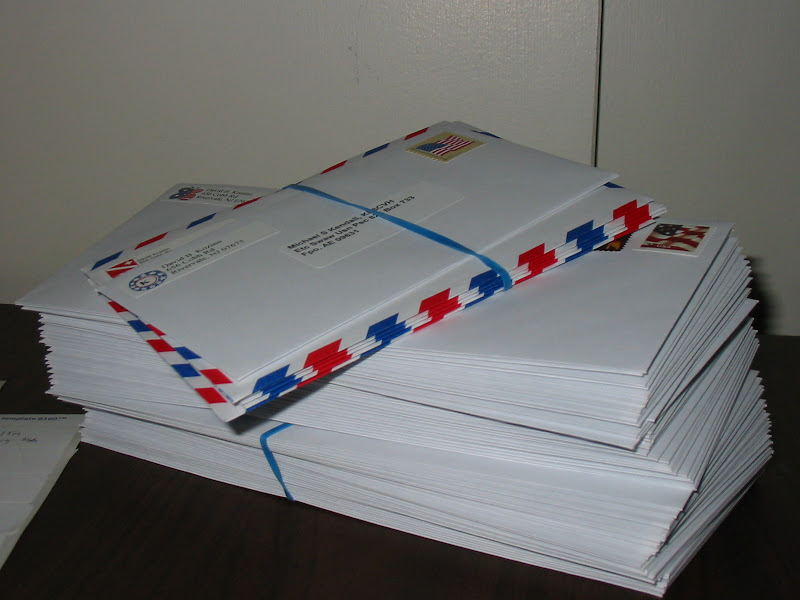 Managers located in the US or to stations located in the US. (A QSL manager is a person who handles the QSL duties for another station.) What I'd forgotten about was that a year (or two? or more?) ago, I marked a lot of my 6m contacts for QSLing to confirm their grid square, needed for the VUCC award. In fact, I marked about 65 of them. Because the ARRL bureau system only allows cards to be sent to stations located outside the continental 48 states (with some exceptions), those cards all had to go direct. So first, I spent quite a few hours (mostly very late at night; one of the advantages of not having to go to work the next day) researching to make sure that I had the correct addresses. After that was all set, I printed out labels for the cards (with the QSO information to go onto my QSL cards) and address labels. It's then a fairly mechanical process of affixing the label to the QSL card, usually writing a short note on the card (which often winds up being just "73, David" when I'm doing this many), putting the card, along with either an SASE (for domestic cards) or a SAE plus some means to supply return postage (typically either "Green Stamps" or an IRC) into an outer envelope, putting on postage, the address label, and a return address label (making sure it says "USA" if it's going overseas, sealing the envelope and repeating. And repeating. etc. The result is what you see in the picture, although I took that after I'd already mailed about 15 other airmail letters.
Of course, then we have the bureau cards. The good news is that there are no envelopes or addresses to worry about, though I did my research there too. Some stations do not accept cards via their bureau, but what's nice is that some stations will now sent you a return card via the bureau via either an email request (such as DL5AXX) or via a web form (such as DJ2MX). I assume that those stations just don't need my card, which and are happy to help you out. That's a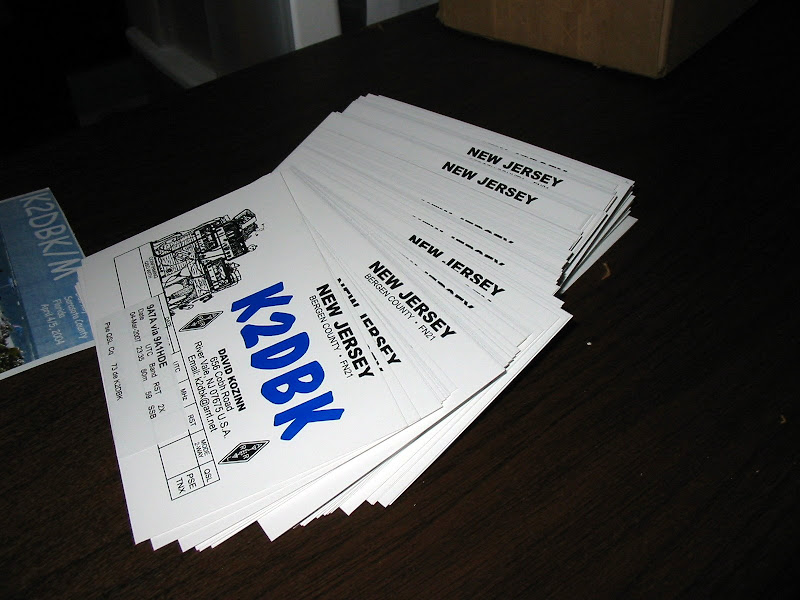 nice "spirit of ham radio" thing, and personally, I'd be happy to do that as well (if someone ever really needed my card.) I recommend doing the research to find out if a station will respond this way, as it can save you a considerable amount of money (versus a direct QSL; It's now USD$3 to get a card returned from Germany, that doesn't count the postage to send it there). The someone tricky part about using the ARRL outbound bureau is that you do need to send the card to the correct manager and the cards need to be sorted in country-prefix order. Fortunately, my logging program prints the labels out in the correct order, but you still need to affix the labels, then, as per the ARRL's instructions, you need to write the QSL manager's call on the upper-left corner of the back of the card, and put any cards going to manager into the pile with that side up. Whew. Ok, it's not the hardest thing in the world to do, and if I'd just managed to keep up with this, it wouldn't be nearly as big a task.
So the good news is that hopefully over the next few months (or years, for the bureau cards) I'll get some responses back from all of this work. While I strongly believe in electronic QSLing through the Logbook of The World, I do like coming home to find a new card or two in the mail.
This was a pretty good week or so for me, in terms of DX. On the 18th, I worked E4/OM2DX, the DXCC Entity of Palestine as an "all-time new one", entity # 284 worked for me. The next day, the ARRL DXCC desk announced that the island of St. Barthelemy (better known as St. Barts) qualified as a new DXCC entity due to some administrative changes. The actual reasons why it became a new "counter" are explained in the ARRL DXCC Desk link above, as well as one of the postings on the Daily DX's St. Barts page.
So what does this mean? Well, for a lot of folks, they want to contact the new entitity as soon as possible, for all kinds of reasons. In some cases, when a "new one" comes on the air for the first time, it may only be on the air for a short time, because it's a remote, uninhabited area (or at least uninhabited by hams), as was the case with Ducie Island or Swains Island. That certainly wasn't going to be the case with St. Barts, which is a well-developed, modern tourist destination in the Caribbean near St. Martin (from which it was recently administratively separated). St. Barts has it's own resident ham population, and it's certain to be on the air frequently. In any case folks were very anxious to work this new entity, and two very well-known DXers, Martti, OH2BH and Olli, OH0XX headed down there to provide contacts for "the deserving".
The timing for all of this worked out quite well for me, since I'm taking about 10 days off from work between using up some leftover vacation days and the holidays. While I didn't work them on the very first day of their operation, I did get them (operating as FJ/OH2AM) fairly soon after that, providing me with my DXCC Entity #285 in the log. Unlike some of the huge DXpeditions that are on the air on many bands and modes simultaneously, even the near-superhuman abilities of Martti and Olli have their limits, so they'd typically operate on one band using CW and a different band using phone at a time, changing bands as night falls on St. Barts to take advantage of the lower bands that become available later in the (local) evening. They set up antennas for just a couple of nights on 80m, and especially since I was off from work, I stayed up very late and managed to work them on 80m after trying for around 1/2 hour at 2AM local time.
According to published information, Olli left for home today (the 25th), with Martti scheduled to leave tomorrow. I was sitting at the computer listening to Martti working stations on 20m until the propagation completely vanished. After a brief break, he moved to 40m to work stations on phone. (Single Sideband). I don't think that they'd worked any station on phone on 40m since their arrival, so predictably the pileups were pretty significant, to put it mildly. However, having nothing better to do (and deciding that sitting in one place and not moving, having come home absolutely stuffed to the gills from our friends Chuck & Lorraine's annual Christmas feast was a good thing), I figured I'd try to work them.
Martti is such a master at working a pileup that sometimes I'll just listen to him working stations just because he's so darn good at it. What's nice about him is that he keeps the pileups under control, and even little-pistol stations like me figure that we've got at least a fighting chance to work him. But today, I heard him doing something that I'd read about, but have only heard maybe once or twice very briefly.
By way of explanation, when operating on 40m phone, it is common for stations outside of the United States to transmit in the portion of the band that is designated as CW only for the US (usually between around 7050kHz and 7100kHz) but listen for stations calling in the US phone portion (above 7125kHz). It's the same as a conventional split operation, just that the split is much larger. But here's where things get tricky: At the present time, shortwave broadcasters outside of the US share the allocation between 7100 and 7350 kHz with amateur radio. They don't use all of the spectrum, but it can be tricky, especially for a station in the Caribbean, to find a clear frequency to listen.
What happened today was that Martti had to find a "window" (range of frequencies) to operate in and those of us calling would try to figure out where he was listening and call there (or just above or below), in the hopes of being here. Because of broadcast interference, Martti had to keep moving the window around, meaning that if you didn't listen, you'd have no chance of making a contact. But here's where it got really interesting: Every now and then, after a contact, he'd say something like "now listening on 205" or "215 is clear". If you weren't really listening, and just yelling, you'd probably miss what he said. Of course, eventually the pileup would figure out that he was listening to just a single frequency and move on, but only the "listeners" were the first there.
So that's where I got my break: He was using a window of 7195 to 7210, and just moving around without much of a pattern that I could hear, and after one call, I heard him say "208 is clear". I tuned to 7208, made one call there, and Martti responded.
After I made that contact, I realized that it had reinforced something that I've always told new hams (and not-so-new hams): The most important thing you can do with ham radio is to listen, listen, listen. If I hadn't been listening, I'm sure I'd still be calling.
This is the fourth (and final, for now) part of a series that I'm doing on software tools for ham radio. I've written some background in part 1, and you can find parts 2 and 3 in my blog as well.
The Internet Tool
Some people think that calling the Internet a tool isn't quite fair. I disagree, and view it as a source for other tools; a meta-tool if you will. Using the Internet, you can find almost anything that you'll need, including all the of the tools that I've mentioned previously.
I'm going to focus, briefly, on a few sites that I use regularly. Again, as with the other tools, these are sites that I happen to use fairly often and like. There are others that provide similar information, and there are thousands of others that I have yet to find.
So, in no particular order, here we go:
- qrz.com: The mother of all callsign lookup sites. Aside from having all US callsigns automatically populated and updated, many (most?) DXers and contesters have their callsigns, mailing addresses, and email addresses listed here. If for some reason you haven't heard of this site, you probably don't have an Internet connection (and haven't been on the air much, since a lot of stations will now say "QSL via qrz.com".)
- Propagation info at http://dx.qsl.net/propagation/: Although there are other sites that go into more detail about a specific aspect of propagation, this site provides an excellent overview on general propagation conditions.
- DX Summit: DX spots from packet clusters all over the world are consolidated here. While you can view things essentially in real-time (as you can on many other sites), one feature that I find particularly useful is the ability to pull down historical spots. For instance, as I write this, FJ/OH2AM is on the air from the new DXCC entity of St. Barthelemy (FJ). Earlier, I wanted to listen for them when they came up on 40m CW, so by searching the spots I was able to find out approximate time and frequency to look for them.
- ARRL Home Page: There is just so much good info on the ARRL home page that I don't know where to begin. If you're a member, there's even more good info on their members-only pages. From information about contests to awards, to general news, it's all there. As a plus, they have an RSS feed available if you don't want to have to go visit the site.
- There are two sites that I use when I'm trying to figure out how much return postage to include when sending out a QSL card: http://www.qsl.net/w9ol/IRC_Chart.htm and http://www.n6dhz.com/irc-chart.html. I tend to check between them because occasionally one's been updated more recently than the other.
- eham.net: There's a lot of good stuff here, but in particular I like their user-generated product reviews section.
- The NG3K Amateur Radio Contest/DX Page has a tremendous amount of information about past, current, and future DX operations. Probably my favorite part of this site is the Announced DX Operations page, which includes information about dates of operation, the QSL manager, and the web site for the operation.
- AC6V's Amateur Radio and DX Reference Guide website was one of the first ham-oriented sites that I found when I got into ham radio, and it's still one that I use frequently. If there is something related to ham radio that can't be found on this site, it probably doesn't exist. Although there is quite a bit of "local" content, this site is particularly good for finding more detailed sites about a particular topic.
- K2DSL’s Maidenhead Grid Square Locator is a web application that will take any one of several pieces of information such as an address, a callsign, or a 4 or 6 digit grid square and return a map showing that Maidenhead grid square. This will primarily be of interest to operators working on 6m and higher, although there are some HF awards that require the grid square as well. (Added 05 June 2009)
- And finally, there's K2DBK's Ham Radio Website. Ok, I had to give a plug for my site. To be honest, I update this blog far more often than I update my site, but I do use it for things like my ZF2DK trip, etc.
I realize, of course, that I've barely scratched the surface of what's available on the Internet, but as with the other tools, I thought it might be useful to share those things that I personally find useful in the hopes that it might help you to find something that you didn't know about. I'd be curious to hear from anyone who discovered something new by virtue of it being mentioned here, and I'd also like to hear about different tools that you find useful.
This is the third part of a series on Ham Radio Tools that I'm doing. The first two parts can be found here and here.
The Digital Mode Tools
One of the really nice things about having a computer in the shack is that many of the digital modes that used to require dedicated hardware (like RTTY) can now be easily done with just a sound card and a simple interface. This makes it really easy to try out new modes without spending a fortune on dedicated hardware. It also makes it possible for programmers to create and modify new modes quickly and easily without worrying about obsoleting the old hardware.
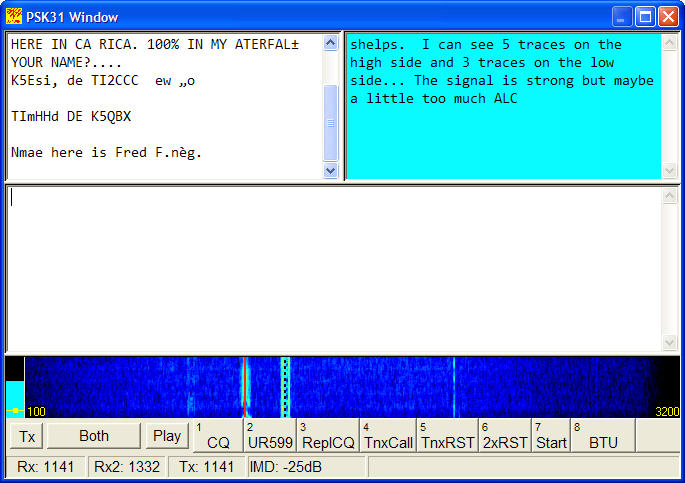
The two digital modes that I use most often are PSK31 and RTTY. I don't do all that much of either, but now and then I'll get my feet wet by playing in a RTTY contest or working someone on PSK maybe as a new country or mode or band. There are really just a couple of programs that I use for these digital outings. Most of the time, if I'm working PSK, I simply use the built-in PSK window in DX4WIN. It doesn't have as many features as some of the more advanced stand-alone PSK programs (check out the PSK31 link above for some of the programs available as well as the list at AC6Vs web pages) and it doesn't yet support the newer PSK63 mode. (Although in doing a little research for this posting, the PSK63 link does explain how to retrofit the PSK63 engine into programs that don't natively support PSK63, I'll have to give it a shot with DX4WIN). However, the advantage is that it's integrated into DX4WIN, so clicking on a callsign will automatically put the callsign into the callsign field of the logger, etc. For me, this is fine for casual contacts, or even trying to work a DXPedition, though I don't think I'd really want to use it for a contest.
For those of you who might not have seen PSK31 in action, the screenshot here from DX4WIN shows that I've got two different QSOs that I'm decoding "listening to" at the same time, with the window on the left being the primary frequency (meaning that if I were to transmit, it would transmit there) and the window on the right showing a secondary frequency QSO. Note again that this is all done in software, the radio is actually in SSB mode and all the magic happens on the computer. Some of the more advanced programs are capable of decoding many more conversations at once.
For RTTY use, MMTTY is the way to go. MMTTY is definitely the cream of the crop here, and has all the bells and whistles you could ever want. The author of MMTTY, Mako (JE3HHT) has  allowed programmers to integrate MMTTY into their programs, so it's very well supported by most logging programs (both DX4WIN and the N1MM loggers that I user support it), but it can also be used as a standalone program. In fact, the standalone program has support built in for at least a few popular contests, and I have on occasion done a RTTY contest entirely with MMTTY (though usually at the end I export the logs and import them into N1MM for score computation and DX4WIN to track everything else). There's a lot to learn about this powerful program, and aside from the information on the authors website, I highly recommend the AA5AU RTTY page, which walks you though how to use MMTTY as well as giving a general explanation about what RTTY is.
Of course, there is another very well-known mode that I think can be called digital: CW. Both of my two main logging programs support sending CW directly from the program, either with macros or via the keyboard. N1MM has a very high degree of integration in that it's easy to configure macros to use during a contest that will take the callsign that you've just entered and put it into a macro along with the contest exchange, including things like a changing serial number.
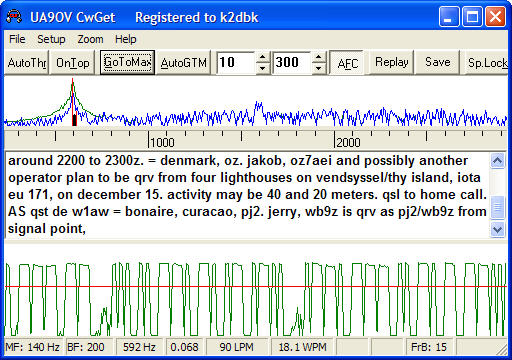
However, I do use one standalone tool (which can run along with my loggers) to help me copy CW. Although I know that my CW copying skills have improved, they have quite a long way to go before I'll be able to comfortably and confidently copy even a formatted contest exchange at high (30+ wpm) speeds. Although I can copy, by ear, certain elements of an exchange (like my callsign, typical RST reports, key phrases like "UP" or "AGN?"), for contest use and (less often) for working DX contacts I will use a CW reader program called CwGet. I've been using CwGet for several years now, though I have been able to rely on it less and less as time passes. What it's really good for, as far as I'm concerned, is to help me make sure that I've got a callsign correct or a complex contest exchange correct. As much as I wish that I could be like my friend Larry, N4VA, who seems to be able to carry on a CW QSO and hold a conversation with someone in the room at the same time, I'm just not quite there yet, and I admit to using CwGet as a security blanket.
To explain what's shown in the screen shot, there are 3 window on the screen: The top window shows where in the bandpass CwGet is "listening" (in this case, it's at 592Hz, which is the audio tone my receiving is generating for the CW being received), the second window shows the decoded text, and the bottom window shows the dihs and dahs coming in. The red horizontal line is essentially a "squelch", meaning that anything below that line will be ignored. In the particular screenshot here, CwGet is copying the weekly DX Bulletin from the ARRL. (This was from their 40m broadcast, and given that I've relatively close to ARRL HQ, it's a very strong signal, so the decoding is perfect; this isn't always the case.)
Incidentally, both CwGet and the PSK31 decoder have some other interesting uses: A while ago, there was an odd hum on the output of one of the local 2m FM repeaters. I fed the audio into CwGet and I was able to figure out that what I was hearing was the CTCSS (PL) tone for that repeater, which was just a bit louder than it should have been.
I've got one more part in this series, where I'll talk about a few miscellaneous tools that didn't fit into any of the previous categories.
This is the second in a series of posts (the first is here) where I'll be talking about the tools that I use for ham radio.
The Propagation Tools
I am, by no stretch of the imagination, a propagation expert. However, I have learned a little bit about how propagation works and what some of the magic numbers mean. If you want to learn more about propagation, I highly recommend picking up a copy of The NEW Shortwave Propagation Handbook and do a web search in your favorite search engine for '"HF propagation" introduction' (link searches on Google).
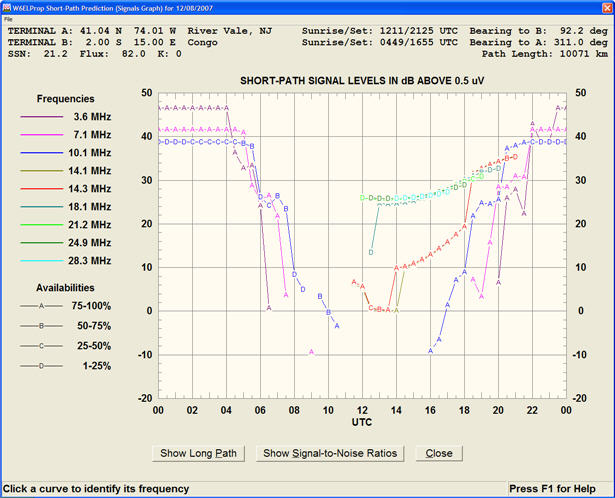
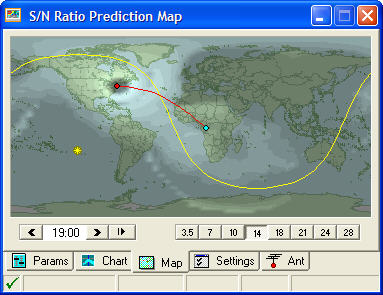
The tool that I probably use the most is W6ELProp, written by Shel, W6EL. The basic model of operation is that you give W6ELprop two endpoints (usually your location and the location of some stations that you'd like to work; in the image captured here I've used my home location and Congo (TN) in Africa) and some information about the current propagation conditions (which are available from many sources; I'll discuss that in another post). Oversimplifying a bit, what W6ELProp does is to calculate when you're most likely to be able to make contact with that station and which band you should use. Actually, it shows predictions for all times of day and for whatever bands you've requested. You get to make the decision as to what's the best time to operate. Like other propagation tools, I use this as a guide. I've found times when it's apparently 100% accurate (in other words, I heard the station I was looking for, when and where predicted), but I've also found times when I couldn't hear a peep and, happily, I've heard stations booming in when the predictions said they shouldn't be there at all. Just because a propagation tools says there isn't propagation remember that it is only a prediction based on an imperfect model.
Incidentally, the screenshot here is just one of a number of different ways to display the data. There are tables, graphs, and maps available, all of which have their individual use. The best way to learn which works for you is to play around with it a bit.
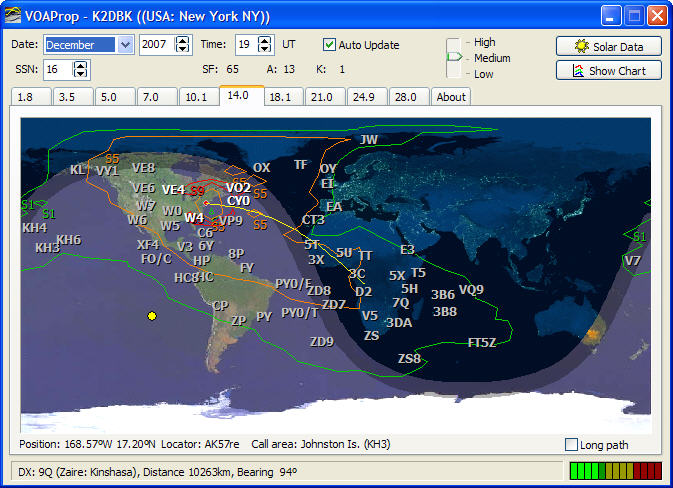
The next tool I use is called VOAProp, written by Julian, G4ILO. VOAProp is a graphical front-end for VOACAP, a HF propagation prediction "engine" originally written to support the Voice Of America broadcasts. VOACAP is very powerful, but not very user-friendly, so Julian built this gre at graphical front end for it. The model for VOAProp is a bit different than W6ELProp: Where W6ELprop is most useful for a scenario where you'd like to know when and where to work a particular location, VOAProp is most useful for answering the question "at a given time and band, what stations am I most like to be able to contact?". You can do the same thing with either of the two tools I've mentioned so far (and in the screen capture shown here, I am pointing specifically to Africa as I did with W6ELProp; the bars on the lower right-hand part of the screen show that decent propagation is predicted, and in fact, I can hear a TN station at this time.) VOAProp has some nice features, including the ability to automatically fetch the propagation information from sources on the Internet (you have to manually enter it into W6ELProp)
The next tool that I use is called HamCAP, written by Alex, VE3NEA. Like VOAProp, HamCAP is also based on the VOAPROP propagation engine. The graphics in HamCAP show where propagation is available graphically similar to VOAProp. It can be used to produce predictions to a particularly location on top of the general map, which is what's being shown in the screen capture here. (Again, showing the path from K2DBK to TN.) The lighter areas are where propagation is better, and you'll note that there's no skip propagation show local to me on 20 meters, which is what this image shows.
The reason why I first started using HamCAP was because it could produce a set of prediction charts for various times and bands in a form that could be uploaded to a website for a DXpedition. I used it to produce this set of propagation prediction charts for my ZF2DK operation earlier this year. (Click on different times and bands to see what the propagation would have been; remember that the dates for this were at the end of July 2007, so things are likely to be different now.) Incidentally, I want to point out that although I assisted Alex with fixing some minor problems with the display in browsers other than IE, he did all the hard work, I just tweaked a teeny bit of javascript.
I have a couple of final comments about these tools: First, I've really glossed over their capabilities. Download them and try them yourself to see what they can really do. (Psst ... they are all free!) Don't expect to learn everything about them in a few minutes, but the investment in time will be worth it. Second, as I mentioned before, bear in mind that all these tools can do is to predict, using mathematical models. The models aren't perfect, and neither is the data that you'll be feeding into them. So use the output from these tools with that in mind. Just because the tools predict no propagation the only way you'll know for sure is to get on the air.
As hams, most of us have at least a small toolbox that we use to maintain our stations. Others have a much bigger collection of tools that they use to build and troubleshoot things.
But for the next few postings, I'd like to talk about a different kind of toolbox: a software toolbox.
Just like the one in the picture, my ham radio software toolbox has several compartments and different types of tools, depending on the job that I want to do. I'll describe a few of the compartments that I have and the tools that I use. Before I start, I will say that these are tools that I've found work for me. There may be tools that work better for you (and there are are probably some that would work better for me too, but you have to start somewhere.) Since I'm a Windows XP user, everything I'll discuss runs on that platform. (Sorry to the Mac and Linux guys.) I have no financial interest in any of the software that I'll talk about, other than in the case of the commercial products, I'd sure like to see those companies stay around for a while. So let's go see what's in the toolbox.
The Logging Tools
For the most part, I use two different types of tools, depending on why I'm logging contacts. I guess I consider myself a DXer first, so I use a DX logging program that I've found works well for me, which is DX4WIN. (Hmm, seems that their home page is a bit out of date. Fortunately, the software isn't.) DX4WIN allows me to track progress towards awards like DXCC, IOTA, and WAS (and many more), and does a nice job handling QSLing chores. It has reasonable integration with Logbook of The World, and is able to import and export information in a wide variety of formats. That's important, because I import data into DX4WIN from my contest logging program (more about that in a bit), and occasionally I'll even need to export from DX4WIN to my contest logger. I consider this my primary logging program, and everything that I log eventually winds up in DX4WIN.
The other logging tool type I use is when I'm participating in a contest. For that, I use the amazing N1MM Logger. N1MM  (the logger, not Tom, N1MM) is rapidly becoming the choice of a lot of very serious contest stations because of it's flexibility, power, and support, but I find it great to use for my casual contesting as well. It can integrate with multiple radios, has built-in CW and voice keyers, can work with network connected multi-op stations, and, well, just about does everything about contesting really well. As if that wasn't enough, it's freeware and open source. (I actually did a couple of very small pieces to support Icom radios back when it wasn't as well known.) As I mentioned before, the main repository for all my QSL data is DX4WIN, so when I finish a contest, I export the data in a number of formats that I need, including Cabrillo for the contest submission, and ADIF for uploading to Logbook of The World and importing into DX4WIN. Just a couple of mouse clicks is all it takes.
One of the things that's really nice about being able to move data between the programs is that occasionally I'll decide to just make a couple of contacts in a contest to "give out points", and I'll start off using DX4WIN. (This is especially true during some of the DX contests when I know I won't really have a lot of time to participte, but find that there's some really good DX to chase. This also only works when there's a relatively simple contest exchange, since DX4WIN isn't well-suited to keeping track of complex contest exchanges). At the end of the contest, since I'm going to submit my log anyway, I'll export the data from DX4WIN into N1MM, and allow N1MM to do all the scoring duties and produce the required Cabrillo format file. It literally takes me less time to do the export/import process than it's taken me to type this paragraph (and I'm a fairly decent typist).
When I began to write this entry, I figured that I'd be able to cover all of the "compartments" that I wanted to discuss in a single entry, but I've realized that it's going to take more to cover everything, so this will be the first is a short series. Among the other compartments that I'll discuss (not necessarily in this order) will be the propagation compartment, the digital modes compartment, and maybe a few others.
See you next time.
I wanted to say a quick hello and welcome to all my new readers. Many of you are no doubt here thanks to Pat, N0HR who has started to include my blog in the list of blogs he's put into his terrific Ham Radio Toolbar. If you haven't seen this yet, check it out, it's got a lot of useful tools. I've been a fan of Propfire (a tool that works with Firefox to display propagation information in your browser window) for a long time. Ham Radio Toolbar works with both IE and Firefox and displays propagation info and a lot more. Also, be sure to check out the rest of Pat's website (www.n0hr.com), he's got a lot of other useful information and goodies there.
I'll be back soon with a regular update, but thanks to Pat and welcome to everyone.
Most of my postings are about something that I've done, or something that I'm planning (or hoping) to do. I don't usually get up on a soapbox about a topic, but something occurred to me last week that I wanted to share.
As many of you are probably aware, last weekend was the CW flavor of the CQ WorldWide DX Contest. As with many of the big DX contests, a lot of folks travel to rare, semi-rare, and not-so-rare locations to operate. Many of the folks who'll be operating at these locations get there at least a few days early so that they can make sure that their stations are running properly, to check propagation, and maybe even to get in a few hours of relaxation before the contest starts.
One of my favorite things about all this is that a lot of these stations are on the air both prior to and after the contest. Sometimes they'll operate on the contest bands, but often they'll operate on the WARC bands (12, 17, and 30m) which provides an opportunity for a contact on those bands with what might otherwise be a difficult location. Even if only operating on the other bands, they are providing the opportunity for others to make contacts. Most of these operators are pretty good about QSLing, and a lot of them seem to come from the US, meaning that, at least for those of us who live here, it's relatively easy and inexpensive to get a QSL card back from one of those stations, if needed. And of course, these stations are all on the air during the contest as well, providing yet another opportunity (even if it's a rather frantic one) to make that contact.
So what's the problem? The problem is that after most contests, the various ham-related lists (or reflectors, if you prefer) all start to fill up with messages about how the bands were "too crowded with contesters" over the previous weekend. It tends to go downhill from there. To be fair, some of the writers have some valid points: There is no excuse for jumping in to CQ over an existing QSO; There's no excuse for not following all the ham radio rules (both laws and gentlemens' agreements); There's no excuse for a signal that's a mile wide and splattering up and down the band. But all of these things hold true regardless of whether there is a contest going on.
Although I'm still a newbie ham at about 7 1/2 years since I got my first license, I have been involved with all sorts of off-air discussions about ham radio since I first got involved. (In fact, unlike some who say that the Internet is causing the decline of ham radio, my personal view is quite the opposite; without access to the Internet I certainly wouldn't have gotten as involved as I did, if I got involved at all. But that's another topic.) I've noticed in my relatively short ham life that the cycle on these lists seems to be the same: Someone (or several people) will complain that (as previously noted), the bands were full of contesters. A few others chime in. A battle of words ensues (and not always a very civil battle), things escalate, and finally (hopefully) a moderator steps in to cool things down. Wait a week or two for the next contest and repeat.
What's bothering me is that I don't hear these same people complaining when the contesters show up a week before or a week after a contest to hand them that "new one" that they needed. Of course, there's no way to know if the complainers refuse to make a contact with one of the "offending" stations before or after the contest, but I'll bet they do.
The spectrum that we as hams have to use is pretty limited, and the best way that we can protect it is by keeping it active. One of the ways that happens is by having contests, and, unfortunately, sometimes those contests will collide with other users. While it would be nice if everyone could have their cake and eat it too (make sure that we don't loose spectrum and still keep things "open" so that folks can chat exactly wherever on the bands, and whenever they like), but like many other things in life, ham radio requires cooperation with others.
So to those who aren't happy that their regular "sked" had to move up or down the band a bit, or maybe didn't happen at all, my humble advice would be to make the best of it. If you're not a contester, maybe you can find another reason to work just a handful of stations in the contest for your own purposes. If you really don't want to get involved at all, spend some time cleaning out your shack (c'mon, you know it's a mess ... mine sure is) or making contacts on a non-contest band or mode. Most contests are 48 hours or shorter, and while weekend time is prime time for radio, that still leaves another 120 hours in the week.
Now, where'd I put that stepladder, this soapbox seems a lot higher than when I first climbed on.
I don't consider myself a particularly prolific blogger, but I do try to make time to get at least one entry in per week. (I don't count little things like an update for my Twitter ID, etc.) Lately, things have been really busy at work, so much so that I haven't been able to get on the air much (after working at the office, I've come home fairly late, eaten dinner, and wound up working from home for a few hours). In turn, that means that I haven't had much to blog about, since the bulk of what I blog about is at least inspired in some way by what I do when I'm on the air. No radio = no blogging. That's no good.
This weekend is the ARRL November SSB Sweepstakes contest, one of the major contests in North America. It's not one of my favorite contests, because I prefer to work DX either as just regular contacts or during contests, but since I had some time this weekend I thought that I'd give it a shot.
I learned a couple of things by playing in the contest, and re-learned one very important thing. I'll save that for last.
Being a small station, I know I'm not truly competitive and I don't really expect to win even a sectional award in such a major contest. That doesn't mean that I don't want to do as well as I can, but it also means that I'm willing to try some things that I might not ordinarily do to learn. If you will, I'm investing now for payoff later.
During these big contests, on which ever band is open the most, you'll hear wall-to-wall strong stations, who are busy working station after station (or "running stations", as it's called). These stations are usually multi-operator, high-power (often up to the legal limit of 1500W) with large antennas, and they can just run station after station for the duration of the contest. Since they've got an almost endless pool to work, they are typically going to pick off the strongest stations since they are the easiest to work. That makes it very hard for a guy like me.
I decided to play around on different bands at different times of the day to see what might work for me. It turns out that 15 meters was open on Sunday afternoon, although signals would go from "loud and clear" to virtually non-existent for the same station sometimes in less than a minute. (This is what hams call QSB.) What I did was to stick it out on 15m for a while and try to catch stations on the "upswing". If I did the contact quickly, it usually worked surprisingly well. The really good news is that a lot of other stations were off on other bands (mostly 20 meters) which was a lot more stable. The guys on 15m were calling CQ without anybody answering, so as long as I could hear them reasonably well (i.e., I was at the QSB peak, not trough), I could get through easily. That made things a whole lot of fun. I'll definitely keep that in my bag of tricks for the future.
Another thing I learned was to get on 75 meters late at night. Sharon & I had gone out for dinner and got home late on Saturday night. We watched a little TV, and I came down to turn off the radio and computer, and decided to make a couple of contacts. It was about 12:30AM (EST) at this point, and I figured I'd just spend a few minutes then turn in. The big surprise for me was that I probably worked more stations faster starting at that point on 75 meters than I'd done all day (and probably faster that all day today as well. There were a lot of stations, but most of them weren't working anybody, just CQing, so usually it was one quick call from me and they were in the log. I wound up will well over 100 stations on 75m just from Saturday alone, and finally at about 2:30AM I decided to head up for bed. Another lesson learned: Go out, have a nice dinner, then, after midnight, have fun on 75m.
As I mentioned, I re-learned something too: Radio can be relaxing. I hadn't made a specific plan for this contest, but I figured that over the course of the 2 days (actually the contest runs for 30 hours, you can operate 24 maximum) I would operation maybe 4 hours. I wound up operating about 12 hours, mostly because I was having fun doing it. I know that I'm not going to win anything, and I really don't care about that. It was nice to forget about work and whatever other stresses I deal with and just "play radio".
Real quick update: I just changed my ID on twitter to k2dbk since I sort of plan to keep most postings there ham-related. I'm not sure if Twitter is smart enough to keep you following me once I change my ID, but I figure I'd just post something here anyway.
 exception. One of the most wanted DXCC Entities is Clipperton Island, and there's a DXpedition underway this week. From what I've read, they've landed on the island, and actually were a bit ahead of schedule, but some folks were wondering why they haven't come on the air yet. I'm no expert, but it certainly looks like the weather is a big issue. Keep in mind that these guys are operating from tents , and, from what I read on their website, had not yet completed setting up their stations when heard from last.
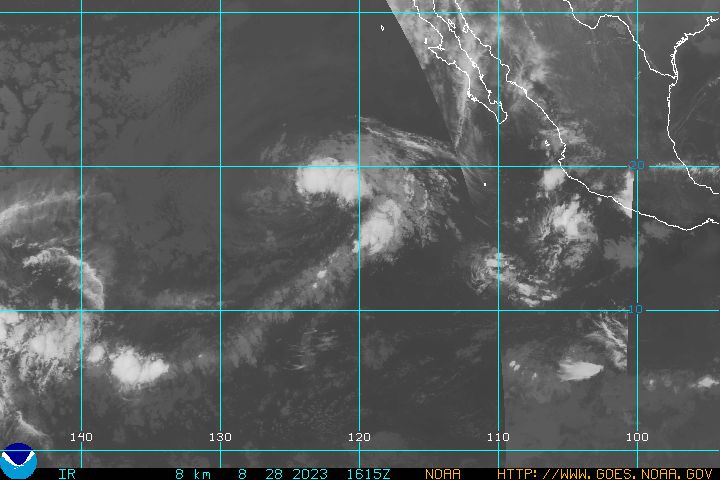 for posterity (you might want to click on it to enlarge), which isn't nearly as impressive as the loop. Click on the LatLon box, and locate 10 degrees north, and 109 degrees west. There's a big set of thunderstorms that's apparently been pounding the island. It's rainy here in NJ, but then again I'm sitting in a permanent structure with plenty of hills to break up the straight-line winds. For what it's worth here's the forecast for Clipperton, which doesn't look great either, though it does seem to get better after a few days.