Last weekend was the CQ WorldWide DX Contest (Single Sideband; the CW version takes place in November). Regular reader know that I "fool around" in contests (and occasionally actually win an award here and there), but rarely take things very seriously. CQ WW DX is considered one of the "big" DX contests annually, so there's a lot of activity. As I've previously mentioned, I often shy away from the really big contests because with my "peanut whistle" station ("peanut whistle" is a term used in ham radio to refer to a relatively small station; the other end of the scale is "big gun", like K3LR or W3LPL [my pictures taken during his 2005 open house] or dozens of others), it's very difficult to even make contacts, much less even pretend to be competitive. On top of that, being at the bottom of the solar cycle makes things worse, and very often it's tough for me to devote any considerable amount of time over a weekend uninterrupted. (I know; contest purists would tell me to make time. I try, but family and other obligations take precedence.)
As it turns out, last weekend I had a bit more time to devote to the contest that I originally expected. Sharon was in Florida visiting her Mom for the weekend, and I needed to be at home pretty much the whole weekend (fortunately, I pretty much just need to physically be around the house, most of what I was home for didn't require me to be doing anything other than just being here). As a result, I wound up spending a lot more time in front of the radio (probably around 14 hours total over the weekend) than I'd planned.
I had originally meant to take some notes during the contest so that I could write a bit about it here, but that just didn't happen. As a result, I'll try to rely on my memory (which means that this won't be nearly as long as I would have liked.)
A few interesting thing that I do remember are that I was surprised at the number of stations that I was (eventually) able to work on 15m, and even 10m, at this point in the solar cycle. I worked 5H3EE surprisingly easily early Saturday afternoon on 15m. He was not very strong, and I guess a lot of folks didn't hear him. I called him once and he responded to my call. That was fun. Late Saturday night, I worked two stations on 160m, which is unusual enough, but by doing that, I think this was the first time that I've ever worked stations on all 6 (10, 15, 20, 40, 80, and 160) bands available during a DX contest.
I also manged to work V4/NE1RD from St. Kitts, though the conditions were so rough that I could barely hear him. As it happens, I'd set up my logging program to record the audio from each contact, because I thought it would be fun to go back and listen to it later, and to show just how tough it was to copy Scott, I've upload a portion of the audio here. It's pretty tough to hear (you'll probably want to turn up the volume a bit), but you'll hear Scott CQing, me answering (sorry for the mis-match in the audio levels), we exchange reports, and things pretty much go downhill from there, unfortunately. This was a reflection on how the conditions were the whole weekend, though things improved dramatically on Sunday.
I tried to set a goal for the contest, and I figured that if nothing else, I'd try to beat my score from last year. I had about 53,000 points (which isn't very much, but I don't recall if I had a lot of time last year). After working the contest for about 4 or 5 hours Friday night and Saturday afternoon (ok, I slept in and didn't get on the air until the afternoon!), I had serious doubts that I'd even come close. I don't recall where I was at the end of Saturday, but I was seriously considering not even bothering to get back on the air on Sunday, because there's only so many times that I'm willing to try to work a run-of-the-mill non-rare DX station without them hearing me. It can get quite frustrating. A few friends who I spoke to who have relatively small stations had the same results, so at least I knew it wasn't just me.
Fortunately, things were a lot better on Sunday, and it actually became fun to contest again. As it turns out, I wound up more than doubling last year's score, although it was nowhere near a personal best for that contest. (To be fair to myself, I think my best effort was in 2002 or 2003, when the sunspot cycle was a lot more cooperative, although I've certainly got a lot more experience now than I did then.)
Here's to hoping that the conditions are improved for next year!
Saturday, November 03, 2007


Tuesday, October 23, 2007
Getting the blog delivered to you
Just a quick note about a new feature I've added here. If you like, you can now sign up to have new blog entries mailed to you. Look for the box on the right of this website titled "Subscribe via email" and enter your email address. The email service is run by Feedburner, which is owned by Google. I trust their privacy policy (which basically says that your email address won't be used for anything other than emailing you updates), but if you're not comfortable with that, of course you're welcome to come back and visit the website the "old fashioned" way in your browser.
Personally, I read most blogs using an RSS Reader, which I find a lot more convenient, since it delivers updated info to me, I don't have to go get it. I currently use RSS Bandit, a standalone tool that sits on your PC, but there are many, many other choices, including online readers such as the Google Reader.
We now return your to your regularly scheduled blog topic.
Personally, I read most blogs using an RSS Reader, which I find a lot more convenient, since it delivers updated info to me, I don't have to go get it. I currently use RSS Bandit, a standalone tool that sits on your PC, but there are many, many other choices, including online readers such as the Google Reader.
We now return your to your regularly scheduled blog topic.
Monday, October 22, 2007
This post has no title
It's a potpourri blog entry this week, several random bits and pieces.
Fellow blogger Scott, NE1RD, will be active from St. Kitts (V4) as V4/NE1RD starting this week. He'll be operating in CQ Worldwide SSB contest next weekend (low power, not QRP, as was incorrectly reported elsewhere) and will be on the air outside the contest as well. I've mentioned this a number of times already, but he's written extensively about his preparations for this trip at his regular blog (100 Pound DXpedition) as well as the separate The 100 Pound DXpedition to St. Kitts website.
Speaking of CQWW, that's one of the "biggie" contests, and while I'll probably "play around" a bit, I don't expect to put too much time for a couple of reasons: First, the band conditions remain awful. That means that a small station like mine, which is relatively weak, has an even harder-than-normal time trying to make any contacts at all. I know that my station is not competitive, and I do not expect to win anything in this kind of contest (despite previous comments to the contrary, for the really big contests, it's pretty darn tough to win anything because of all the competition), but I do like to be on the air. However, it gets frustrating when I can't even work anyone, or it takes me 15 minutes to work a run-of-the-mill station, repeatedly calling. None of that means that I won't try, it's just that it's a whole lot more fun when I'm actually making contacts. The second issue is that I've got a bunch of family obligations this weekend which are going to cut big gaps into my operating time. As I said, I'll be out there, just not as much as I'd like to be.
Despite the band conditions, I have been able to work some interesting DX. Over the past couple of days, I've worked 5L2MS from Liberia on several new bands, and also the C52C group in The Gambia as well. Neither of those were new countries for me, but I did pick up a couple of new CW bands for C5, and several new bands with the folks from 5L2MS. The latter group is still operational, and I'd like to try to pick them up in a few other places. Both groups seemed to be well organized and had surprising good signals to my location.
Part of the reason that I was able to work both of these stations is that I like to think that I'm working smarter, not harder (harder=more power, better antennas, etc.) Not that I wouldn't mind the "harder", but that's not what I've got. To reiterate what many (including me) have said before, you need to listen before you try to transmit. In both of these cases, I was able to find a pattern where the operator was listening (like most DXpeditions, they operated split, meaning that the operator transmitted on one frequency while listening over a range of other frequencies for those stations calling), either noting that he'd move up then down, or all the way up, then start from the bottom of the range again, etc. It's very satisfying when you're able to "bust" a big pileup by quite literally being in the right place at the right time.
One last item is that I did something yesterday that I don't do very much: I had a nice ragchew with Ian, GI3ZDE in Northern Ireland. I've heard Ian many times before, mostly on 20m, but never really "stopped by" to chat. Yesterday, I saw him spotted on 17m, so I tuned in to listen while doing some work on the computer, and after he finished a couple of contacts, I figured I'd say hello. We probably spoke for about 10 or 15 minutes, and might have gone a bit longer but the band was starting to drop out (in fact, within a few minutes of completing our QSO, I couldn't hear him at all as he continued to work other stations). I was trying to figure out how many contest or short DX contacts it would take to fill 15 minutes of operating, but decided that was a pretty pointless activity. It was just nice to chat with a fellow ham on the other side of the Atlantic, talking about something totally unimportant.
And that too is what ham radio is all about.
Fellow blogger Scott, NE1RD, will be active from St. Kitts (V4) as V4/NE1RD starting this week. He'll be operating in CQ Worldwide SSB contest next weekend (low power, not QRP, as was incorrectly reported elsewhere) and will be on the air outside the contest as well. I've mentioned this a number of times already, but he's written extensively about his preparations for this trip at his regular blog (100 Pound DXpedition) as well as the separate The 100 Pound DXpedition to St. Kitts website.
Speaking of CQWW, that's one of the "biggie" contests, and while I'll probably "play around" a bit, I don't expect to put too much time for a couple of reasons: First, the band conditions remain awful. That means that a small station like mine, which is relatively weak, has an even harder-than-normal time trying to make any contacts at all. I know that my station is not competitive, and I do not expect to win anything in this kind of contest (despite previous comments to the contrary, for the really big contests, it's pretty darn tough to win anything because of all the competition), but I do like to be on the air. However, it gets frustrating when I can't even work anyone, or it takes me 15 minutes to work a run-of-the-mill station, repeatedly calling. None of that means that I won't try, it's just that it's a whole lot more fun when I'm actually making contacts. The second issue is that I've got a bunch of family obligations this weekend which are going to cut big gaps into my operating time. As I said, I'll be out there, just not as much as I'd like to be.
Despite the band conditions, I have been able to work some interesting DX. Over the past couple of days, I've worked 5L2MS from Liberia on several new bands, and also the C52C group in The Gambia as well. Neither of those were new countries for me, but I did pick up a couple of new CW bands for C5, and several new bands with the folks from 5L2MS. The latter group is still operational, and I'd like to try to pick them up in a few other places. Both groups seemed to be well organized and had surprising good signals to my location.
Part of the reason that I was able to work both of these stations is that I like to think that I'm working smarter, not harder (harder=more power, better antennas, etc.) Not that I wouldn't mind the "harder", but that's not what I've got. To reiterate what many (including me) have said before, you need to listen before you try to transmit. In both of these cases, I was able to find a pattern where the operator was listening (like most DXpeditions, they operated split, meaning that the operator transmitted on one frequency while listening over a range of other frequencies for those stations calling), either noting that he'd move up then down, or all the way up, then start from the bottom of the range again, etc. It's very satisfying when you're able to "bust" a big pileup by quite literally being in the right place at the right time.
One last item is that I did something yesterday that I don't do very much: I had a nice ragchew with Ian, GI3ZDE in Northern Ireland. I've heard Ian many times before, mostly on 20m, but never really "stopped by" to chat. Yesterday, I saw him spotted on 17m, so I tuned in to listen while doing some work on the computer, and after he finished a couple of contacts, I figured I'd say hello. We probably spoke for about 10 or 15 minutes, and might have gone a bit longer but the band was starting to drop out (in fact, within a few minutes of completing our QSO, I couldn't hear him at all as he continued to work other stations). I was trying to figure out how many contest or short DX contacts it would take to fill 15 minutes of operating, but decided that was a pretty pointless activity. It was just nice to chat with a fellow ham on the other side of the Atlantic, talking about something totally unimportant.
And that too is what ham radio is all about.
Monday, October 15, 2007
You'll never know unless you try
Two weekends ago, I participated in the California QSO Party contest. As I've mentioned in the past (here and here), I like to play around in these contests because they are usually a bit lower-key than the really big contests, and sometimes, you actually might win something. Even if you don't win anything, it's something to do, and helps keeps the bands active. As hams, it's up to us to keep the activity going, because if we don't, there are plenty of commercial entities who would love to grab parts of the spectrum that is allocated to Amateur Radio. The CQP is one of (if not the) best run QSO parties, with all kinds of information available online and tons of activity.
As I mentioned in my entry entitled "It takes patience", trying to bounce your electrons off the ionosphere can be particularly difficult during this point in the solar cycle. Regardless of what the propagation numbers say, it's a fact that you will not make any contacts on a given band regardless of the predictions if you don't try. So, sometimes you have to try something that you think might not work, because there's a chance that it will.
One of the things that I've read about contesting is that you need to plan your strategy carefully to maximize your score. For contests, like the CQP, where you can work the same station on both different bands and different modes for credit, it makes sense to at least try to get an edge somewhere by checking out all (or almost all) the bands. Normally for the CQP, my "meat and potatoes" band had been 20m during the day. Unfortunately, the band conditions were just awful and I was having a lot of trouble being heard, even on CW. (And yes, I did actually did about 2/3 of my contacts on CW, which helped my score since CW contacts were worth 3 points versus phone contacts being worth 2). I decided that since wasn't making very many contacts anyway, I might as well try other bands.
At the peak of the solar cycle (or at least not down here in the trough), I would have had my fill of stations on 10m, but there was just nothing there. Next up was 15m and somewhat surprisingly, there were stations out there to work. They weren't strong, but there wasn't nearly as much competition, and the band was quieter. As a result, I made almost 20% of my total contacts on 15m, at a time when the W6ELprop predicted that there was essentially a zero chance of the band being open between my location and California. The important point is that if I hadn't tuned to 15m and listened, I never wouldn't have known.
As I mentioned in my entry entitled "It takes patience", trying to bounce your electrons off the ionosphere can be particularly difficult during this point in the solar cycle. Regardless of what the propagation numbers say, it's a fact that you will not make any contacts on a given band regardless of the predictions if you don't try. So, sometimes you have to try something that you think might not work, because there's a chance that it will.
One of the things that I've read about contesting is that you need to plan your strategy carefully to maximize your score. For contests, like the CQP, where you can work the same station on both different bands and different modes for credit, it makes sense to at least try to get an edge somewhere by checking out all (or almost all) the bands. Normally for the CQP, my "meat and potatoes" band had been 20m during the day. Unfortunately, the band conditions were just awful and I was having a lot of trouble being heard, even on CW. (And yes, I did actually did about 2/3 of my contacts on CW, which helped my score since CW contacts were worth 3 points versus phone contacts being worth 2). I decided that since wasn't making very many contacts anyway, I might as well try other bands.
At the peak of the solar cycle (or at least not down here in the trough), I would have had my fill of stations on 10m, but there was just nothing there. Next up was 15m and somewhat surprisingly, there were stations out there to work. They weren't strong, but there wasn't nearly as much competition, and the band was quieter. As a result, I made almost 20% of my total contacts on 15m, at a time when the W6ELprop predicted that there was essentially a zero chance of the band being open between my location and California. The important point is that if I hadn't tuned to 15m and listened, I never wouldn't have known.
Wednesday, October 10, 2007
New and improved contest tips from K9JY
As I mentioned several weeks ago, during the month of September, Scot, K9JY, published a terrific set of contesting tips on his blog. To help make things a bit easier, Scot recently consolidated those tips into a single index page titled 30 Days — 30 Ham Radio Contesting Tips with a brief description of each tip and a link to the original full-length tip. If you didn't see all the tips the first time, please be sure to go and read them.
Even if you did see all the tips the first time, go back and read them again. I just did!
Even if you did see all the tips the first time, go back and read them again. I just did!
Friday, October 05, 2007
What goes up, must come down
As they say, what goes up, must come down. Fortunately, sometimes, what goes down sometimes goes back up. I'll explain.
Back in April or May, a pretty nasty storm came through here. A mature tree (I think it was some variety of oak, but I'm really not sure) got blown down. Fortunately, that tree was at the edge of the woods behind our house and blew over back into the woods, well away from any buildings or cars. Because the ground was very soft at the time, the entire tree blew over, pulling the root system out of the ground, and leaving it just sitting there, with a pretty deep hole where the roots had been before. There was no real rush to do anything about it, but Sharon and I decided that we'd like to get it cut up for cosmetic reasons, as well as allowing the base to fall back into the hole, which kept filling up with just enough water to attract mosquitoes. Sharon called a local tree company and told them what we wanted to have done. Because there were a lot of higher-priority jobs, they told us it might be a little while until they were able to get to the tree.
"A little while" can mean all kinds of different things, and the frame of reference has a lot to do with this. I'll spare you the usual comparisons other than to say that on a geologic scale, it was even less than "a little while" until the tree company came. However, on a conventional day-to-day life scale, I think I'm safe in assuming that waiting from May until October 5 for the tree company to show up is probably more than "a little while".
As it turns out, there was a good side to them not showing up until today. Another tree, on the edge of the woods, had died at some point in the relatively recent past, and was starting to look like it might decide to come down on its own. Since one of the two main trunks was tilting towards our house, we decided that it'd probably be a good idea to have it taken down professionally, rather than allowing it to fall. Since the guys were already out cutting up the first tree, they gave us a good price to cut down the other tree. (Oh yeah, the other good thing about them not showing up until today was that I decided, pretty much for no reason, that I'd work from home today, so I was at home when they showed up.)
(I don't usually go this long without reference to radio, but I'll bet someone may have figured out what's coming next). So here's the radio tie-in: One end of my G5RV passed through the branches of the dead tree. I had originally hope to just lower both ends of the antenna enough to get out of the way, but Tom (the foreman) pointed out that since it was still draped through the branches, it would have been destroyed when he started dropping limbs. My big concern was that if I had to drop it all the way down and pull down the support ropes, that I wouldn't be able to get it back up in the air again. (When it was originally put up, a bunch of guys from the local radio club came over, including one with a bow and arrow, who did the trick.) Tom assured me that he'd get it back up in the tree, and since the tree had to come down, meaning the G5RV had to come with it, I really had no choice.
As you can see from the photo, Tom (that's him in the tree) climbed up and cut off a bunch of larger limbs so there wasn't much left by the time it was time to cut the trunks. He used a pair of climbing spikes, and I figured he'd do the same to get the support rope for the G5RV back up to where it was. It turns out that he had an easier way, one that I'd seen Scott, NE1RD mention in his blog not long ago.
Tom went back to the truck and returned with what's called a throwbag, which I've got pictured here. Basically, this is a small pouch that (in this case) has 16 ounces (about 454 grams) of lead shot pellets inside. It's connected to some lightweight and very slippery line, which won't get easily snagged on leaves and branches. What you do is to toss this over a branch, and because the bag is heavy enough, it'll drop down through the branches. You tie your antenna support line to the end of the yellow throwbag line, and pull your antenna into the air. It's remarkably simple, safe (yes, if you hit someone with the bag it's going to hurt a bit, but unless you're very unlucky there won't be any permanent damage to either party), and pretty inexpensive. I found one (pictured here) at the Bartlett Manufacturing website which costs about $17 including 100 feet of line. (I didn't really shop around, there might be better deals elsewhere).
I would have probably have tried to swing it around and toss it up, but Tom used a different technique. He used the same sort of motion that you'd use when throwing a basketball free-throw shot underhand, rocking back and forth a few times, and then throwing. I think that part of the reason he used that particular motion is because he didn't have a lot of space to work in. The limb that he was aiming for is behind the tree that he's on in the picture, and in order to get over and under the proper branches, he had to get a pretty specific trajectory. It took him several tries, but he managed to get it over a limb that he guessed was about 50 feet in the air. (I'd say it was a good guess, since after the throwbag came down, the 100 foot rope had about half of it on one side of the limb, and about half on the other, with both ends just barely on the ground; even I can divide 100 by 2!). I told him that was amazed at how he was able to get it over the branch, and he said that he was embarrassed because he can usually hit just about anything he wants in one try. Granted he is a professional, but it's still impressive.
One other good thing came out of taking down the antenna. I was able to examine the wire and the support line, which I normally can't see very well, being up in the air and all. The wire looked surprisingly good, and most of the support line was fine, with one exception: About a foot past where the support rope tied to the insulator, it must have been rubbing on a branch, because it was fairly well worn. I don't know how long it might have stayed up there before breaking, but given that I had some new support line available, I took advantage of the opportunity and decided to replace the old line with new. I've thought about replacing the support line as preventative maintenance anyway, but hadn't planned on doing it on virtually no notice. I was lucky that I had some of the original line that I'd bought when I first put the G5RV up (I had no idea at the time how much I'd need, I think I bought something like 500 feet; all told, I probably used about 200, much of which is coiled up on the eyebolts in the tree where it's tied off. I don't need that much when it's in the air, but I do need it for the rare occasion when the antenna needs to come down.) If this had happened a few days later, I would have picked up some of that nice dark line that's always available at hamfest (the BARA hamfest is tomorrow, as it turns out), but I was happy to have anything on hand.
So, in my case, what went up, came down, but went right back up again. The antenna works just fine (in fact, it might be just a bit higher because the support line is no longer hung up on some branches from the now-removed tree) I was only off the air for a few hours, and I don't have to worry about that particular tree falling on my house.
Back in April or May, a pretty nasty storm came through here. A mature tree (I think it was some variety of oak, but I'm really not sure) got blown down. Fortunately, that tree was at the edge of the woods behind our house and blew over back into the woods, well away from any buildings or cars. Because the ground was very soft at the time, the entire tree blew over, pulling the root system out of the ground, and leaving it just sitting there, with a pretty deep hole where the roots had been before. There was no real rush to do anything about it, but Sharon and I decided that we'd like to get it cut up for cosmetic reasons, as well as allowing the base to fall back into the hole, which kept filling up with just enough water to attract mosquitoes. Sharon called a local tree company and told them what we wanted to have done. Because there were a lot of higher-priority jobs, they told us it might be a little while until they were able to get to the tree.
"A little while" can mean all kinds of different things, and the frame of reference has a lot to do with this. I'll spare you the usual comparisons other than to say that on a geologic scale, it was even less than "a little while" until the tree company came. However, on a conventional day-to-day life scale, I think I'm safe in assuming that waiting from May until October 5 for the tree company to show up is probably more than "a little while".
As it turns out, there was a good side to them not showing up until today. Another tree, on the edge of the woods, had died at some point in the relatively recent past, and was starting to look like it might decide to come down on its own. Since one of the two main trunks was tilting towards our house, we decided that it'd probably be a good idea to have it taken down professionally, rather than allowing it to fall. Since the guys were already out cutting up the first tree, they gave us a good price to cut down the other tree. (Oh yeah, the other good thing about them not showing up until today was that I decided, pretty much for no reason, that I'd work from home today, so I was at home when they showed up.)
(I don't usually go this long without reference to radio, but I'll bet someone may have figured out what's coming next). So here's the radio tie-in: One end of my G5RV passed through the branches of the dead tree. I had originally hope to just lower both ends of the antenna enough to get out of the way, but Tom (the foreman) pointed out that since it was still draped through the branches, it would
 have been destroyed when he started dropping limbs. My big concern was that if I had to drop it all the way down and pull down the support ropes, that I wouldn't be able to get it back up in the air again. (When it was originally put up, a bunch of guys from the local radio club came over, including one with a bow and arrow, who did the trick.) Tom assured me that he'd get it back up in the tree, and since the tree had to come down, meaning the G5RV had to come with it, I really had no choice.
As you can see from the photo, Tom (that's him in the tree) climbed up and cut off a bunch of larger limbs so there wasn't much left by the time it was time to cut the trunks. He used a pair of climbing spikes, and I figured he'd do the same to get the support rope for the G5RV back up to where it was. It turns out that he had an easier way, one that I'd seen Scott, NE1RD mention in his blog not long ago.
Tom went back to the truck and returned with what's called a throwbag, which I've got pictured
 here. Basically, this is a small pouch that (in this case) has 16 ounces (about 454 grams) of lead shot pellets inside. It's connected to some lightweight and very slippery line, which won't get easily snagged on leaves and branches. What you do is to toss this over a branch, and because the bag is heavy enough, it'll drop down through the branches. You tie your antenna support line to the end of the yellow throwbag line, and pull your antenna into the air. It's remarkably simple, safe (yes, if you hit someone with the bag it's going to hurt a bit, but unless you're very unlucky there won't be any permanent damage to either party), and pretty inexpensive. I found one (pictured here) at the Bartlett Manufacturing website which costs about $17 including 100 feet of line. (I didn't really shop around, there might be better deals elsewhere).
I would have probably have tried to swing it around and toss it up, but Tom used a different technique. He used the same sort of motion that you'd use when throwing a basketball free-throw shot underhand, rocking back and forth a few times, and then throwing. I think that part of the reason he used that particular motion is because he didn't have a lot of space to work in. The limb that he was aiming for is behind the tree that he's on in the picture, and in order to get over and under the proper branches, he had to get a pretty specific trajectory. It took him several tries, but he managed to get it over a limb that he guessed was about 50 feet in the air. (I'd say it was a good guess, since after the throwbag came down, the 100 foot rope had about half of it on one side of the limb, and about half on the other, with both ends just barely on the ground; even I can divide 100 by 2!). I told him that was amazed at how he was able to get it over the branch, and he said that he was embarrassed because he can usually hit just about anything he wants in one try. Granted he is a professional, but it's still impressive.
One other good thing came out of taking down the antenna. I was able to examine the wire and the support line, which I normally can't see very well, being up in the air and all. The wire looked surprisingly good, and most of the support line was fine, with one exception: About a foot past
 where the support rope tied to the insulator, it must have been rubbing on a branch, because it was fairly well worn. I don't know how long it might have stayed up there before breaking, but given that I had some new support line available, I took advantage of the opportunity and decided to replace the old line with new. I've thought about replacing the support line as preventative maintenance anyway, but hadn't planned on doing it on virtually no notice. I was lucky that I had some of the original line that I'd bought when I first put the G5RV up (I had no idea at the time how much I'd need, I think I bought something like 500 feet; all told, I probably used about 200, much of which is coiled up on the eyebolts in the tree where it's tied off. I don't need that much when it's in the air, but I do need it for the rare occasion when the antenna needs to come down.) If this had happened a few days later, I would have picked up some of that nice dark line that's always available at hamfest (the BARA hamfest is tomorrow, as it turns out), but I was happy to have anything on hand.
So, in my case, what went up, came down, but went right back up again. The antenna works just fine (in fact, it might be just a bit higher because the support line is no longer hung up on some branches from the now-removed tree) I was only off the air for a few hours, and I don't have to worry about that particular tree falling on my house.
Saturday, September 22, 2007
It takes patience
By pretty much all accounts, we are either at, or very close to, the bottom of the current solar cycle. For those of us who like to bounce signals off the ether (no, not ethernet), that means that it's generally a lot harder to work distant stations. In fact, it's just about impossible on some bands, because the ionization required to support propagation on those bands is either entirely absent, or is at such a low level, that it's effectively non-existant.

My home station is pretty modest: I have an Icom 756 ProII and use either a Heil Pro-set Plus (generally for contesting), my relatively new Heil GM4, or even my Bencher BY-1 paddles. That feeds into a G5RV antenna in the backyard, which is strung between two trees at a height of between around 30' to maybe 45'. (One end is lower, it was a somewhat smaller tree.)
The G5RV (I'm referring now to the antenna, not to Louis Varney, G5RV who designed it) is a compromise antenna.(See the first G5RV link for lots of details on that aspect.) It's designed to work on all bands between 10m (28mHz) and 80m (3.5mHz), although I've been able to use mine (with less-than-stellar results) on 6m (50mHz) and 160m (1.8mHz) as well. When I first got interested in HF, I wanted to put up an antenna that would work on most of the HF bands, would be relatively inexpensive, and would be easy to install. Although getting the feedline into what is now my permanent shack was quite a challenge (I'll save that story for another post), a bunch of folks from my radio club came over and helped get the G5RV (as well as a Coment GP-15 tri-band vertical for 2m, 70cm, and 6m) up in the air and set up.
When I was trying to figure out what kind of antenna to put up, I pretty quickly came to the conclusion that for HF, I was going to be using some kind of wire antenna, as opposed to a beam of some type. Quite a few people I spoke to told me that a G5RV would work, but not very well, and I probably wouldn't work a lot of DX. Fortunately (for me), at least the latter part of that statement proved to be wrong.
I was fortunate to start working DX towards the end of 2000, at which point Solar Cycle 23 was just at the first of a double-peak (see the earlier link to see what I'm talking about), so it was relatively easy to work all over the world. 20m, the workhorse band, was open until very late at night (more like very early the next morning). I hadn't really gotten the hang of working 40m or 80m, but there was still plenty of DX the higher bands.
When I commented to some of the G5RV nay-sayers that I seemed to be having little trouble working plenty of DX, they attributed that to the fact that it was the peak of the solar cycle, plus the fact that as a relatively new DXer, almost everything was new, so it just seemed like things were working out.
So, fast forward to late summer of 2007. The bands are in terrible shape, there's noise, propagation in general is just lousy, and some of the key indicators of solar activity, such as solar flux, look like an EKG of a patient who is dead. (At times when the cycle was at it's peak, the base level was higher, and the spikes would go to the M and X levels frequently.) There are plenty of places on the web to get a good explanation of what all this means (and I highly recommend picking up a copy of "The New Shortwave Propagation Handbook" by Jacobs, Cohen, and Rose if you want to really learn something about the subject).
Anyway, despite all the difficulties, I do try to work a little DX as often as I can. It's more exciting when there's a DXpedition going on to an interesting place, but when there isn't, I'll try to find a station in a country that I haven't worked on some new band or new mode (or both), just to keep the cobwebs from forming on my microphone or my key. But as it happens, there is a pretty interesting DXpedition going on at the moment from a place called St. Brandon, an island in the Indian Ocean just north of Maurtius. The callsign for the operation is 3B7C and the group doing this is the 5 Star DXers Association, who got together for to do things like this. St. Brandon is relatively rare as DXCC entities go, although there was a team operating from there as 3B7SP earlier this year (who were originally supposed to operate from another nearby island.)
Although I worked 3B7SP when they were on, I wanted to try to work 3B7C to make some contacts on new bands. Because 3B7 is rare, as expected, the pileups were huge, especially during the first few days. I made a few attempts to contact them during the first few days of their operation on 40m, which should have been (and in fact, was) the best place to try to work them, but I wasn't able to get through. However, as time went on, I kept trying, first in the spots where I figured I'd have the best chance to work them (40m and 80m), and then eventually on 20m and 17m.
The key here for me, and this is where it ties into the post title, is that you have to be patient. On several nights, I sat by the radio, calling over and over again while trying to figure out their split pattern (when it wasn't obvious). Fortunately, my radio has a built-in voice & CW keyer, and the computer has a CW keyer, so it didn't have to do it "manually" for the whole time, but I did have to listen, and listen, and listen. Most importantly, I had to be trying to make a contact, not griping on some email reflector about how poor the conditions are (yes, I complained here, but that was after I'd made the contact). It seems that too many people find excuses ("The bands are just no good", "my antenna isn't good enough", etc.) rather than actually getting in front of the radio and trying to make a contact. I can guarantee you that you will not make a DX contact on the air without using your radio. That's what I do, and to date, it's netted me about 283 different DXCC entities, all of which were worked with my 100 watts into a compromise antenna. I had to be patient, but it's worked well.
On an unrelated note, after Scott, NE1RD, mentioned that he'd been toying with Twitter, I decided to give it a shot as well. You can view my feed on their website, and there are other options to follow it in other ways as well.

My home station is pretty modest: I have an Icom 756 ProII and use either a Heil Pro-set Plus (generally for contesting), my relatively new Heil GM4, or even my Bencher BY-1 paddles. That feeds into a G5RV antenna in the backyard, which is strung between two trees at a height of between around 30' to maybe 45'. (One end is lower, it was a somewhat smaller tree.)
The G5RV (I'm referring now to the antenna, not to Louis Varney, G5RV who designed it) is a compromise antenna.(See the first G5RV link for lots of details on that aspect.) It's designed to work on all bands between 10m (28mHz) and 80m (3.5mHz), although I've been able to use mine (with less-than-stellar results) on 6m (50mHz) and 160m (1.8mHz) as well. When I first got interested in HF, I wanted to put up an antenna that would work on most of the HF bands, would be relatively inexpensive, and would be easy to install. Although getting the feedline into what is now my permanent shack was quite a challenge (I'll save that story for another post), a bunch of folks from my radio club came over and helped get the G5RV (as well as a Coment GP-15 tri-band vertical for 2m, 70cm, and 6m) up in the air and set up.
When I was trying to figure out what kind of antenna to put up, I pretty quickly came to the conclusion that for HF, I was going to be using some kind of wire antenna, as opposed to a beam of some type. Quite a few people I spoke to told me that a G5RV would work, but not very well, and I probably wouldn't work a lot of DX. Fortunately (for me), at least the latter part of that statement proved to be wrong.
I was fortunate to start working DX towards the end of 2000, at which point Solar Cycle 23 was just at the first of a double-peak (see the earlier link to see what I'm talking about), so it was relatively easy to work all over the world. 20m, the workhorse band, was open until very late at night (more like very early the next morning). I hadn't really gotten the hang of working 40m or 80m, but there was still plenty of DX the higher bands.
When I commented to some of the G5RV nay-sayers that I seemed to be having little trouble working plenty of DX, they attributed that to the fact that it was the peak of the solar cycle, plus the fact that as a relatively new DXer, almost everything was new, so it just seemed like things were working out.
So, fast forward to late summer of 2007. The bands are in terrible shape, there's noise,
 propagation in general is just lousy, and some of the key indicators of solar activity, such as solar flux, look like an EKG of a patient who is dead. (At times when the cycle was at it's peak, the base level was higher, and the spikes would go to the M and X levels frequently.) There are plenty of places on the web to get a good explanation of what all this means (and I highly recommend picking up a copy of "The New Shortwave Propagation Handbook" by Jacobs, Cohen, and Rose if you want to really learn something about the subject).
 Anyway, despite all the difficulties, I do try to work a little DX as often as I can. It's more exciting when there's a DXpedition going on to an interesting place, but when there isn't, I'll try to find a station in a country that I haven't worked on some new band or new mode (or both), just to keep the cobwebs from forming on my microphone or my key. But as it happens, there is a pretty interesting DXpedition going on at the moment from a place called St. Brandon, an island in the Indian Ocean just north of Maurtius. The callsign for the operation is 3B7C and the group doing this is the 5 Star DXers Association, who got together for to do things like this. St. Brandon is relatively rare as DXCC entities go, although there was a team operating from there as 3B7SP earlier this year (who were originally supposed to operate from another nearby island.)
Although I worked 3B7SP when they were on, I wanted to try to work 3B7C to make some contacts on new bands. Because 3B7 is rare, as expected, the pileups were huge, especially during the first few days. I made a few attempts to contact them during the first few days of their operation on 40m, which should have been (and in fact, was) the best place to try to work them, but I wasn't able to get through. However, as time went on, I kept trying, first in the spots where I figured I'd have the best chance to work them (40m and 80m), and then eventually on 20m and 17m.
The key here for me, and this is where it ties into the post title, is that you have to be patient. On several nights, I sat by the radio, calling over and over again while trying to figure out their split pattern (when it wasn't obvious). Fortunately, my radio has a built-in voice & CW keyer, and the computer has a CW keyer, so it didn't have to do it "manually" for the whole time, but I did have to listen, and listen, and listen. Most importantly, I had to be trying to make a contact, not griping on some email reflector about how poor the conditions are (yes, I complained here, but that was after I'd made the contact). It seems that too many people find excuses ("The bands are just no good", "my antenna isn't good enough", etc.) rather than actually getting in front of the radio and trying to make a contact. I can guarantee you that you will not make a DX contact on the air without using your radio. That's what I do, and to date, it's netted me about 283 different DXCC entities, all of which were worked with my 100 watts into a compromise antenna. I had to be patient, but it's worked well.
On an unrelated note, after Scott, NE1RD, mentioned that he'd been toying with Twitter, I decided to give it a shot as well. You can view my feed on their website, and there are other options to follow it in other ways as well.
Sunday, September 16, 2007
Hey, you never know!
A few weeks ago, I mentioned that I was surprised to discover that I'd won the SMIRK contest for the 2nd call area. Originally, I hadn't even planned to submit my log, but Larry, N4VA, talked me into it, and I'm glad he did. I also learned a lesson, which is to always submit your log. Not surprisingly, Larry's not the only one who recommends that.
This month, Scot, K9JY, has been running a series of contesting tips in his blog. Some are pretty obvious, some not so, but all are worthwhile reading. Today's posting is about exactly what I discussed in the first paragraph, always submitting your log. I won't rehash what he posted (read the link for the details) but as I've mentioned, my experience is that it's easy to do (since other than about my first 5 or 10 HF contacts, I've always logged electronically) and every now and then, you might find that you actually win something.
Those of you who know me know that I'm far from a serious contester, though I do occasionally get involved enough to want to try to reach some self-set goal. Sometimes that goal is make a certain number of contacts, sometimes to better my score from a previous year (which can be a real challenge as the solar cycle bottoms out, or in a 6m contest when there is good sporadic E-skip one year, and none the next), or sometimes to hit a target set by the contest sponsor at which point you'll automatically receive a participation certificate. I've done that a bunch of times, and have gotten nice certificates from several contests, including the California QSO Party, the Kentucky QSO Party, and even won (again, unexpectedly) for NJ in the Virginia QSO Party.
I agree with Scot: If you go to the trouble of making the contacts, go ahead and submit your log. As the ad for the New York Lottery says "Hey, you never know!".
This month, Scot, K9JY, has been running a series of contesting tips in his blog. Some are pretty obvious, some not so, but all are worthwhile reading. Today's posting is about exactly what I discussed in the first paragraph, always submitting your log. I won't rehash what he posted (read the link for the details) but as I've mentioned, my experience is that it's easy to do (since other than about my first 5 or 10 HF contacts, I've always logged electronically) and every now and then, you might find that you actually win something.
Those of you who know me know that I'm far from a serious contester, though I do occasionally get involved enough to want to try to reach some self-set goal. Sometimes that goal is make a certain number of contacts, sometimes to better my score from a previous year (which can be a real challenge as the solar cycle bottoms out, or in a 6m contest when there is good sporadic E-skip one year, and none the next), or sometimes to hit a target set by the contest sponsor at which point you'll automatically receive a participation certificate. I've done that a bunch of times, and have gotten nice certificates from several contests, including the California QSO Party, the Kentucky QSO Party, and even won (again, unexpectedly) for NJ in the Virginia QSO Party.
I agree with Scot: If you go to the trouble of making the contacts, go ahead and submit your log. As the ad for the New York Lottery says "Hey, you never know!".
Monday, September 03, 2007
ZF2DK cards going out
Just a quick note to let folks know that the QSL cards that I talked about previously have been printed up. I've responded to those cards that I've received and they'll be going in the mail this week.
As a side note, I wound up printing the cards on Staples "Gloss White Photo Quality Postcards" (Staples item #490861) and I'm very happy with the results. I'd previously used a non-gloss card when printed my own cards, and they came out OK, but these really do look a lot nicer. The only problem (which I knew about in advance) is that the cards separate into 5 1/2" x 4 1/4" cards, and I need to trim them down to be 5 1/2" x 3 1/2" to be "standard" QSL size. I wouldn't want to do that for hundreds of cards, but for the couple of dozen that I'll wind up sending out, I can deal with it.
I would be curious to know if anyone who prints their own cards on a regular basis has found a card stock that they like better, especially if it doesn't involve having to trim the printed cards.
As a side note, I wound up printing the cards on Staples "Gloss White Photo Quality Postcards" (Staples item #490861) and I'm very happy with the results. I'd previously used a non-gloss card when printed my own cards, and they came out OK, but these really do look a lot nicer. The only problem (which I knew about in advance) is that the cards separate into 5 1/2" x 4 1/4" cards, and I need to trim them down to be 5 1/2" x 3 1/2" to be "standard" QSL size. I wouldn't want to do that for hundreds of cards, but for the couple of dozen that I'll wind up sending out, I can deal with it.
I would be curious to know if anyone who prints their own cards on a regular basis has found a card stock that they like better, especially if it doesn't involve having to trim the printed cards.
Sunday, September 02, 2007
Tips for operating from the Caymans - A summary
I thought I was done with posts about my Cayman trip, but something came up recently that I thought would be a useful addition to the blog. A friend forwarded a note to me from another ham from a private club mailing list, asking for information about operating from the Cayman Islands. Although most of this information is contained elsewhere here, I wrote the other ham an email with a lot of the relatively important information summarized. I thought it might be useful to post my email as a summary which I could use to refer folks to in the future. Here's the letter, with a few minor edits.
First of all, the key to getting your license is to START EARLY! I started in March and didn't get the license until May. Things down there work on "island time", you need to be prepared to wait a bit. The folks are all very nice, it's just that it might take a couple of weeks for them to get around to answering an email. The Caymanian equivalent of the FCC is the ICTA, which is at www.icta.ky. Unfortunately, although there's a link for Amateur radio, it's marked "coming soon", and has been since I first looked back in February 2007. Remember, it's island time. One note about the delay in getting a response is that the main person to contact for Amateur licensing, Kevin Washington, apparently has been ill, so he's not always in the office. Kevin's email is kevin.washington@icta.ky. I also dealt with Nikki Forbes, Nikki.Forbes@icta.ky, and there's also the licensing@icta.ky address (which I think may go to both of them).
Note that the Cayman license is good for one year from date of issue. Also, note that in order to bring radio gear into the country, you need to get (and pay for; I think it was USD$ 12) an import permit. I traveled pretty light, and if I hadn't said something to the customs folks there, I doubt they would have even noticed that I had any gear with me, but I have heard from others who've been down there that if you don't have an import permit (and they find your gear), you'll be required to post a cash bond equal to the value of the gear. (They don't want you "importing" gear that's going to stay on the island.) The real pain in that case, aside from having to lay out the money, is going through the process to collect it when you're coming back. I figured that the $12 import permit was a good insurance policy. In my case, I gave the customs agent the form, she had to ask a few people to figure out what to do with it, then she handed it back to me, and said "ok, thanks". Of course, if you wind up staying at a place where you don't need to bring gear, it won't be an issue.
Probably the best person to contact regarding all things ham radio down there is Andrew Eden, ZF1EJ. His email is aquadesi@candw.ky. Andrew runs the Cayman club station, ZF1A. I didn't get a chance to operate from there, but from speaking with others I understand that if you bring your own rig, you can operate from there (it's an antennas-only shack, or at least it was from what others have told me), though I'm not sure what kind of arrangements you'd need to make. However, Andrew was very helpful in responding to all of my questions about radio in general, the island, and dealing with the ICTA. He normally will respond pretty quickly to email, so if you don't hear back from him after a few days to a week, drop him a gentle reminder (like everyone, he gets busy) and I'm sure you'll hear back from him.
The one other thing that I can think of off the top of my head is to be sure to let folks know that you're going. I documented the list of folks that I contacted to let them know I was going. There are probably others that I missed, but I have to say that I was pretty amazed at how many places my announcement showed up after sending to this list:
Name of publication/list: Contact
Ohio/Penn DX Bulletin: kb8nw@arrl.net425
DX News: Mauro Pregliasco, I1JQJ (i1jqj@425dxn.org)
Daily DX: bernie@dailydx.com
NJDXA: na2m@njdxa.org
DXNL: dxmb@dxhf.darc.de
RSGB IOTA - NA-016: http://www.rsgbiota.org/activate_fm2.php4
NG3K: bill@ng3k.com
Go-List: golist@gmail.com
First of all, the key to getting your license is to START EARLY! I started in March and didn't get the license until May. Things down there work on "island time", you need to be prepared to wait a bit. The folks are all very nice, it's just that it might take a couple of weeks for them to get around to answering an email. The Caymanian equivalent of the FCC is the ICTA, which is at www.icta.ky. Unfortunately, although there's a link for Amateur radio, it's marked "coming soon", and has been since I first looked back in February 2007. Remember, it's island time. One note about the delay in getting a response is that the main person to contact for Amateur licensing, Kevin Washington, apparently has been ill, so he's not always in the office. Kevin's email is kevin.washington@icta.ky. I also dealt with Nikki Forbes, Nikki.Forbes@icta.ky, and there's also the licensing@icta.ky address (which I think may go to both of them).
Note that the Cayman license is good for one year from date of issue. Also, note that in order to bring radio gear into the country, you need to get (and pay for; I think it was USD$ 12) an import permit. I traveled pretty light, and if I hadn't said something to the customs folks there, I doubt they would have even noticed that I had any gear with me, but I have heard from others who've been down there that if you don't have an import permit (and they find your gear), you'll be required to post a cash bond equal to the value of the gear. (They don't want you "importing" gear that's going to stay on the island.) The real pain in that case, aside from having to lay out the money, is going through the process to collect it when you're coming back. I figured that the $12 import permit was a good insurance policy. In my case, I gave the customs agent the form, she had to ask a few people to figure out what to do with it, then she handed it back to me, and said "ok, thanks". Of course, if you wind up staying at a place where you don't need to bring gear, it won't be an issue.
Probably the best person to contact regarding all things ham radio down there is Andrew Eden, ZF1EJ. His email is aquadesi@candw.ky. Andrew runs the Cayman club station, ZF1A. I didn't get a chance to operate from there, but from speaking with others I understand that if you bring your own rig, you can operate from there (it's an antennas-only shack, or at least it was from what others have told me), though I'm not sure what kind of arrangements you'd need to make. However, Andrew was very helpful in responding to all of my questions about radio in general, the island, and dealing with the ICTA. He normally will respond pretty quickly to email, so if you don't hear back from him after a few days to a week, drop him a gentle reminder (like everyone, he gets busy) and I'm sure you'll hear back from him.
The one other thing that I can think of off the top of my head is to be sure to let folks know that you're going. I documented the list of folks that I contacted to let them know I was going. There are probably others that I missed, but I have to say that I was pretty amazed at how many places my announcement showed up after sending to this list:
Name of publication/list: Contact
Ohio/Penn DX Bulletin: kb8nw@arrl.net425
DX News: Mauro Pregliasco, I1JQJ (i1jqj@425dxn.org)
Daily DX: bernie@dailydx.com
NJDXA: na2m@njdxa.org
DXNL: dxmb@dxhf.darc.de
RSGB IOTA - NA-016: http://www.rsgbiota.org/activate_fm2.php4
NG3K: bill@ng3k.com
Go-List: golist@gmail.com
Saturday, August 25, 2007
The job isn't done until the paperwork is finished
One of the advantages of being a "small pistol" station is that I don't worry about how to deal with the thousands of QSL card requests that some of the "big gun" contest stations and DXpeditions have to deal with. Over the past year, I made a bit over 1700 QSOs, which includes my operation from the Cayman Islands and any contests I've been in. I've never tried to figure out what percentage of stations I contact that I "need" for some award (DXCC, WAS, IOTA, etc.), but at this point in my ham career, I'm sure it's not a big percentage. (I should clarify that last statement: It's not that I don't wish that I had a higher percentage of "new ones", it's just becoming harder and harder to find and work them.)
However, one thing that I've always made it a point to do is to make sure that if I get a QSL card from someone, they get a card back from me. For those cards that come "direct" (which means that someone has mailed their card directly to me, just like you'd mail a letter to someone), they'll get a card back direct, usually within a day of my receiving their card. Often, the sender with include an SASE (self-addressed stamped envelope) or at least an SAE (self-addressed envelope), though sometimes they don't. Again, I don't send out that many cards, so I don't mind paying the return postage; it's part of the cost of being active in the hobby. (One of these days I'll pull up my soapbox and complain about those stations who don't seem willing to return a QSL card to me, even when they are stations in countries, often the US, that have a reliable postal system so I know they got the card, and when I've included an SASE or SAE plus postage; but that's something for another time.)
When I receive a QSL card request for a contact that I've made from my home station, I just reach into the box of cards that I had printed (by The QSL Man, W4MPY, who I highly recommend), fill it out, and send it back, usually the same day that I receive the card. Because I figured that I'd eventually use up a bunch of my "regular use" card, I had a couple of thousand of them printed up professionally, which means that they tend to look nicer than they would if I'd printed them myself, plus the per-card price is cheaper. The only problem with having cards professionally printed is that if you aren't going to have it done in quantity, it winds up being pretty expensive on a per-card basis. There are a couple of companies that will do small runs (100; a normal printing run is 1000 or more) of cards, but they are usually limited in what kinds of designs they'll do. For my Cayman trip, I made about 120 total QSOs. I'm guessing that at most, I'd have no more than 50 or so requests for cards, so even doing a batch of 100 commercially doesn't make a lot of sense.
So, as with my previous trip to the Outer Banks and to Lido Key, I decided that I'd design and print up the cards myself. For those trips, I took a few pictures and made up cards using some pictures from the trips along with the appropriate text/ I use Adobe Photoshop Elements which i s more than powerful enough for something like this. (It's gotten somewhat more expensive than when I first bought it; I think I paid something like $20 or $30 for version 2.0; looks like it's now around $80 for verison 5.0, but there are plenty of alternatives.) The front of the card just has the basic information, and I use a regular word processor to set up a QSO table and any other info that I want to print on the back of the card. Everything is set to print on inkjet or laser postcards that will print four to a sheet. I used some card stock from Staples, but I sure there are alternatives. The tricky part is getting them to run through the printer the
 right way so that I get the QSO info on the back more or less lined up correctly on the back so that it's centered on the card. After I've gotten the cards printed, I separate them and then I usually need to trim them a bit. A standard QSL card looks like it's about 5 7/16" (13.8cm) x 3.5" (8.9cm), but in order to fit my cards on the stock that I use, mine wind up as 5.25" (13.335 cm) x 3.5" (8.9cm). When I pull them apart, there's a little room left over on each card, which I trim off. Not only does it look nice, but it's then close enough to a standard size to fit easily into most envelopes.
I'd originally hoped to make a lot more QSOs than I did on my Cayman trip (for reasons that I've described ad nauseum in previous posts here), but the only impact that had on my QSLing is that it meant that I won't be having the cards professionally printed. So, as with the previous cards, the hard part was actually sitting down and doing the card design. I will freely admit that I am not the best (ok, I'm probably one of the worst) graphic designers in existence, but I've pretty much figured out a template to use, which is to use a large background picture and have one or more inset photos. I finally figured out what to use for this trip, and after spending a bit of time juggling the images around (plus with some advice from my younger son Brett, who is far less "graphically challenged" than I am, along with my older son Justin, KC2MCS, and of course my XYL Sharon), I've finally come up with a card design that I'm reasonably happy with, which is shown here. This is still a draft, and I realized that I needed to add in the IOTA reference, which is required in order to be valid for IOTA award purposes. I'll take care of that as soon as I finish writing this entry, set up the reverse side, and try to get the cards printed this week. I've got about a dozen folks who sent cards direct and I'm feeling a bit guilty that I haven't been able to respond yet.
However, one thing that I've always made it a point to do is to make sure that if I get a QSL card from someone, they get a card back from me. For those cards that come "direct" (which means that someone has mailed their card directly to me, just like you'd mail a letter to someone), they'll get a card back direct, usually within a day of my receiving their card. Often, the sender with include an SASE (self-addressed stamped envelope) or at least an SAE (self-addressed envelope), though sometimes they don't. Again, I don't send out that many cards, so I don't mind paying the return postage; it's part of the cost of being active in the hobby. (One of these days I'll pull up my soapbox and complain about those stations who don't seem willing to return a QSL card to me, even when they are stations in countries, often the US, that have a reliable postal system so I know they got the card, and when I've included an SASE or SAE plus postage; but that's something for another time.)
When I receive a QSL card request for a contact that I've made from my home station, I just reach into the box of cards that I had printed (by The QSL Man, W4MPY, who I highly
 recommend), fill it out, and send it back, usually the same day that I receive the card. Because I figured that I'd eventually use up a bunch of my "regular use" card, I had a couple of thousand of them printed up professionally, which means that they tend to look nicer than they would if I'd printed them myself, plus the per-card price is cheaper. The only problem with having cards professionally printed is that if you aren't going to have it done in quantity, it winds up being pretty expensive on a per-card basis. There are a couple of companies that will do small runs (100; a normal printing run is 1000 or more) of cards, but they are usually limited in what kinds of designs they'll do. For my Cayman trip, I made about 120 total QSOs. I'm guessing that at most, I'd have no more than 50 or so requests for cards, so even doing a batch of 100 commercially doesn't make a lot of sense.
So, as with my previous trip to the Outer Banks and to Lido Key, I decided that I'd design and print up the cards myself. For those trips, I took a few pictures and made up cards using some pictures from the trips along with the appropriate text/ I use Adobe Photoshop Elements which i
 s more than powerful enough for something like this. (It's gotten somewhat more expensive than when I first bought it; I think I paid something like $20 or $30 for version 2.0; looks like it's now around $80 for verison 5.0, but there are plenty of alternatives.) The front of the card just has the basic information, and I use a regular word processor to set up a QSO table and any other info that I want to print on the back of the card. Everything is set to print on inkjet or laser postcards that will print four to a sheet. I used some card stock from Staples, but I sure there are alternatives. The tricky part is getting them to run through the printer the
 right way so that I get the QSO info on the back more or less lined up correctly on the back so that it's centered on the card. After I've gotten the cards printed, I separate them and then I usually need to trim them a bit. A standard QSL card looks like it's about 5 7/16" (13.8cm) x 3.5" (8.9cm), but in order to fit my cards on the stock that I use, mine wind up as 5.25" (13.335 cm) x 3.5" (8.9cm). When I pull them apart, there's a little room left over on each card, which I trim off. Not only does it look nice, but it's then close enough to a standard size to fit easily into most envelopes.
I'd originally hoped to make a lot more QSOs than I did on my Cayman trip (for reasons that I've described ad nauseum in previous posts here), but the only impact that had on my QSLing is that it meant that I won't be having the cards professionally printed. So, as with the previous cards, the hard part was actually sitting down and doing the card design. I will freely admit that I am not the best (ok, I'm probably one of the worst) graphic designers in existence, but I've pretty much figured out a template to use, which is to use a large background picture and have one or more inset photos.
 I finally figured out what to use for this trip, and after spending a bit of time juggling the images around (plus with some advice from my younger son Brett, who is far less "graphically challenged" than I am, along with my older son Justin, KC2MCS, and of course my XYL Sharon), I've finally come up with a card design that I'm reasonably happy with, which is shown here. This is still a draft, and I realized that I needed to add in the IOTA reference, which is required in order to be valid for IOTA award purposes. I'll take care of that as soon as I finish writing this entry, set up the reverse side, and try to get the cards printed this week. I've got about a dozen folks who sent cards direct and I'm feeling a bit guilty that I haven't been able to respond yet.
Tuesday, August 21, 2007
Maryland-DC QSO Party
This is a kind of "leftover" item from a couple of weeks ago, but this was a pretty quiet week from a radio perspective. A little over a week ago (August 11 & 12) was the Maryland-DC QSO Party (or MDC QSO Party). Like most other contests, the object is to contact as many other stations as you can within the parameters of the contest. In this case, what's special is that if your station is physically located in either the state of Maryland or in Washington, DC, you can contact any other station for points. If you're outside of the MDC area, you can only contact stations within MDC for credit. Most states have their own "QSO Party" contests, and some of them, like the California QSO Party and the Florida QSO Party are very popular, with hundreds or thousands of in-state participants. Others aren't so popular, and only attract a relatively small number of in-state participants. (Unfortunately, it seems that in my home state, the New Jersey QSO Party seems to fall in the latter category; it's usually the same weekend as a big national contest, the North American QSO Party, and I think that the NAQP draws away some of the participants.) Sometimes, these state QSO parties have special rules that make them more fun. The MDC QP is one of those.
The special thing for the MDC QP is that you get different points for working different types of stations, and for using morse code instead of voice. For this contest, you get 10 points for working a "club station" (which is a station operated by members of a radio club), 5 points for working a "mobile station", which is (generally speaking) a station that's operated from a vehicle, though frequently one that's not in motion while participating, 4 points for a station that's using low power (5 watts or less, what hams call "QRP"), 3 points for a station using morse code, and one point for all other stations. (You can only choose one category to claim credit, so for instance, if there was a mobile, low-power club station using morse code you don't get to add all the points up.) It's a little complicated, but the good news is that you don't have to worry about figuring out the score until the contest is over. Like other contests, there's something called a "multiplier", which is used in the score computation. For MDC, the multipliers are the counties in Maryland plus Washington DC plus Baltimore City. (If you're outside of the MDC area, you also have multipliers for each state, Canadian provinces, and foreign countries. Because of this pretty major difference in scoring, the ranking of stations for MDC and non-MDC stations are kept separate.)
With all of that said, one of the nicer things about the sort of "medium-sized" QSO parties is that there's enough competition to make it interesting (you want to have other stations to make contacts with, after all!), but not so much that small stations, like mine, can't be heard. (That's one of the problems with the really big contests; although the "big guns" need to work everyone you can, including me, you spend a lot more time trying to attract attention to yourself.) With these smaller contests, it's just plain fun for me, which, as I've said, is sort of what the hobby is all about. I am definitely not a serious contester, and while it's fun to have a good score, I haven't yet gotten to the point of never getting up from the chair during the contest (there are those who literally don't get up; I'll leave it to the reader to figure out what that means over the course of 12, 24, or 48 hours). So, when conditions are good and there are lots of stations to contact, I'll make contacts. When conditions are poor, I'll find something else to do. This year's MDC QSO Party was a perfect example of this.
Because of the way radio propagation works, radio signals travel different distances depending on what frequency (or band) is being used. Certain bands work best at particular times of the day, which unfortunately sometimes means that the best bands to use to contact a station at a particular distance just isn't available. From my house in NJ, the two sets of frequencies that work best to contact stations in the MDC area are known as the 40m band (roughly 7Mhz) and 80m band (roughly 3.5Mhz). Unfortunately 80m isn't really very good during the daylight hours, and 40m just plain didn't want to cooperate during the contest, especially on Saturday.
I wasn't really home Saturday night very much, so I only wound up making 22 contacts during the entire contest, with about 2/3s on 40m (mostly Sunday afternoon) and the rest on 80m (a bit on Saturday night, and a bit on Sunday night). My total score was around 2200 points, which is nothing to write home about, but I had fun doing it. I got to chat with a bunch of folks (when the operators on both ends know that they aren't going to be making thousands of contacts, there's time to chat), ran into one or two people that I'd spoken with before, and even made some contacts with a couple of interesting club stations, including the club stations for the Voice Of America, K3VOA.
To me, this is what ham radio is about.
The special thing for the MDC QP is that you get different points for working different types of stations, and for using morse code instead of voice. For this contest, you get 10 points for working a "club station" (which is a station operated by members of a radio club), 5 points for working a "mobile station", which is (generally speaking) a station that's operated from a vehicle, though frequently one that's not in motion while participating, 4 points for a station that's using low power (5 watts or less, what hams call "QRP"), 3 points for a station using morse code, and one point for all other stations. (You can only choose one category to claim credit, so for instance, if there was a mobile, low-power club station using morse code you don't get to add all the points up.) It's a little complicated, but the good news is that you don't have to worry about figuring out the score until the contest is over. Like other contests, there's something called a "multiplier", which is used in the score computation. For MDC, the multipliers are the counties in Maryland plus Washington DC plus Baltimore City. (If you're outside of the MDC area, you also have multipliers for each state, Canadian provinces, and foreign countries. Because of this pretty major difference in scoring, the ranking of stations for MDC and non-MDC stations are kept separate.)
With all of that said, one of the nicer things about the sort of "medium-sized" QSO parties is that there's enough competition to make it interesting (you want to have other stations to make contacts with, after all!), but not so much that small stations, like mine, can't be heard. (That's one of the problems with the really big contests; although the "big guns" need to work everyone you can, including me, you spend a lot more time trying to attract attention to yourself.) With these smaller contests, it's just plain fun for me, which, as I've said, is sort of what the hobby is all about. I am definitely not a serious contester, and while it's fun to have a good score, I haven't yet gotten to the point of never getting up from the chair during the contest (there are those who literally don't get up; I'll leave it to the reader to figure out what that means over the course of 12, 24, or 48 hours). So, when conditions are good and there are lots of stations to contact, I'll make contacts. When conditions are poor, I'll find something else to do. This year's MDC QSO Party was a perfect example of this.
Because of the way radio propagation works, radio signals travel different distances depending on what frequency (or band) is being used. Certain bands work best at particular times of the day, which unfortunately sometimes means that the best bands to use to contact a station at a particular distance just isn't available. From my house in NJ, the two sets of frequencies that work best to contact stations in the MDC area are known as the 40m band (roughly 7Mhz) and 80m band (roughly 3.5Mhz). Unfortunately 80m isn't really very good during the daylight hours, and 40m just plain didn't want to cooperate during the contest, especially on Saturday.
I wasn't really home Saturday night very much, so I only wound up making 22 contacts during the entire contest, with about 2/3s on 40m (mostly Sunday afternoon) and the rest on 80m (a bit on Saturday night, and a bit on Sunday night). My total score was around 2200 points, which is nothing to write home about, but I had fun doing it. I got to chat with a bunch of folks (when the operators on both ends know that they aren't going to be making thousands of contacts, there's time to chat), ran into one or two people that I'd spoken with before, and even made some contacts with a couple of interesting club stations, including the club stations for the Voice Of America, K3VOA.
To me, this is what ham radio is about.
Monday, August 13, 2007
Holy Cow, I won!

In case you're interested, here is the complete list of winners for the 2007 SMIRK contest. Congratulations to all!
Monday, July 30, 2007
Cayman update #2a
I just wanted to post a quick couple of pictures from the trip. First, here's a view of how close the antenna was mounted to the roof. That roof is metal, as is (obviously) the railing that the antenna is attached to, and most of the windows are metal as well. The counterpoise wire is angling off to the left in this shot, but it's just about impossible to see. Also, it's a little hard to tell from this angle, but the antenna was mounted on the 2nd floor.
Aside from the difficulties with the antenna, the actual physical operating conditions were hardly difficult. That's me during the IOTA contest operating from our bedroom at the house. You can see the laptop and radio in the picture, the power supply was a few feet away on a chair (mostly because it has a fan that is pretty noisy and runs constantly. In the background, looking out the window in the foreground you can see the Buddistick antenna, and past that, across the water, is the Blue Tip Golf Course. Yeah, we did have a pretty amazing view out the window.
Admittedly, this was not a "roughing-it" trip by any stretch of the imagination. In fact, short of actually living there full-time this was about as easy as it gets. Scott, NE1RD commented in his blog that his idea of roughing it was staying in a hotel that didn't have room service. Well technically, we didn't have room service here (it was essentially a private house) but since we did have maid service I guess that doesn't count. About the toughest thing that I had to do was to open the slider to adjust the antenna, which let some of the heat into the room. Gee, I guess I'd better not complain to the BS7H folks.
 antenna was mounted to the roof. That roof is metal, as is (obviously) the railing that the antenna is attached to, and most of the windows are metal as well. The counterpoise wire is angling off to the left in this shot, but it's just about impossible to see. Also, it's a little hard to tell from this angle, but the antenna was mounted on the 2nd floor.
Aside from the difficulties with the antenna, the actual physical operating conditions were hardly difficult. That's me during the IOTA contest operating from our bedroom at the house. You
 can see the laptop and radio in the picture, the power supply was a few feet away on a chair (mostly because it has a fan that is pretty noisy and runs constantly. In the background, looking out the window in the foreground you can see the Buddistick antenna, and past that, across the water, is the Blue Tip Golf Course. Yeah, we did have a pretty amazing view out the window.
Admittedly, this was not a "roughing-it" trip by any stretch of the imagination. In fact, short of actually living there full-time this was about as easy as it gets. Scott, NE1RD commented in his blog that his idea of roughing it was staying in a hotel that didn't have room service. Well technically, we didn't have room service here (it was essentially a private house) but since we did have maid service I guess that doesn't count. About the toughest thing that I had to do was to open the slider to adjust the antenna, which let some of the heat into the room. Gee, I guess I'd better not complain to the BS7H folks.
Sunday, July 29, 2007
Cayman Update #2
I wrote the following post while offline in the Grand Cayman airport, and had forgotten that I've covered a fair amount of the same material. I'm now sitting in the Charlotte airport, with the storms in Newark having delayed our return flight home, and I decided that rather than edit what I wrote, I'll just post it as written. Please forgive the duplication.
Sorry for the lack of updates from during the trip. This update is being written as I sit in the airport waiting for the first leg of my return flights home. Although my original intent was to provide a few updates during the trip, other matters, such as sitting by the pool, jet-skiing, eating, eating, eating, and the occasional (!) "adult beverage" seemed to take up a lot more time than I'd expected.
The Antenna Issues
As I mentioned in my first posting, I did have some trouble getting the Buddistick tuned. Over the course of the week, I discovered a few things that almost certainly causes the issues. First, as you'll see from some pictures (I'm not sure if they'll be in this blog or elsewhere, as I'm currently writing this offline) the antenna was mounted on a railing on the second floor of the house. We were quite close to water, but unfortunately the roof of the house was metal, which did cause problems. (I considered mounting the antenna on the grass in the backyard or on a patio table, but decided not to do that as I would have had to either operate outside or run the feedline over the backyard. Neither of those options seemed desirable.)
However, I think the bigger issue was that I was probably using a counterpoise that was too short. One of the nice things about the Buddistick is that you can experiment, and you can find that the antenna will tune with different combinations of coil and whip settings and counterpoise lengths, though not all of those settings are optimal. For a while I was using a counterpoise length of a bit over 10 feet, which at some point during my testing from home I'd found worked reasonably well. However, what I finally realized was that the bandwidth for acceptable SWR was pretty small, and I wasn't getting what I'd expected to see in terms of actual SWR. (I was getting a minimum of around 1.8:1, and I'd previously seen much lower, approaching 1.0:1). It finally dawned on my that my "assumed good" counterpoise length might be wrong, and I went back to square one and re-calculated what the length should be, based on a dipole with a center frequency of 14.250 mHz. (I was operating exclusively phone.) That came out to be something like 16' 3" (roughly; I don't recall exactly what I used), and when I used that and checked with the analyzer, I found that I had excellent SWR (1.2:1 or less), though too low on the band. I moved up a coil setting or two, adjusted the whip, and in about 5 minutes I had excellent SWR through the entire 20m phone sub-band. (Using the built-in SWR meter on my '706, it showed entirely flat.) Unfortunately, I didn't have this stroke of genius until Friday, which meant that I probabably missed out on a lot of contacts that I should have had. (Too much sun frying my brain?)
The Noise Issues
One other problem that I had was noise on the bands. It seems that there were a couple of reasons for this. The first reason was probably due to various electronics within the house where we were staying (or from the other houses in the area.) This type of noise did seem to come and go, so it could have been things like hair dryers or appliances being switched on and off.
The second cause of noise was something that I should have found before I left. Although I did hook up my laptop to make sure that the CI-V interface to my radio worked, and even hooked up the antenna, I never actually made any contacts with the complete setup, despite my "Practice makes closer to perfect" philosophy. That was a mistake. I discovered a couple of different sources of noise coming from the laptop. The laptop that I was using is a Dell D620, which has both a "mini-stick" mouse as well as a touchpad. Whenever I touched the touchpad (which is common during logging), there was a very loud buzzing noise generated. The fix for that was to use the "mini-stick" mouse, though it was a little annoying since it's difficult to not have the palm of your hand occasionally touch the touchpad while typing.
The second problem was related to the power supply. When I'd tested the setup, I didn't have the laptop plugged in to the power supply since I'd only intended to test for a few minutes. Apparently the power supply for the laptop is a noisy switcher type, and not only generated noise when plugged into the laptop, but also generated noise when plugged in at all. The fix for that, of course, was to leave the power supply unplugged. For the most part, this wasn't a problem, since most of my operating was limited to a one to two hour stretch, but I did forget to plug in once and found the battery dead. One thing that I'll check when I get home is whether some ferrites would have helped the situation.
More to follow soon ...
Sorry for the lack of updates from during the trip. This update is being written as I sit in the airport waiting for the first leg of my return flights home. Although my original intent was to provide a few updates during the trip, other matters, such as sitting by the pool, jet-skiing, eating, eating, eating, and the occasional (!) "adult beverage" seemed to take up a lot more time than I'd expected.
The Antenna Issues
As I mentioned in my first posting, I did have some trouble getting the Buddistick tuned. Over the course of the week, I discovered a few things that almost certainly causes the issues. First, as you'll see from some pictures (I'm not sure if they'll be in this blog or elsewhere, as I'm currently writing this offline) the antenna was mounted on a railing on the second floor of the house. We were quite close to water, but unfortunately the roof of the house was metal, which did cause problems. (I considered mounting the antenna on the grass in the backyard or on a patio table, but decided not to do that as I would have had to either operate outside or run the feedline over the backyard. Neither of those options seemed desirable.)
However, I think the bigger issue was that I was probably using a counterpoise that was too short. One of the nice things about the Buddistick is that you can experiment, and you can find that the antenna will tune with different combinations of coil and whip settings and counterpoise lengths, though not all of those settings are optimal. For a while I was using a counterpoise length of a bit over 10 feet, which at some point during my testing from home I'd found worked reasonably well. However, what I finally realized was that the bandwidth for acceptable SWR was pretty small, and I wasn't getting what I'd expected to see in terms of actual SWR. (I was getting a minimum of around 1.8:1, and I'd previously seen much lower, approaching 1.0:1). It finally dawned on my that my "assumed good" counterpoise length might be wrong, and I went back to square one and re-calculated what the length should be, based on a dipole with a center frequency of 14.250 mHz. (I was operating exclusively phone.) That came out to be something like 16' 3" (roughly; I don't recall exactly what I used), and when I used that and checked with the analyzer, I found that I had excellent SWR (1.2:1 or less), though too low on the band. I moved up a coil setting or two, adjusted the whip, and in about 5 minutes I had excellent SWR through the entire 20m phone sub-band. (Using the built-in SWR meter on my '706, it showed entirely flat.) Unfortunately, I didn't have this stroke of genius until Friday, which meant that I probabably missed out on a lot of contacts that I should have had. (Too much sun frying my brain?)
The Noise Issues
One other problem that I had was noise on the bands. It seems that there were a couple of reasons for this. The first reason was probably due to various electronics within the house where we were staying (or from the other houses in the area.) This type of noise did seem to come and go, so it could have been things like hair dryers or appliances being switched on and off.
The second cause of noise was something that I should have found before I left. Although I did hook up my laptop to make sure that the CI-V interface to my radio worked, and even hooked up the antenna, I never actually made any contacts with the complete setup, despite my "Practice makes closer to perfect" philosophy. That was a mistake. I discovered a couple of different sources of noise coming from the laptop. The laptop that I was using is a Dell D620, which has both a "mini-stick" mouse as well as a touchpad. Whenever I touched the touchpad (which is common during logging), there was a very loud buzzing noise generated. The fix for that was to use the "mini-stick" mouse, though it was a little annoying since it's difficult to not have the palm of your hand occasionally touch the touchpad while typing.
The second problem was related to the power supply. When I'd tested the setup, I didn't have the laptop plugged in to the power supply since I'd only intended to test for a few minutes. Apparently the power supply for the laptop is a noisy switcher type, and not only generated noise when plugged into the laptop, but also generated noise when plugged in at all. The fix for that, of course, was to leave the power supply unplugged. For the most part, this wasn't a problem, since most of my operating was limited to a one to two hour stretch, but I did forget to plug in once and found the battery dead. One thing that I'll check when I get home is whether some ferrites would have helped the situation.
More to follow soon ...
Tuesday, July 24, 2007
Cayman Update #1
Greetings from Grand Cayman! So far, I haven't been on the radio too much (maybe about 90 minutes over the past couple of days) and as of this writing, have made 47 contacts. Certainly not very many, but I think it's going to pick up. I operated for a bit yesterday, after a very long day (woke up at 4:30 AM to head to the airport), and another bit today. Yes, this is a vacation, so I haven't spend a lot of time of time on the radio, but I have had a lot of fun so far with what little time I have spent.
I did run into a couple of problems: The first problem was getting the antenna to tune. I'll have some pictures later, but the antenna is mounted on a railing outside the room where we're staying (which is basically a 4-bedroom house). My room is on the 2nd floor, overlooking a canal, and maybe about 1/2 mile from the North Sound. The problem is that the antenna is very close to the house, and that's making it difficult to tune. I probably spent about 45 minutes this afternoon getting a decent SWR on 20m, which I had expected to be the "bread and butter" band. Once it got tuned up, I did fairly well; Most stations were in the US, but I've worked some VEs, Italy, Spain, Venezuala, Puerto Rico, Netherlands, Finland, a few others. Over the next day or so, I will set up for 40m, and I'm hoping that I'll be able to work a lot more countries outside of North America.
The second problem is that I discovered that the laptop that I'm using (a Dell D620) causes a bunch of QRM in two difference ways. The first problem is that apparently the power supply for the laptop is really noisy. It's so noisy that I've been charging up the laptop when I'm not operating and leaving unplugged when I'm on the air. I was going to take a few ferrites with me and didn't, which was a mistake. The second issue is actually a bigger one: It seems that whenever I touch the keyboard, the noise from the laptop dramatically increases through the laptop. (As my friend Larry, N4VA points out, apparently I make a good antenna.) Because of this, it's making logging tricky, since for all but the strong signals the noise from the laptop wipes out the signal. I've managed to work around this for the most part, but I may wind up going to paper logging at some point.
But despite these small problems, I am having fun. I've had a couple of small pileups, and I'm having a blast being "wanted" for a change. What's been nice is that while I'd love to be able to try my hand at running a really significant pileup, things have been such that I can usually have a short chat with folks instead of the typical "some-station you are 59 from ZF2DK QRZ".
I do plan to try to get on 40m over the next day or two, and I think that I'll be able to do a bit better than. I've been a little reluctant to re-configure the antenna, since it's been quite a challenge getting it set up for 20m, but given my operating schedule, I think I'll do better on 40.
One other thing that I wanted to mention is that I've uploaded my logs to date to both the ARRL Logbook of the World and to DL5NAM's site.
One other update is that I will NOT be doing any PSK31 when I'm here. The problem with the laptop has really ruled that out completely. As I mentioned in some prior posts, practice doesn't make perfect, it just gets you closer. Unfortunately, this is one thing that I wasn't prepared for, and if touching the keyboard cause QRM, it's going to be really tough to work PSK. Lesson learned.
Thanks to those who have worked me. Most likely, I'll be on 20m again tomorrow at around 22:00 for a while, so look for them then. I've been near, thought not exactly on, 14.260. We have some relatively early dinner plans tomorrow night and if we get back when I expected, I may be on 40m at around 0200Z or a later.
I did run into a couple of problems: The first problem was getting the antenna to tune. I'll have some pictures later, but the antenna is mounted on a railing outside the room where we're staying (which is basically a 4-bedroom house). My room is on the 2nd floor, overlooking a canal, and maybe about 1/2 mile from the North Sound. The problem is that the antenna is very close to the house, and that's making it difficult to tune. I probably spent about 45 minutes this afternoon getting a decent SWR on 20m, which I had expected to be the "bread and butter" band. Once it got tuned up, I did fairly well; Most stations were in the US, but I've worked some VEs, Italy, Spain, Venezuala, Puerto Rico, Netherlands, Finland, a few others. Over the next day or so, I will set up for 40m, and I'm hoping that I'll be able to work a lot more countries outside of North America.
The second problem is that I discovered that the laptop that I'm using (a Dell D620) causes a bunch of QRM in two difference ways. The first problem is that apparently the power supply for the laptop is really noisy. It's so noisy that I've been charging up the laptop when I'm not operating and leaving unplugged when I'm on the air. I was going to take a few ferrites with me and didn't, which was a mistake. The second issue is actually a bigger one: It seems that whenever I touch the keyboard, the noise from the laptop dramatically increases through the laptop. (As my friend Larry, N4VA points out, apparently I make a good antenna.) Because of this, it's making logging tricky, since for all but the strong signals the noise from the laptop wipes out the signal. I've managed to work around this for the most part, but I may wind up going to paper logging at some point.
But despite these small problems, I am having fun. I've had a couple of small pileups, and I'm having a blast being "wanted" for a change. What's been nice is that while I'd love to be able to try my hand at running a really significant pileup, things have been such that I can usually have a short chat with folks instead of the typical "some-station you are 59 from ZF2DK QRZ".
I do plan to try to get on 40m over the next day or two, and I think that I'll be able to do a bit better than. I've been a little reluctant to re-configure the antenna, since it's been quite a challenge getting it set up for 20m, but given my operating schedule, I think I'll do better on 40.
One other thing that I wanted to mention is that I've uploaded my logs to date to both the ARRL Logbook of the World and to DL5NAM's site.
One other update is that I will NOT be doing any PSK31 when I'm here. The problem with the laptop has really ruled that out completely. As I mentioned in some prior posts, practice doesn't make perfect, it just gets you closer. Unfortunately, this is one thing that I wasn't prepared for, and if touching the keyboard cause QRM, it's going to be really tough to work PSK. Lesson learned.
Thanks to those who have worked me. Most likely, I'll be on 20m again tomorrow at around 22:00 for a while, so look for them then. I've been near, thought not exactly on, 14.260. We have some relatively early dinner plans tomorrow night and if we get back when I expected, I may be on 40m at around 0200Z or a later.
Saturday, July 21, 2007
Going, going .....
Just a quick note, as we're packing up the suitcases for the trip. I'm well under the weight limit, and I've split up my radio gear into 3 different chunks. The bulk of the gear is going into a relatively small rolling bag, the type that fits into an overhead compartment on a plane (though I'll be checking it; we have to change planes and I don't want to have to deal with lugging that separately.) A couple of things (including the antenna) are going into my "big" suitcase (which actually isn't all that big; the nice thing about the islands, even a relatively "fancy" place like Cayman is that "dressy" is usually a pair of nice shorts and a golf shirt, with "really fancy" needing a pair of Dockers instead). The 706 itself goes into the backpack that I got as a gift a few years ago, which in turn goes into a larger backpack that I use as my carry-on for the plane. (The backpack was made specifically for the 703, but since the two radios are the same size, it fits perfectly, and the padding does a great job of protecting the radio.) The reason for putting the backpack into a larger backpack is because I also need to take a laptop, glasses, some other personal items, etc., and there's just not enough room for all of that in the backpack case.
I had originally thought about just taking one even larger bag so that I could put all the gear in that, along with my clothes (all except the radio, which I'd always planned to carry onto the plane), but I decided that it'd be easier to split things up, a use a few clothing items to act as padding for the smaller suitcase. For one thing, although the amount of radio gear I'm taking is small, I didn't want to have have to worry about the combined weight of everything approaching the limit. Since we can take two bags per person anyway, this just wound up being easier.
So, I'll be closing up the suitcases shortly, showering, and heading for bed early, as we have a very early pick-up for the airport in the morning.
I'm going to try to do a few entries while I'm down in Cayman, possibly even with a few pictures. Keep your fingers crossed for good conditions, and I hope to work you while I'm there.
I had originally thought about just taking one even larger bag so that I could put all the gear in that, along with my clothes (all except the radio, which I'd always planned to carry onto the plane), but I decided that it'd be easier to split things up, a use a few clothing items to act as padding for the smaller suitcase. For one thing, although the amount of radio gear I'm taking is small, I didn't want to have have to worry about the combined weight of everything approaching the limit. Since we can take two bags per person anyway, this just wound up being easier.
So, I'll be closing up the suitcases shortly, showering, and heading for bed early, as we have a very early pick-up for the airport in the morning.
I'm going to try to do a few entries while I'm down in Cayman, possibly even with a few pictures. Keep your fingers crossed for good conditions, and I hope to work you while I'm there.
Saturday, July 14, 2007
Pre-packing (or Practice Makes Perfect, Part 2)
With just over a week until my trip, it was time to go through my radio "packing list" as I did a few weeks ago, except this time I'd "pre-pack" everything and not put it away. The idea is to not leave anything for the last minute, and to make sure that if there were any items on my packing list that I still need to buy or borrow, that I had them. In the process of doing this, I discovered that my packing list wasn't as complete as it should have been. I printed out the list, and as I pulled out each item and put it into a temporary bag (it'll be repacked for real soon), there were a few items that I realized that I never put on the list. Although some of the items were relatively unimportant (I decided to throw a few small alligators clips in, for instance), I realized that I did entirely forget to put the Buddistick (and accessories) on the list. Oops. Most likely (!) I wouldn't have forgotten that, but since I decided that I'd probably use my packing list for any future ventures, I might as well get it right.
Of course, as I was typing this, I realized that I in fact had forgotten to pack one very important thing: My Cayman license and import permit. The reason why I realized that I had forgotten to pre-pack that was because I looked down, and there it was, sitting in front of my keyboard, where it's been sitting for a couple of months now, so that I, um, wouldn't forget it. It guess it had been sitting there for so darned long that I had ignored it. Oops again. Well, I've now made a couple of copies of the documents, and pre-packed them, as well as the originals.
As a side note, the reason that I mentioned the import permit is because there's apparently a law in the Cayman Islands that if you bring in your radio equipment, you need to have an import permit (which costs around USD$15). If you don't have that, I've been told by a couple of guys who've gone down there that you have to post bond equivalent to the value of the radio upon entry, which is returned to you when you leave with your equipment. I've also had one or two folks tell me that they've gotten in without the bond or the permit, but I figured that I'd avoid the hassle and paperwork by getting the permit in advance.
Back to pre-packing. Aside from those items that I didn't forget but were on the list, and those items that I did forget and weren't on the list (until now), things went pretty well. I have a very small number of items that are being left until the last minute, the only significant item being the radio itself, since it's in use right now. Either later today or tomorrow I'm going to pack that as well, and swap in a spare 2m rig that I normally use when doing a temporary mobile setup. The only downside is that if by some chance I have a little time to play around in the CQ WW VHF contest next week (which isn't likely; we have all-day plans for Saturday, and are leaving for Cayman on Sunday), I won't have a 2m all-band tranceiver. Oh well. The one really good piece of news is that all of the equipment takes up relatively little space, and is fairly light. Not including the radio (which will most likely be part of my carry-on so it won't count as part of my weight allowance for the flights), the bag weighs 18 pounds (about 8.2 kilos), so that won't break the weight budget. By the way, as I mentioned, this is not the final packing. This is just a bag that I thought I could fit most of my gear into. In the picture, you can see some of what I'm taking, like the power supply, feedline, some spare radial wire, some tie wraps, and even the "cheat sheet" for my '706 just in case I need to adjust some rarely-used setting.
Of course, as I was typing this, I realized that I in fact had forgotten to pack one very important thing: My Cayman license and import permit.
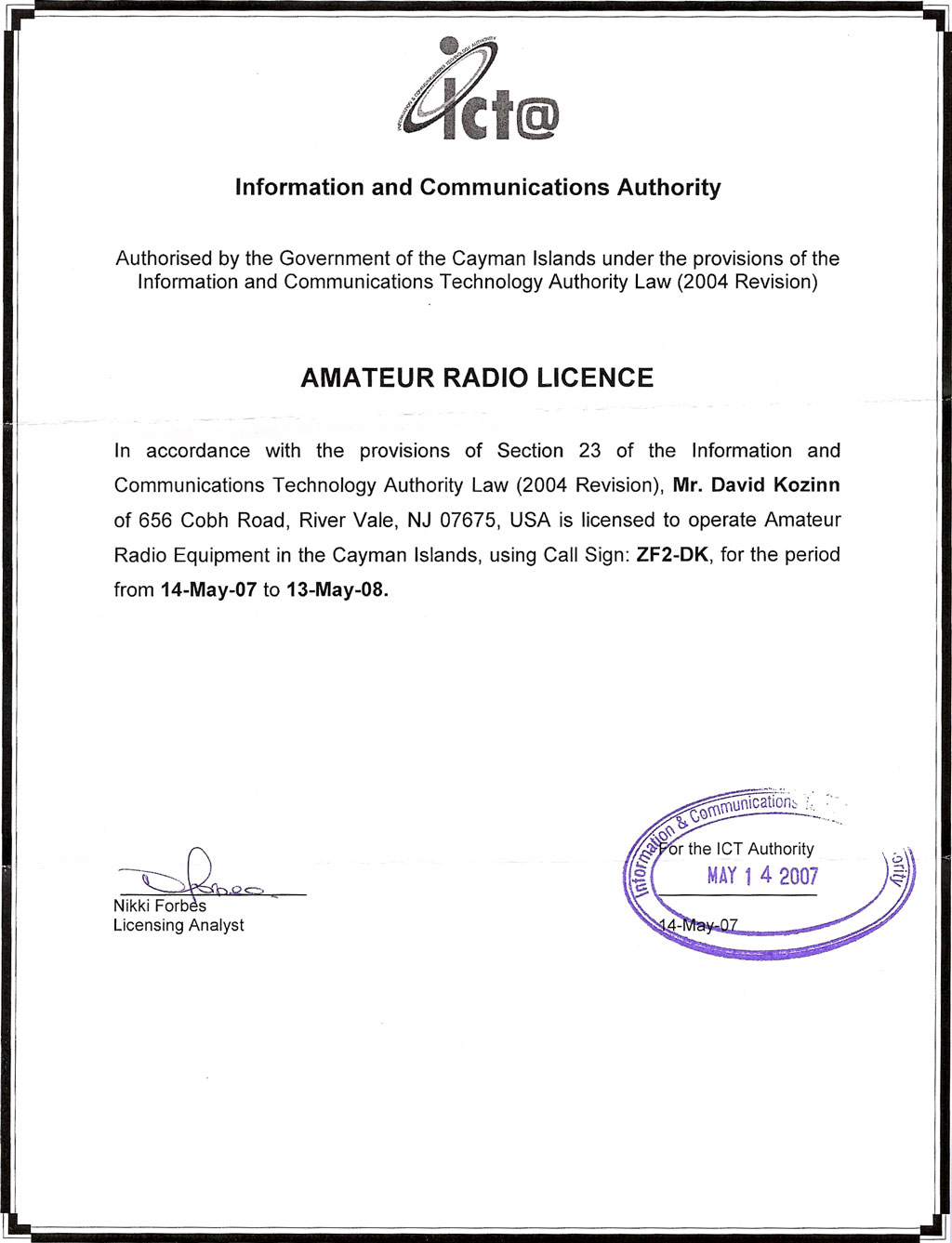 The reason why I realized that I had forgotten to pre-pack that was because I looked down, and there it was, sitting in front of my keyboard, where it's been sitting for a couple of months now, so that I, um, wouldn't forget it. It guess it had been sitting there for so darned long that I had ignored it. Oops again. Well, I've now made a couple of copies of the documents, and pre-packed them, as well as the originals.
As a side note, the reason that I mentioned the import permit is because there's apparently a law in the Cayman Islands that if you bring in your radio equipment, you need to have an import permit (which costs around USD$15). If you don't have that, I've been told by a couple of guys who've gone down there that you have to post bond equivalent to the value of the radio upon entry, which is returned to you when you leave with your equipment. I've also had one or two folks tell me that they've gotten in without the bond or the permit, but I figured that I'd avoid the hassle and paperwork by getting the permit in advance.
Back to pre-packing. Aside from those items that I didn't forget but were on the list, and those items that I did forget and weren't on the list (until now), things went pretty well. I have a very small number of items that are being left until the last minute, the only significant item being the radio
 itself, since it's in use right now. Either later today or tomorrow I'm going to pack that as well, and swap in a spare 2m rig that I normally use when doing a temporary mobile setup. The only downside is that if by some chance I have a little time to play around in the CQ WW VHF contest next week (which isn't likely; we have all-day plans for Saturday, and are leaving for Cayman on Sunday), I won't have a 2m all-band tranceiver. Oh well. The one really good piece of news is that all of the equipment takes up relatively little space, and is fairly light. Not including the radio (which will most likely be part of my carry-on so it won't count as part of my weight allowance for the flights), the bag weighs 18 pounds (about 8.2 kilos), so that won't break the weight budget. By the way, as I mentioned, this is not the final packing. This is just a bag that I thought I could fit most of my gear into. In the picture, you can see some of what I'm taking, like the power supply, feedline, some spare radial wire, some tie wraps, and even the "cheat sheet" for my '706 just in case I need to adjust some rarely-used setting.
Sunday, July 08, 2007
Buddistick Radials
Thanks to NE1RD for his explanation of what he uses for additional radials with his Buddistick. I borrowed his idea, and constructed 9 "add-on" radials for my Buddistick. (It was supposed to be ten, but while I was constructing the "harness" that the radials connect to one of the wires slipped out of the ring terminal while I was crimping it, so I wound up with nine. Ooops.)
Overall, the process went fairly well. I wanted to use spade terminal quick-disconnects, but I couldn't find any that were the actual correct size for the 26 AWG wire (from The Wireman, part #534) that I used. I wound up using some terminals that were for 16-22 AWG wire, and they seemed to work OK. I had to really crunch down on the crimps to make sure that the wires stay in place, but since there shouldn't be any mechanical stress on the wires, hopefully that won't be an issue. (I also learned why folks spend a few extra dollars and buy a racheting crimper rather than just using a relatively cheap "100% hand power" crimper. I only had to do about 30 crimps, and my hand is still sore 2 days later from applying the pressure.)
What you can see in the two pictures (you can click on the pictures to get a larger view) is that I've got the coax (which in this case is just connected to my Autek VA1RX antenna analyzer) connected (the thicker wire) along with about 5 of the extra radials, plus the regular buddistick radial wire. Until now, I'd done all my testing outside, usually with the antenna mounted anywhere from about 3 feet to around 7 feet above the ground. One of the reasons why I wanted to make these radials in the first place is because Scott mentioned in his blog that he often uses them from a balcony or other location where it can't get near real RF ground. For my upcoming trip, I'm not really sure exactly where the antenna will be set up, so I figured that for a few dollars and a little bit of time, I can make these radials up just in case I need them. (The nice thing about using that particular wire is that it's really, really light. According to their website, it weight less than a pound for 1000' of wire. I don't have anywhere near that much, so it adds very little to my overall equipment weight.)
Anyway, I figured that for testing purposes, instead of testing outside, I'd test inside the house, from our bedroom on the second floor, which is pretty much as far from ground as I can easily get in my house. My original intent was to mount the antenna on the outside of the window and run the radials inside. Unfortunately, my bedroom windows have no way to clamp the antenna outside anywhere near vertically, because of an overhanging roof. If I really had to operate from there, I probably could have come up with some way to mount things, but given that A) This was just a quick test, and B) It was about 95 degrees out, and I really didn't want to leave the window open all that long, I figured I'd just see if I could mount the antenna somewhere in the room.
That seemed like a good idea, but the antenna is pretty close to 8' long (and my ceilings are 8' high) when the whip is extended, so I found up putting the antenna on the floor, as seen in the picture, instead of "mounting" it anywhere. (I actually have the mini-tripod, so I could have used that instead of the clamp, and would have if I was going to leave it set up.) What I found after setting things up and tuning (which I do seem to be getting better at doing; and I highly recommend the use of an analyzer to do so) was that I got excellent SWR (1.2:1 at the target frequency) and it seems that the SWR range was a bit more broadbanded that with just the single Buddistick radial. I am still learning about antennas (aren't we all?) so I'm not sure if that is the expected result, but it did seem to work just fine, and, to paraphrase that famous setting, you can never be too rich, too thin, or have too good an RF ground.
Overall, the process went fairly well. I wanted to use spade terminal quick-disconnects, but I couldn't find any that were the actual correct size for the 26 AWG wire (from The Wireman, part #534) that I used. I wound up using some terminals that were for 16-22 AWG wire, and
 they seemed to work OK. I had to really crunch down on the crimps to make sure that the wires stay in place, but since there shouldn't be any mechanical stress on the wires, hopefully that won't be an issue. (I also learned why folks spend a few extra dollars and buy a racheting crimper rather than just using a relatively cheap "100% hand power" crimper. I only had to do about 30 crimps, and my hand is still sore 2 days later from applying the pressure.)
What you can see in the two pictures (you can click on the pictures to get a larger view) is that I've got the coax (which in this case is just connected to my Autek VA1RX antenna analyzer) connected (the thicker wire) along with about 5 of the extra radials, plus the regular buddistick radial wire. Until now, I'd done all my testing outside, usually with the antenna mounted anywhere from about 3 feet to around
 7 feet above the ground. One of the reasons why I wanted to make these radials in the first place is because Scott mentioned in his blog that he often uses them from a balcony or other location where it can't get near real RF ground. For my upcoming trip, I'm not really sure exactly where the antenna will be set up, so I figured that for a few dollars and a little bit of time, I can make these radials up just in case I need them. (The nice thing about using that particular wire is that it's really, really light. According to their website, it weight less than a pound for 1000' of wire. I don't have anywhere near that much, so it adds very little to my overall equipment weight.)
Anyway, I figured that for testing purposes, instead of testing outside, I'd test inside the house, from our bedroom on the second floor, which is pretty much as far from ground as I can easily get in my house. My original intent was to mount the antenna on the outside of the window and run the radials inside. Unfortunately, my bedroom windows have no way to clamp the antenna outside anywhere near vertically, because of an overhanging roof. If I really had to operate from there, I probably could have come up with some way to mount things, but given that A) This was just a quick test, and B) It was about 95 degrees out, and I really didn't want to leave the window open all that long, I figured I'd just see if I could mount the antenna somewhere in the room.
That seemed like a good idea, but the antenna is pretty close to 8' long (and my ceilings are 8' high) when the whip is extended, so I found up putting the antenna on the floor, as seen in the picture, instead of "mounting" it anywhere. (I actually have the mini-tripod, so I could have used that instead of the clamp, and would have if I was going to leave it set up.) What I found after setting things up and tuning (which I do seem to be getting better at doing; and I highly recommend the use of an analyzer to do so) was that I got excellent SWR (1.2:1 at the target frequency) and it seems that the SWR range was a bit more broadbanded that with just the single Buddistick radial. I am still learning about antennas (aren't we all?) so I'm not sure if that is the expected result, but it did seem to work just fine, and, to paraphrase that famous setting, you can never be too rich, too thin, or have too good an RF ground.
Thursday, July 05, 2007
Practice makes prefect, er, perfect
They say that practice makes perfect. I'm not sure that it makes perfect, but it does help you make fewer mistkakes mistakes.
I have read enough stories about folks going on trips where they've forgotten some key component that's needed to make their radio gear work. While Grand Cayman isn't exactly Scaffold Reef (there seem to be some electronics stores on the island, even a Radio Shack), I don't want to wind up running around for half a day to find a missing cable, especially one that won't be easy to find and that I've got sitting at home.
Over the weekend, I pulled out what I had expected to take to Cayman with me and set up a "station" on the patio table. I had created a spreadsheet (using Google Docs -- one nice advantage is that it's "always there", as long as I can get to the Internet) with the list of items that I needed and started going down the list and taking the items outside. I didn't take absolutely everything for this initial pass (I will do it again), but I did take what I expected to be the key components to construct my station. (Notably, I didn't take spare parts, like fuses, etc.)
Things went remarkably well for a first pass, but I did discover a few things: First, there was a particular extension cord that I'd planned to take with me, but I discovered that my son had appropriated it for use in his bedroom. Guess I'll need another one. Second, while setting my station up outside I discovered something very interesting. The LCD display on my Icom 706MkIIG is polarized. So are my sunglasses. Now, that's not necessarily a problem, but in this case it is. You may remember from your grade school science class that if you took took two polarized filters and turned them at right angles then placed one on top of the other, you can no longer see through them at all. In this case, it appears that my sunglasses are polarized one way and the display is polarized the other way. (Generally, filters seem to be polarized either horizontally or vertically). I never noticed this before because even though I've taken the radio on a couple of trips, I either had the radio inside or (before that) I had a different pair of non-polarized sunglasses.
This isn't really a big deal, but to me, the value of trying this out was to find something that would have been at least an annoyance. Now, I've got a solution, which is to bring along a cheap pair of non-polarized sunglasses.
I have read enough stories about folks going on trips where they've forgotten some key component that's needed to make their radio gear work. While Grand Cayman isn't exactly Scaffold Reef (there seem to be some electronics stores on the island, even a Radio Shack), I don't want to wind up running around for half a day to find a missing cable, especially one that won't be easy to find and that I've got sitting at home.
Over the weekend, I pulled out what I had expected to take to Cayman with me and set up a "station" on the patio table. I had created a spreadsheet (using Google Docs -- one nice advantage is that it's "always there", as long as I can get to the Internet) with the list of items that I needed and started going down the list and taking the items outside. I didn't take absolutely everything for this initial pass (I will do it again), but I did take what I expected to be the key components to construct my station. (Notably, I didn't take spare parts, like fuses, etc.)
Things went remarkably well for a first pass, but I did discover a few things: First, there was a particular extension cord that I'd planned to take with me, but I discovered that my son had appropriated it for use in his bedroom. Guess I'll need another one.
 Second, while setting my station up outside I discovered something very interesting. The LCD display on my Icom 706MkIIG is polarized. So are my sunglasses. Now, that's not necessarily a problem, but in this case it is. You may remember from your grade school science class that if you took took two polarized filters and turned them at right angles then placed one on top of the other, you can no longer see through them at all. In this case, it appears that my sunglasses are polarized one way and the display is polarized the other way. (Generally, filters seem to be polarized either horizontally or vertically). I never noticed this before because even though I've taken the radio on a couple of trips, I either had the radio inside or (before that) I had a different pair of non-polarized sunglasses.
This isn't really a big deal, but to me, the value of trying this out was to find something that would have been at least an annoyance. Now, I've got a solution, which is to bring along a cheap pair of non-polarized sunglasses.
Subscribe to:
Posts (Atom)