About a week from now, you'll be seeing all the Dayton Hamvention® post-event writeups. Due to work and life schedules, I've never had the opportunity to go there myself, but I've read the reports for each of the nine years that I've been a ham to see what I missed. With tongue firmly planted in cheek, I thought I'd get the jump on the writeups and do my own post-event posting before the event even started.
The trip out to Dayton was uneventful/unbelievably exciting as usual. We headed out early so that we we could visit the Air Force Museum, and on the way we passed a giant antenna farm. We got to the hotel and went to our usual restaurant, where we ran into a bunch of other hams.
The next day, we started walking the flea market. We couldn't believe how crowded/empty it was compared to previous years! Of course, it rained continuously/intermittently all afternoon. It was amazing to see the number of out-of-shape hams driving around in carts while eating bags of pork rinds. Using the outdoor "facilities" was an experience that I wouldn't wish on the worst lid.
We headed into the Hara Arena, which was as run-down as ever. We all agreed that they should just tear down the place and move the Hamvention® somewhere else, though of course after hours of arguments nobody could figure out exactly where that might be. Using the indoor "facilities" was an experience that I wouldn't wish on the worst lid.
The vendor exhibits inside the arena were really crowded/empty compared to last year, and a bunch of major vendors {didn't bother to even show up/surprised everyone with the new goodies on display}. We were disappointed that our favorite manufacturer wasn't willing to sell us their brand-new state-of-the-art rig for 90% off list price. We'll never deal with them again!
We ran into a bunch of DXing/contesting buddies and wound up heading out to dinner with them. After that, we went back to the hotel and visited a few of the suites, where we ran into more DXing/contesting buddies. We ate too much pizza, drank too much beer then headed back to the room.
The next morning, we headed back to the flea market where it rained some more and was really hot/cold. We saw a bunch of guys dressed oddly, and were annoyed at the non-ham stuff that was being sold, although we did pick up some nice potholders. We also saw a bunch of vehicles with enough antennas to make NASA jealous.
We attended a bunch of seminars which were all great, except the rooms were always too small and we had to stand next to a bunch of people who smelled bad. We attended the big dinner and it was great seeing all the famous hams in attendance.
The next day, we made one more pass through the flea market where it was still raining. We picked up 1000' of some kind of feedline really cheap, but wished we'd had one of those electric carts because we had to walk 2 miles, uphill, back to the car.
The trip back home took much longer than expected due to the horrible traffic. If only there was some form of communications that we could have used to communicate with all the other hams on the road!
Tuesday, May 12, 2009


Sunday, April 26, 2009
Things sure have been quiet lately
I decided to take a look at my log to see what might be of interest since my last update. Unfortunately, the answer has been “not much”. Unfortunately, I was never able to make a contact with VK9GMW from Mellish Reef, which was disappointing. I heard them a few times and tried to make contact, but just wasn’t able to do it. I did manage to work TI7KK who were operating from Islas Murcielago, the relatively rare IOTA NA-191. Thanks as always to Larry, N4VA, for letting me know that this was a rare one.
I did work a couple of new entities on 160m, KG4CN at Guantanamo Bay, and C6DX in the Bahamas. I don’t work a lot on 160m mainly because although my antenna will work (sort of) on that band, it doesn’t work very well. Those two entities bring my grand total to 10 entities worked on 160m. I don’t think I’ll be getting single-band DXCC anytime soon there.
I did notice one rather amusing thing while looking at my log: I worked 4L4WW in the country of Georgia, and the next contact I had was N4PN, in the state of Georgia.
One final thing is that I’ve started to participate in the “Ham Banner Exchange” that Fred, WB4AEJ has started. If you’re reading this on my blog website (as opposed to getting it via email or RSS feed), you’ll see a banner at the top of the page for another ham website. Fred has set this up for free as a way to encourage people to find other ham-related websites that might be of interest. The way this works is that you agree to display the different banners on your website, and in return, your banners are displayed on other websites. Again, it’s all free and I’ve already noticed an increase in web traffic to my sites. For more information, check out the FAQs and if you’re interested, you can sign up at the Ham Banner Exchange login page.
Saturday, April 04, 2009
Saturday Surprise
I got a nice surprise this afternoon while tuning around the bands. There are a couple of contests going on, but nothing I was participating in, and the only interesting DX that I was looking for was VK9GWM, the guys out on the rather rare Mellish Reef for a DXpedition. I hadn’t heard them today and was just starting to think that they’d might be showing up on 30m or 40m at around 2100Z or so. Meanwhile, I saw a spot for Chris, TL0A in the Central African Republic. Although I have worked many of the countries on the African continent, that’s one of the few that I haven’t worked, so I tuned to the 17m frequency from the spot but heard nothing. I left the radio on that frequency while I was doing some other work in my shack/office. A few minutes later, someone spotted that TL0A had moved to 20m on 14.200Mhz. I tuned there quickly, hoping to beat the crowds, and I got there just in time to hear a French-accented voice says “…210”. I didn’t know if he was working split (listening on 14210) or moving there, so I did what I always recommend: I listened.
It turned out that Chris had move to 14.210 and was working simplex there. I heard him complete a contact, and I called, but he pulled out another station. Still, nobody had spotted that he’d moved there, so I thought I still might have a chance to work him before the pileups began. He finished a brief contact, and I called him again. This time, he heard me and I was able to have a brief chat with him. Within a couple of minutes, he’d changed to working split and started getting spotted on the cluster. Listening to the pileups that followed, it was obvious that if I hadn’t gotten to him before he was spotted on his new frequency, there is no way that I would have made the contact.
The lesson here is that you have to be persistant and you have to listen.
On a totally unrelated note, thanks to Scot, KA3DRR for assigning me shackadelic number 007 … and he didn’t even know that I’m a James Bond fan!
Sunday, March 29, 2009
Catching up, take 3
I seem to have falling into one of those “I really should post something soon … maybe tomorrow” ruts again, and as a result, have gotten a bit behind. I haven’t been on the radio all that much, but I did do a few things of note.
Last weekend was the Virginia QSO party. The band conditions weren’t very good, but I did manage to make 162 contacts in 68 different counties or Independent Cities (something that i think is unique to Virginia) for a total claimed score of 15,232 points. Not my best effort (I had 195 contacts last year), but I think that I did pretty well considering the time spent and considering the band conditions. I had a lot of fun during the last hour or so of the contest because I was able to hold onto a pretty clear “run” frequency on 75 meters and worked about 25 or 30 station over about 40 minutes. I’ve discussed this before, but by way of explanation, in most contests, you either “search & pounce” (S&P) or “run”. Most stations spend their time doing S&P because there are usually far more stations in a contest than there are available frequencies. When you’re running a relatively low-powered station it’s easier just to tune up and down the bands and contact the stations that are “running”. Running means that you stay on a single frequency and work the S&P folks as they come to you. In most cases, it’s best to be running, since if you’ve got a clear frequency and a decent signal, you can just sit there and work station after station pretty much as fast as you can make the contacts. When you S&P, you often have to wait for other stations (who are trying to contact a “run” station), and it’s usually a lot slower. Getting a decent run frequency can be pretty difficult, and I think I just got lucky. I can say that it’s way more fun to run than to S&P.
The only other interesting thing was that I managed to work the Lord Howe Island Dxpedition (VK9LA) on Sunday afternoon. Lord Howe Island is fairly rare, and is a new DXCC entity for me, so I was very pleased to work them. I’ve tried a couple of mornings at around 8AM local time (1200Z) to work them on 30m, but wasn’t having much luck. I was home Sunday afternoon doing some paperwork (tax time!) and intermittently looking at the cluster spots to see if VK9LA was showing up. At around 2000Z, I started to hear them on 20m, and based on information from the spots on the cluster plus propagation predictions from W6ELProp it looked like the path to the VK9LA guys was long path. Long path means that the signals are taking the path that’s 180 degrees opposite the shortest path around the globe to a station. Short path to LHI is about 9450 miles (15200km), and long path is 15,400 miles (24800km). It’s likely that I’ve worked stations long-path in that part of the world before, but I certainly haven’t done so recently with the band conditions so terrible. I tried to work them for a while, but just wasn’t having any success, so I took a break for a short while (jumped on the exercise bike) and came back to the radio a bit before 2100Z and after about 15 minutes I managed to work them.
Friday, March 13, 2009
IRCs
I discovered something today about International Reply Coupons, or IRCs that has an interesting tie-in with one of the big news stories of the day. First, some background about what an IRC is, and why they are of interest to hams.
Although electronic systems such as the ARRL’s Logbook of The World and eqsl.cc provide a computerized way for hams to confirm contacts with each other (a contact is known as a QSO, a confirmation of that contact is a QSL), many of us still enjoy receiving a physical memento of the contact in the form of a QSL Card. Most hams have their own QSL card, which can vary from a “stock” card with the only customization being the unique callsign assigned to that ham all the way to multi-part tri-fold full-color cards. Often hams will use different QSL cards when operating from different locations, which I do when I operate from various places other than my home location. When requesting a QSL card from someone, it’s considered courteous to supply return postage, particularly if the station contacted is particularly rare or is likely to have to send out a lot of QSL cards for any reason. (There are plenty of exceptions to this, and while personally I appreciate it when someone includes return postage when requesting a card from me, I don’t usually don’t care that much if they don’t since I don’t send out that many cards that it’s a problem.)
If you’re sending a card to someone in the same country (in my case, in the US), the return postage is usually in the form of a Self-Addressed Stamped Envelope (or SASE). It gets more difficult when crossing country borders. A US stamp simply isn’t valid on an envelope coming back to me from any other country, so the options are to buy foreign stamps or to include some way for the other station to purchase the stamps in their country. I’m not going to go into all the pros and cons of the various methods (I’ll save that for another time), but it turns out that the International Postal Union (IPU) recognized this as as problem a very long time ago.
The issue originally came up unrelated to ham radio, where businesses wanted to be able to get a mail reply from someone in a foreign country. What they came up with is something called an International Reply Coupon (IRC). An IRC can be purchased from a post office in a country that’s a member of the IPU (which is most countries) for some set price, which varies by country. It can be exchanged in any other country for postage sufficient to send a letter via airmail. The price of IRCs varies from country to country, and the costs are also relative to world currency values. In some countries, it’s fairly inexpensive to purchase an IRC, while in others, it’s quite expensive. The cost for an IRC also doesn’t necessarily match the price of an airmail stamp in the country. For example, at the present time, the cost to buy an IRC from the US Postal Service is $2.10, but an airmail stamp is currently $0.94, so there’s quite a premium.
It turns out that it’s perfectly legal to purchase an IRC in a country where they are relatively cheap and to turn them in for stamps in a country where the value of the airmail postage is more than what was paid for the IRC in the first place. This is known as arbitrage and is commonly done in financial circles (though usually not specifically with IRCs). However, many hams simply use the IRCs they receive as their own form of currency, passing along a received IRC to someone else with the idea that they really just want to get that QSL card and aren’t trying to make money.
But there was someone who decided that this would be a fine way to make money quite a long time ago, and that’s where the tie-in to the news of the day begins. The person in question was Charles Ponzi, for whom the infamous Ponzi scheme was named. The articles that I’ve linked to here have a comprehensive explanation of what he did, but in a nutshell, Ponzi started off by buying relatively inexpensive IRCs in Italy and turning them in for stamps in the US, making a very significant profit. This was all legal, until he decided that he could make far more money by simply getting investors to give him cash to (in theory) buy more IRCs which would produce huge profits for the investors after the IRCs were sold. The problem is that Ponzi never actually bought or sold the IRCs, and managed to convince his investors to leave their profits with him. He told them they were making lots of money, while in reality the only one who really made money (aside from a few of his very early investors; read the articles to understand why) was Ponzi himself.
This brings us to a courtroom in New York City on the 12th of March, 2009, where Bernard Madoff pled guilty to running what will almost certainly turn out to be one of the biggest Ponzi schemes of all time, costing investors at least $50 billion.
And that’s how we get a rather convoluted link between one of the biggest swindlers of all time and ham radio.
Saturday, February 28, 2009
Back to DX
It’s been a few weeks since my last update, and in the interim, I’ve moved my radio focus back from earning the Triple Play Award to working DX. As most DXers know by now, a Dxpedition to the very rare Desecheo Island was on the air for around two weeks as K5D, and I was fortunate enough to make quite a number of contacts. The contacts (all showing up in their online QSL log) were:
| 160 | 80 | 40 | 30 | 20 | 17 | 15 | |
| Phone | X | X | X | X | X | ||
| CW | X | X | X | X | X | ||
| RTTY | X | X |
My first contact with them was on 40m phone barely 12 hours after the operation started. While I’d expected to make a few contacts at some point towards the end of the operation, I hadn’t expected to make contact so soon. But, as a number of my friends told me, even with the huge global pileups Desecheo, which is just a few miles from Puerto Rico, is a “chip shot” from my home. That did turn out to be the case. My goal was to make at least one contact on each of the three modes, and to work them on at least once on each band where I could hear them.
I tried to be a good “ham radio citizen”, so while I did work pretty hard to get each of the modes, and to make a single contact on each band, I did hold off a bit on the bands where I’d already made a contact (to work them on a new mode) until later during the dxpedition when the pileups had died down considerably. I hope that by doing this I allowed others to make perhaps the only contact they had. That being said, when the station isn’t busy, I’ll certainly try to work them. I did wind up with one duplicate contact (75m phone) since when trying to make my contact a couple of guys decided to have a rag-chew essentially right on top of the K5D station and I wasn’t sure that K5D had correctly logged my call. I tried again a few minutes later and that contact was definitely OK, and it turned out that both contacts showed up in the K5D online log.
I am very pleased to have made a 160m (or “Top Band”) contact with them. I don’t have a real antenna for 160m, and although my G5RV does load with the tuner, it neither transmits nor receives very well. However, my persistence paid off, and after five or six nights, trying for an hour or so each night (perhaps even longer than that), just a day or so before they ceased operations, the 160m was very quiet and I did manage to make a contact with them.
On a final note, I did receive my Triple Play Award certificate this week:

Tuesday, February 10, 2009
Triple Play Award #152!
I did it! I made and confirmed all 150 needed contacts for the ARRL's Triple Play Award! I applied for the award yesterday morning and got confirmation via the Logbook of the World system last night that I'd received the 152nd Triple Play Award. (The awards are serialized, so it's pretty nice to have such a low number.) They've published the list of awards handed out in numerical order on the awards page, and it's really fun to watch folks who you've been contacting start to show up on the list.
Like contesting, this is a cooperative effort. No matter how good you are, no matter how big your station is, no matter where you're located, you can't make contacts on your own. Sure, there are things like the K3UK LoTW Sked Room (click on LoTW in the menu) and the "hangout" frequencies (3.618Mhz at night, around 14.290Mhz +/- during the day) that are great tools to get folks together, but without the people helping each other, the award would be impossible to achieve. Also, as I previously mentioned, the bands might not be quite as bad as some say they are. All of these contacts were made using 100watts to a G5RV antenna at about 35 feet (10.5m).
Below is the list of the folks with whom I made the officially credited contacts, but this list doesn't tell the whole story: There are others who tried to make a contact with me but were unable to do so (despite valiant efforts), and others who made contacts with me who don't show up here because someone else confirmed the contact first. I am equally grateful to all of them, and I am also proud to know that I've helped some of them (as well as others) on their way to the award.
Like contesting, this is a cooperative effort. No matter how good you are, no matter how big your station is, no matter where you're located, you can't make contacts on your own. Sure, there are things like the K3UK LoTW Sked Room (click on LoTW in the menu) and the "hangout" frequencies (3.618Mhz at night, around 14.290Mhz +/- during the day) that are great tools to get folks together, but without the people helping each other, the award would be impossible to achieve. Also, as I previously mentioned, the bands might not be quite as bad as some say they are. All of these contacts were made using 100watts to a G5RV antenna at about 35 feet (10.5m).
Below is the list of the folks with whom I made the officially credited contacts, but this list doesn't tell the whole story: There are others who tried to make a contact with me but were unable to do so (despite valiant efforts), and others who made contacts with me who don't show up here because someone else confirmed the contact first. I am equally grateful to all of them, and I am also proud to know that I've helped some of them (as well as others) on their way to the award.
| Entity | CW | Phone | Digital |
|---|---|---|---|
| Alabama | KC4HW | K4AB | WX4TM |
| Alaska | AL1G | AL1G | NL7V |
| Arizona | K6LL | K9WZB | W9NGA |
| Arkansas | W5QP | N5ZM | WB5AAA |
| California | K6RB | K6FW | W6YX |
| Colorado | K0EU | W0KIT | KT0DX |
| Connecticut | W2JU | NN1N | K1ZZ |
| Delaware | K1RY | WW3DE | K1RY |
| Florida | N4BP | WT4Y | N4AOE |
| Georgia | WF4W | K4KV | WB4MAK |
| Hawaii | AH6RR | NH7O | KH6MB |
| Idaho | W7ZRC | KC7KZ | N7ESU |
| Illinois | KK9H | N2BJ | N7US |
| Indiana | K9WX | KB9AX | AC9X |
| Iowa | N0NI | K0NO | K0WHV |
| Kansas | AB0S | WV0T | K0FJ |
| Kentucky | KS4V | AB4IQ | AB4IQ |
| Louisiana | KF5ER | W5RI | K5JRW |
| Maine | K1LOG | K1LOG | AC1O |
| Maryland | K3WI | KR3E | K3WI |
| Massachusetts | W1TO | K1YA | K1JE |
| Michigan | K8MAD | N8FV | W8RIT |
| Minnesota | K0TG | K0TI | AA0AW |
| Mississippi | WQ5L | KE5MOZ | NA5DX |
| Missouri | K0OU | KU0G | N0HIO |
| Montana | KB7Q | K7BG | KE7X |
| Nebraska | N0OB | N0OB | WN0L |
| Nevada | NX7F | NX7F | N7TR |
| New Hampshire | K1DG | K1DG | K1RO |
| New Jersey | W2YC | K2DLS | KR2D |
| New Mexico | N2IC | WA0SXV | WA5ZUP |
| New York | NP3D/W2 | N2WK | K2PAL |
| North Carolina | W4KAZ | N4HN | K4FX |
| North Dakota | W0TUP | W0TUP | W0TUP |
| Ohio | K8AJS | W8CZN | W8HF |
| Oklahoma | K5UV | W5IF | NX5O |
| Oregon | N6TW | K7ZS | N7QU |
| Pennsylvania | K3SV | W3KB | W3TNU |
| Rhode Island | K3IU | N1HRA | KI1G |
| South Carolina | N3ZL | K4JPG | K4RW |
| South Dakota | KD0S | KE0WM | K7RE |
| Tennessee | W9WI | K4EDI | WA4OSD |
| Texas | WO5I | NV5H | N5NA |
| Utah | K7UA | WA7YAZ | WA7YAZ |
| Vermont | K1IB | K1LPS | K1LPS |
| Virginia | K1KO | KJ4DHF | NU3H |
| Washington | W7OM | W7VP | W7VXS |
| West Virginia | AJ1M | AJ1M | W8AKS |
| Wisconsin | K9IMM | WW9R | AA9RR |
| Wyoming | WY7FD | WY7FD | WY7FD |
Monday, February 02, 2009
More about the Triple Play Award
I'm not quite sure how many contacts I had toward the Triple Play Award that I discussed last week, but I've made some nice progress since then. In fact, as I write this late Sunday night (or rather, early Monday morning), according to the Awards page within Logbook of the World, I need only a handful of contacts to complete the award. The "slots" left are:
Although I mentioned it last week, what's really struck me is how incredibly helpful and friendly everyone has been. People will gladly move to another band or mode when asked if you need a contact, and it's certainly contagious. I don't think I've heard anyone yet say that they wouldn't accomodate a fellow award-seeker with the possible exception of asking them to wait a few minutes while another contact is completed.
What I think is really special is that many of the folks who've already received their awards (you can see the current list on the ARRL's Awards page) still hang around to "give out" their state to others. Some have even posted information about their TPA efforts on their web site, like this one from Tom, N9DD which has pictures of the some of the folks that he's met along the way, including yours truly.
The award has served as a focal point for a informal community of hams, and I find that very gratifying. As I've mentioned in the past, I see ham radio as a way to relax and have fun, and it's really great having a new bunch of friends to "hang out" with.
So, as I mentioned last time, why not drop by 3.618 LSB most evenings and say hello (and it's looking like 14.290 or 14.292 USB is becoming the daytime "hangout"). You might just be that #150 that someone needs.
Oh yeah ... if you happen to be located in any of the states that I've mentioned, please drop me a line or leave a comment ... I'd really like to work you so that I can finish up my award!
Update: The South Dakota confirmation did come through, so I now have 9 left to go.
- CW: Hawaii, Kansas, Louisiana, South Dakota
- Phone: Idaho, Kansas, Utah, Wyoming
- Digital: Hawaii, Utah
Although I mentioned it last week, what's really struck me is how incredibly helpful and friendly everyone has been. People will gladly move to another band or mode when asked if you need a contact, and it's certainly contagious. I don't think I've heard anyone yet say that they wouldn't accomodate a fellow award-seeker with the possible exception of asking them to wait a few minutes while another contact is completed.
What I think is really special is that many of the folks who've already received their awards (you can see the current list on the ARRL's Awards page) still hang around to "give out" their state to others. Some have even posted information about their TPA efforts on their web site, like this one from Tom, N9DD which has pictures of the some of the folks that he's met along the way, including yours truly.
The award has served as a focal point for a informal community of hams, and I find that very gratifying. As I've mentioned in the past, I see ham radio as a way to relax and have fun, and it's really great having a new bunch of friends to "hang out" with.
So, as I mentioned last time, why not drop by 3.618 LSB most evenings and say hello (and it's looking like 14.290 or 14.292 USB is becoming the daytime "hangout"). You might just be that #150 that someone needs.
Oh yeah ... if you happen to be located in any of the states that I've mentioned, please drop me a line or leave a comment ... I'd really like to work you so that I can finish up my award!
Update: The South Dakota confirmation did come through, so I now have 9 left to go.
Tuesday, January 27, 2009
The ARRL Triple Play Award
Not long ago, the ARRL announced new award called the "Triple Play Award". The info at the link gives all the details, but the concept is simple: Work all 50 US states on CW, Phone, and Digital (RTTY, PSK, etc.) starting on January 1. All contacts must be confirmed via the ARRL Logbook of The World. To be honest, when I first heard this, my reaction was "well, that's nice, but I'm not that interested in working non-DX stations, and it'll take me forever to work that many stations on all those modes".
But that was before I wound up with over 400 contacts during the ARRL RTTY Roundup and more than 250 contacts in the CW North American QSO Party (NAQP) . I realized at that point that I'd had about 45 or so states confirmed on RTTY, and close to that many confirmed on CW. I picked up a few states on sideband during the SSB version of the NAQP, and realized that I actually had a pretty good number of the 150 required contacts already confirmed.
Andy, K3UK, set up a "sked" (schedule) page on his website (click "LoTW" at the top of the page) where hams trying to find different states could meet to arrange contacts easily, and there has been a decent group of folks there each day for the last couple of weeks. During the evening hours, 3.618Mhz (LSB) has been a kind of on-air meeting place. I started out by "lurking"; just reading the messages posted or listening to the chatter on-air and occasionally making a contact. The real fun started when, after I'd work some station that I needed I'd have another station call because they actually need a contact from New Jersey!
Ok, in case it's not obvious, New Jersey isn't exactly considered even remotely rare, or usually even very interesting, for the purposes of most ham radio awards. However, because the Triple Play Award (or TPA, as the guys on the sked page have been calling it) is so new, lots of folks still need a contact with New Jersey. While I haven't exactly been trying to work giant pileups, I have been "giving out" New Jersey to more and more folks. It's just plain fun to be able to help someone else earn their awards, and, while "hanging out", I've managed to pick up a few of the tougher states myself.
As I was writing this entry, I managed to work WY7FD on both RTTY and CW modes on 80m. As of now, that means that the only states with which I haven't made any contacts for TPA are Hawaii and Utah. I've worked both of those states in the past, so the trick now is to find a time and place to work a station who'll be uploading his log to Logbook of the World.
Speaking of Logbook of the World, because all contacts for this award have to be confirmed through LoTW, you get nearly instant (in relative terms) gratification when you work someone. Most of the folks trying to get the award upload their logs at least once per day (and some appear to do it even more often), so you usually know for certain that you're "in the log" very quickly. Don't get me wrong: I still like getting paper QSL cards, but for an award like this it's really fun just seeing how fast the contacts are confirmed.
One more quick thing: I have to say that it's been wonderful how friendly and accomodating folks have been in helping each other make contacts. Most folks will gladly change modes or bands to help out someone looking for a particular state. It's not that hams aren't friendly in general, but it just seems like my fellow TPA award seekers are really going out of their way to help out.
If you haven't done so yet, why not stop by the K3UK chat room and join a bunch of us on 3.618 each evening?
But that was before I wound up with over 400 contacts during the ARRL RTTY Roundup and more than 250 contacts in the CW North American QSO Party (NAQP) . I realized at that point that I'd had about 45 or so states confirmed on RTTY, and close to that many confirmed on CW. I picked up a few states on sideband during the SSB version of the NAQP, and realized that I actually had a pretty good number of the 150 required contacts already confirmed.
Andy, K3UK, set up a "sked" (schedule) page on his website (click "LoTW" at the top of the page) where hams trying to find different states could meet to arrange contacts easily, and there has been a decent group of folks there each day for the last couple of weeks. During the evening hours, 3.618Mhz (LSB) has been a kind of on-air meeting place. I started out by "lurking"; just reading the messages posted or listening to the chatter on-air and occasionally making a contact. The real fun started when, after I'd work some station that I needed I'd have another station call because they actually need a contact from New Jersey!
Ok, in case it's not obvious, New Jersey isn't exactly considered even remotely rare, or usually even very interesting, for the purposes of most ham radio awards. However, because the Triple Play Award (or TPA, as the guys on the sked page have been calling it) is so new, lots of folks still need a contact with New Jersey. While I haven't exactly been trying to work giant pileups, I have been "giving out" New Jersey to more and more folks. It's just plain fun to be able to help someone else earn their awards, and, while "hanging out", I've managed to pick up a few of the tougher states myself.
As I was writing this entry, I managed to work WY7FD on both RTTY and CW modes on 80m. As of now, that means that the only states with which I haven't made any contacts for TPA are Hawaii and Utah. I've worked both of those states in the past, so the trick now is to find a time and place to work a station who'll be uploading his log to Logbook of the World.
Speaking of Logbook of the World, because all contacts for this award have to be confirmed through LoTW, you get nearly instant (in relative terms) gratification when you work someone. Most of the folks trying to get the award upload their logs at least once per day (and some appear to do it even more often), so you usually know for certain that you're "in the log" very quickly. Don't get me wrong: I still like getting paper QSL cards, but for an award like this it's really fun just seeing how fast the contacts are confirmed.
One more quick thing: I have to say that it's been wonderful how friendly and accomodating folks have been in helping each other make contacts. Most folks will gladly change modes or bands to help out someone looking for a particular state. It's not that hams aren't friendly in general, but it just seems like my fellow TPA award seekers are really going out of their way to help out.
If you haven't done so yet, why not stop by the K3UK chat room and join a bunch of us on 3.618 each evening?
Sunday, January 11, 2009
The bands are better than you think
Ok, we all know that the bands have been in pretty poor shape for the last few years. Everyone is complaining about how there's nothing to work. At least some people who wanted to get into the hobby, or back into it, aren't bothering, as shown by this quote from the solarcycle.com forum:
But are things really that bad? They are certainly worse than they were at the peak of the solar cycle, but I submit that there is still a lot to do on the radio. Better than just using my gut feeling, I took a look at my log starting about 18 months ago, in July 2007. I wanted to pick a starting point that was clearly close to the bottom of the the trough of Solar Cycle 23.
 What I did was to configure my log as if I'd just gotten on the radio on the first of July, 2007, and pulled some reports for things like DXCC, WAZ, and WAS to see what I'd have if I'd only had these last 18 months on the air. I think that what I found may surprise you.
First, keep in mind that all my contacts have been made from my home station: An Icom 756 Pro II running 100 watts into a G5RV antenna up at about 35 feet (10.7 meters). No amps, no beams. Most of my operating is casually "chasing DX" or operating contests for fun. Because when I was working these stations, I wasn't explicitly trying to earn an award only from that point forward, so there are probably some "easy" countries that I haven't bothered to work during that period, since I'd already worked them prior to that time. Given all that, let's see what I've got.
First, we'll look at DXCC: Over the last 18 months, I've worked 168 DXCC entities as "mixed" (combined phone, CW, and digital), with 118 on phone, 131 CW, and 83 on digital (primarily RTTY, with a little PSK thrown in there and there.) Although the numbers on the higher bands (10m through 17m) aren't great, I worked 134 on 20m, 122 on 40m, and 59 on 75/80m. Here's something to think about: At this point in the solar cycle, working the lower bands, like 80m (and even 160m, though I don't work 160m much myself) is better than when the solar activity is better. Overall, I worked close to 500 "band/countries". (Each time you work a county on a different band, it counts as a "band/country", so, for instance, I've worked Laos on 3 different bands during this period, so that counts as 3 band/countries).
Perhaps what's even more interesting than just working the 168 entities is that there's a good number of what could be considered rare or semi-rare entities in there. I went through the list and wanted to mention some that I thought were interesting from my location on the east coast of the US.
The point here is that there has been plenty of not-just-routine DX to work over the last 18 months, despite the conditions.
Let's look at another award, the Worked All Zone (WAZ) award that depends on good conditions for DX. Over the same period of time, I worked 35 out of the available 40 zones, which are located all over the world.
Closer to home, over that same 18 month period, I worked all 50 US states, with 50 on phone, 49 on CW, and 50 on digital (again, mostly RTTY). Again, the lower bands have been best, with 42 states on 20m, 48 on 40m, and 43 on 75/80m. (I even worked 11 states on 160m!) Again, the point is that there is plenty plenty to do.
My conclusion is that those two guys who didn't think that it was worth getting back into radio were wrong. There are still plenty of stations to work, and plenty to do on the radio. I've only touched the tip of the iceberg here. There are folks who try to work US counties, Islands, Lighthouses, museum ships, and much more. They are all on the air, making contacts every day. There's plenty to do on the air, but it does require that you turn on the radio. Stop complaining on the Internet. Use your radio. Trust me, you'll be a lot happier.
Two of my neighbors had talked of getting back in to Ham radio as they had done as kids, but their wives made them check out conditions first before they buy...and it looks like they are looking for a new hobby.
But are things really that bad? They are certainly worse than they were at the peak of the solar cycle, but I submit that there is still a lot to do on the radio. Better than just using my gut feeling, I took a look at my log starting about 18 months ago, in July 2007. I wanted to pick a starting point that was clearly close to the bottom of the the trough of Solar Cycle 23.
What I did was to configure my log as if I'd just gotten on the radio on the first of July, 2007, and pulled some reports for things like DXCC, WAZ, and WAS to see what I'd have if I'd only had these last 18 months on the air. I think that what I found may surprise you.First, keep in mind that all my contacts have been made from my home station: An Icom 756 Pro II running 100 watts into a G5RV antenna up at about 35 feet (10.7 meters). No amps, no beams. Most of my operating is casually "chasing DX" or operating contests for fun. Because when I was working these stations, I wasn't explicitly trying to earn an award only from that point forward, so there are probably some "easy" countries that I haven't bothered to work during that period, since I'd already worked them prior to that time. Given all that, let's see what I've got.
First, we'll look at DXCC: Over the last 18 months, I've worked 168 DXCC entities as "mixed" (combined phone, CW, and digital), with 118 on phone, 131 CW, and 83 on digital (primarily RTTY, with a little PSK thrown in there and there.) Although the numbers on the higher bands (10m through 17m) aren't great, I worked 134 on 20m, 122 on 40m, and 59 on 75/80m. Here's something to think about: At this point in the solar cycle, working the lower bands, like 80m (and even 160m, though I don't work 160m much myself) is better than when the solar activity is better. Overall, I worked close to 500 "band/countries". (Each time you work a county on a different band, it counts as a "band/country", so, for instance, I've worked Laos on 3 different bands during this period, so that counts as 3 band/countries).
Perhaps what's even more interesting than just working the 168 entities is that there's a good number of what could be considered rare or semi-rare entities in there. I went through the list and wanted to mention some that I thought were interesting from my location on the east coast of the US.
| 1A0 | Sov. Military Order of Malta |
| 3B7 | Agalega & St. Brandon |
| 3V | Tunisia |
| 3X | Guinea |
| 5H | Tanzinia |
| 5N | Nigeria |
| 5T | Mauritania |
| 6W | Senegal |
| 7Q | Malawi |
| 7X | Algeria |
| 9L | Sierra Leone |
| 9Q | Dem. Rep. of the Congo |
| 9X | Rwanda |
| C3 | Andorra |
| C5 | Gambia |
| CE0Y | Easter Island |
| CY0 | Sable Island |
| D2 | Angola |
| E4 | Palestine |
| EL | Liberia |
| FO/M | Marquesas Islands |
| FO0 | Clipperton Island |
| FR | Reunion |
| FW | Wallis & Futuna Island |
| HK0 | San Andres & Providencia |
| JX | Jan Mayen |
| OY | Faroe Islands |
| S7 | Seychelles |
| TI9 | Cocos Island |
| VK9W | Willis Island |
| VP6 | Pitcairn Island |
| VP6/D | Ducie Island |
| XF4 | Revilla Gigedo |
| XW | Laos |
| ZC4 | UK Sovereign Bases on Cyrprus |
The point here is that there has been plenty of not-just-routine DX to work over the last 18 months, despite the conditions.
Let's look at another award, the Worked All Zone (WAZ) award that depends on good conditions for DX. Over the same period of time, I worked 35 out of the available 40 zones, which are located all over the world.
Closer to home, over that same 18 month period, I worked all 50 US states, with 50 on phone, 49 on CW, and 50 on digital (again, mostly RTTY). Again, the lower bands have been best, with 42 states on 20m, 48 on 40m, and 43 on 75/80m. (I even worked 11 states on 160m!) Again, the point is that there is plenty plenty to do.
My conclusion is that those two guys who didn't think that it was worth getting back into radio were wrong. There are still plenty of stations to work, and plenty to do on the radio. I've only touched the tip of the iceberg here. There are folks who try to work US counties, Islands, Lighthouses, museum ships, and much more. They are all on the air, making contacts every day. There's plenty to do on the air, but it does require that you turn on the radio. Stop complaining on the Internet. Use your radio. Trust me, you'll be a lot happier.
Monday, January 05, 2009
Antenna Modeling
Terry, WX7S, is posting a series of article on his blog about antenna modeling. There are already numerous resources that cover this topic, but I like Terry's approach of breaking things down into pretty short topics. The information is great, but there isn't so much of it all at once that your eyes glaze over. The series is available on his blog, here's a link to the first post. You can find the entire series (and more) by clicking on the Antenna Modeling Category heading on his blog.
Tuesday, December 30, 2008
Loose ends
Once again I've gotten a bit behind in posting, but I do have a few minutes and wanted to mention a few things.
I received three envelopes from the W2 QSL bureau recently. A lot of the cards were for "routine" QSOs, but there were a handful of "goodies", including a bunch of new countries confirmed on 75/80m. That brings my total for 80m to 82 confirmed, and I've got nearly another 40 above that worked, so I'll soon have enough confirmations for the 5-Band DXCC award. I'll actually have enough for 5BDXCC plus a couple of other endorsements for single bands, since I'll then have 100 or more contacts confirmed on all bands from 10m through 80m, except for 30m (and 60m, which I don't use and which doesn't count for DXCC purposes.) In looking up my stats, I realized that I've also got far more than 100 just on CW mode, and I only need 6 more confirmations on RTTY/Digital for single mode there. It's nice to make progress, even with the bands so bad lately, though since I haven't done a a DXCC submission in a while it's probably going to be pretty darn expensive when I finally do.
Along with the bureau cards for my regular K2DBK call, I also got a handful of cards for my ZF2DK operation about 18 months ago. I had to print up some more cards (on postcard stock on my inkjet printer) since I'd only printed a fairly limited number of them originally and had run out. It wasn't too hard to do, but I did wind up trying to remember/figure out how to feed the card stock through the printer so that the picture and the text were printed "rightside-up" relative to each other. Well, I tried to do that, and still managed to print two sheets of cards with the printing on the back "upside down". Oh well, the card will still count just the same. And I got to use my nifty "QSO confirmed by K2DBK" stamp that I picked up from W9XR a while back.
In other news, I've got a couple of possible trips coming up this summer. One will be "hamcation", which is to say that I plan to go and operate a significant amount. I'm working out the details, but one possibility would be to go down to the US Virgin Islands, particularly St. Croix, and operate from there. (Ok, I might take a break to check out the beaches and do a little snorkeling now and then.) I may be able to bring along my son Justin, KC2MCS with me. (He's agreed to upgrade to at least a General class license, and possibly Extra, so that he can join me.)
The other trip is more of a vacation with some ham radio thrown in, similar to my try to Grand Cayman. The current thinking is that we might go to Costa Rica (TI) and I'd operate in my spare time there. More on both of these trips when the plans firm up.
On a final note, related to the two possible upcoming trips, I'd like to remind my readers about my DX Publicity Contacts Page where I've collected various sources that are good to notify if you're going to be operating as DX. Please let me know if you've got any updates or additions to that page.
I received three envelopes from the W2 QSL bureau recently. A lot of the cards were for "routine" QSOs, but there were a handful of "goodies", including a bunch of new countries confirmed on 75/80m. That brings my total for 80m to 82 confirmed, and I've got nearly another 40 above that worked, so I'll soon have enough confirmations for the 5-Band DXCC award. I'll actually have enough for 5BDXCC plus a couple of other endorsements for single bands, since I'll then have 100 or more contacts confirmed on all bands from 10m through 80m, except for 30m (and 60m, which I don't use and which doesn't count for DXCC purposes.) In looking up my stats, I realized that I've also got far more than 100 just on CW mode, and I only need 6 more confirmations on RTTY/Digital for single mode there. It's nice to make progress, even with the bands so bad lately, though since I haven't done a a DXCC submission in a while it's probably going to be pretty darn expensive when I finally do.
Along with the bureau cards for my regular K2DBK call, I also got a handful of cards for my ZF2DK operation about 18 months ago.
 I had to print up some more cards (on postcard stock on my inkjet printer) since I'd only printed a fairly limited number of them originally and had run out. It wasn't too hard to do, but I did wind up trying to remember/figure out how to feed the card stock through the printer so that the picture and the text were printed "rightside-up" relative to each other. Well, I tried to do that, and still managed to print two sheets of cards with the printing on the back "upside down". Oh well, the card will still count just the same. And I got to use my nifty "QSO confirmed by K2DBK" stamp that I picked up from W9XR a while back.
In other news, I've got a couple of possible trips coming up this summer. One will be "hamcation", which is to say that I plan to go and operate a significant amount. I'm working out the details, but one possibility would be to go down to the US Virgin Islands, particularly St. Croix, and operate from there. (Ok, I might take a break to check out the beaches and do a little snorkeling now and then.) I may be able to bring along my son Justin, KC2MCS with me. (He's agreed to upgrade to at least a General class license, and possibly Extra, so that he can join me.)
The other trip is more of a vacation with some ham radio thrown in, similar to my try to Grand Cayman. The current thinking is that we might go to Costa Rica (TI) and I'd operate in my spare time there. More on both of these trips when the plans firm up.
On a final note, related to the two possible upcoming trips, I'd like to remind my readers about my DX Publicity Contacts Page where I've collected various sources that are good to notify if you're going to be operating as DX. Please let me know if you've got any updates or additions to that page.
Monday, December 15, 2008
I stand corrected
Jerry, WA2TTI, read my previous posting and solved the mystery of why I can't find any information about Windwood: It no longer exists.
Jerry wrote:
Jerry wrote:
Windwood is no more, it has been sold and no ham radios. The station I was at was Radio Reef, a better contest station. I was there in April and then again in Dec 3-10. This is a great place as you can see by the pictures. JerryRadio Reef looks awesome from what I can see on their web site: http://www.radioreef.com/ Maybe I'll have to take a trip down there myself.
Sunday, December 14, 2008
Wish I was there
Last week I worked Jerry, WA2TTI while he was on vacation in St. Croix. He was operating from Windwood, the station better known as WP2Z. WP2Z is a very well-known contesting station, but between contests, I believe that it's available for rental. (The link that I had to the information about renting it seems to be broken; anyone have a valid link?) Since he was operating from there, he was entitled to use the KP2 prefix to indicate that he was there. (Since St. Croix is part of the US Virgin Islands, a US callsign is valid there, and you are not required to use the KP2 identifier, but since there are far fewer stations on the air from KP2 than from the regular US "2" area of New York and New Jersey, it's doubtful that anyone operating from there wouldn't use KP2.)
I've worked stations on St. Croix many times (including working WP2Z 52 times so far; I'm sure I'll work them again) on every HF band that I use (including 160 meters, where I only have a total of 32 contacts out of the around 13,500 total that I have logged) on CW and Phone, and even in a few places using RTTY or PSK. I certainly didn't "need" to work Jerry, but after listening to him chat for a bit I figured I'd say hello.
It turns out that Jerry's wife had a small video camera and took some video during the contact, which he's uploaded to his Picasaweb site. In case you're wondering what the heck he starts talking about, he'd mentioned to someone earlier than he'd been given the speed of a car in "furlongs per fortnight", a valid though not particularly useful unit of measurement. My comment to him (just before the video starts) was that I'd used Google to compute what a speed of 60 mph would be in furlongs per fortnight, and the video picks up from there.
By the way, if you've never used Google to do conversions, it's really easy: Just use a search term like "45 hours to days" or "74 usd to gbp" or "60 mph to furlongs per fortnight" and Google does the rest.
Anyway, it was fun getting to hear myself on the "other end" of the conversation, and the other pictures in Jerry's web album are nice to look at as well.
I've worked stations on St. Croix many times (including working WP2Z 52 times so far; I'm sure I'll work them again) on every HF band that I use (including 160 meters, where I only have a total of 32 contacts out of the around 13,500 total that I have logged) on CW and Phone, and even in a few places using RTTY or PSK. I certainly didn't "need" to work Jerry, but after listening to him chat for a bit I figured I'd say hello.
It turns out that Jerry's wife had a small video camera and took some video during the contact, which he's uploaded to his Picasaweb site. In case you're wondering what the heck he starts talking about, he'd mentioned to someone earlier than he'd been given the speed of a car in "furlongs per fortnight", a valid though not particularly useful unit of measurement. My comment to him (just before the video starts) was that I'd used Google to compute what a speed of 60 mph would be in furlongs per fortnight, and the video picks up from there.
By the way, if you've never used Google to do conversions, it's really easy: Just use a search term like "45 hours to days" or "74 usd to gbp" or "60 mph to furlongs per fortnight" and Google does the rest.
Anyway, it was fun getting to hear myself on the "other end" of the conversation, and the other pictures in Jerry's web album are nice to look at as well.
Saturday, November 29, 2008
Podcast / audio now available
I'm experimenting with a new service called "Odiogo" which produces an audio feed (a.k.a. Podcast) automatically from each blog entry. You can hear the audio directly at my blog (that's http://k2dbk.blogspot.com) or you can subscribe to it using a variety of RSS readers and even iTunes by clicking on this here. (That link is also available on the blog site.) I'd be curious to hear from any readers (or perhaps they should be called "listeners") who find this useful.
If you're reading this directly on the website or get it emailed to you, you can ignore the following: One other change is that the URL for the RSS feed has changed. It's now http://feedproxy.google.com/K2DBKsHamRadioBlog. This was done as part of integration into Google (who owns Feedburner), but you shouldn't have to change anything as the feed will automatically redirect itself. If you run into any problems, please let me know.
If you're reading this directly on the website or get it emailed to you, you can ignore the following: One other change is that the URL for the RSS feed has changed. It's now http://feedproxy.google.com/K2DBKsHamRadioBlog. This was done as part of integration into Google (who owns Feedburner), but you shouldn't have to change anything as the feed will automatically redirect itself. If you run into any problems, please let me know.
Tuesday, November 18, 2008
Courtesy isn't a one-way street
This past weekend was the ARRL SSB Sweepstakes contest. This is another one of the major contests that are part of the fall contest season. There's something that's far more of a constant during the contest season than anything else. More constant than forgetting to configure some piece of your station properly until the last minute, more constant than some emergency cropping up just when the bands are getting hot, and far more constant than propagation: Complaints.
Starting before each contest, with a major peak after each one (though it's worse after the phone contests) the complaint emails will start hitting the reflectors (email lists) about how inconsiderate the contesters are. This usually has to do with a contester jumping on top of an ongoing (non-contest) QSO without even a passing attempt to ensure that the frequency is available. Unfortunately, a large number of these complaints are merited, but there are a number of regular complaints that are not valid. For instance, just because you've met your buddy on the same frequency for the last 42 years at some specific time doesn't mean you "own" the frequency, and someone holding that frequency prior to your arrival has to give it up because you say so. While it may be courteous to do so, in this case, "possession" (use) of the frequency is not 9/10ths of the law.
In fact, the FCC rules governing our hobby in Parts 97.101(b), (c), and (d) specifically say:
Here's what happened to me, which annoyed me enough to write this. I was busy for much of the day on Saturday, but I had some free time to participate in the previously mentioned SS contest on Sunday. Although I normally "Search & Pounce" (listen for stations calling for other stations, work them, and move on), I decided that it would be fun to try "run" stations, which means that I'd do the calling and let others come to me. This is a lot more fun than having to tune around, can result in a higher rate (the number of stations you work during a given period of time), which in turn generally results in a higher score, though it does mean that you have to be able to find a clear frequency to use. This is particularly difficult for low-power stations like myself, since, due to propagation, often a stronger station will be on the same frequency but in a different part of the country and will eventually overpower me. That's OK when it happens, and I usually just move off the frequency and try elsewhere.
What happened Sunday was that I'd managed to find a clear frequency on 40m to use to "run", specifically 7.244Mhz. I started CQing (calling) at around 20:00Z (see my previous post for more information about why I'm using UTC, not local time!) and had been working stations pretty steadily until around 20:36Z. (I worked 28 stations during that time, which may have been my best rate ever in an HF contest.) Right around then, between CQs, I heard a couple of guys come up on the frequency and start chatting. I said, at least three times between transmissions "gentlemen, this frequency is occupied, please QSY, thanks, K2DBK" (informing them that I was there, and asking them to move), then returned to CQing. They didn't move, and didn't even acknowledge me. I know that sometimes propagation can be stronger in one direction than another, or that they could have been using very high power and couldn't hear me, but I really doubt that was the case. One of the operators was located in North Carolina and I'd been working even QRP (low power) stations there easily.
It's time for some background: The National Traffic System is one of the many public services performed by volunteers all over the country. (Please click on the link for more information, there's far to much to go into here.) I was a very active participant in the NTS until a couple of years ago (I stopped primarily because of conflicts with other responsibilities with work and my family), but I still consider myself a supporter of the NTS system. In order to move traffic (message) around the country, there are regional area nets that meet on the HF frequencies (including 40m) since HF is best for medium and long-distance communications.
At about 20:45Z, one of the stations started calling the 4th Region National Traffic System Net (aka 4RN). (Remember, I'd already asked them, when they were just chatting, to move somewhere else.) Instead of asking me if I'd stand by, or moving up or down a few kilohertz (which is commonly done on HF nets), the net control simply proceeded to call the net, which interfered with my ability to use the frequency.
Although I would have legally been in the right to simply remain on the frequency, I did what I considered to be the right thing to do, which was to move to another available frequency. The net control had done exactly what other non-contesters complain about: They "took" a frequency without asking. While I acknowlege the possibility that neither the net control station nor any other station heard me informing them that the frequency was in use, I remain fairly certain that they did in fact hear me and simply decided to keep operating on "their" frequency. Had the net control station asked that I move because there was a regularly scheduled net there, I almost certainly would have done so. Had he asked that I stand by until the net completed, I would have been even happier to do so. (I would have gotten a short break and would have gotten my frequency back when they were done, probably ten or fifteen minutes later.) Instead, they chose to take the low road and intentionally interferred with my operation.
If I really wanted to, I could have easily recorded everything that happened, and possibly file a complaint with the FCC. (In fact, I may have done so, and honestly haven't checked; my contest logger can be configured to record audio while operating, and while I don't think I left that feature turned on for this contest, I may have. Guess I'll have to check my computer.) But I am not going to do that, since A) There is the chance that this was an honest mistake, B) I would prefer not to have someone performing a valuable service, running an NTS net, get in trouble, and C) I still believe that it's in the best interest of hams to work out these kinds of issues themselves.
So keep in mind that courtesy isn't a one-way street. There will always be situations where one person is using a frequency that for some reason another person wants to use. Don't try to "take" the frequency, at least ask if the person who was there would be willing to move or to stand by if the use is expected to be short. There is enough animosity in the world, let's try to make make our hobby more pleasant than that.
Starting before each contest, with a major peak after each one (though it's worse after the phone contests) the complaint emails will start hitting the reflectors (email lists) about how inconsiderate the contesters are. This usually has to do with a contester jumping on top of an ongoing (non-contest) QSO without even a passing attempt to ensure that the frequency is available. Unfortunately, a large number of these complaints are merited, but there are a number of regular complaints that are not valid. For instance, just because you've met your buddy on the same frequency for the last 42 years at some specific time doesn't mean you "own" the frequency, and someone holding that frequency prior to your arrival has to give it up because you say so. While it may be courteous to do so, in this case, "possession" (use) of the frequency is not 9/10ths of the law.
In fact, the FCC rules governing our hobby in Parts 97.101(b), (c), and (d) specifically say:
(b) Each station licensee and each control operator must cooperate in selecting transmitting channels and in making the most effective use of the amateur service frequencies. No frequency will be assigned for the exclusive use of any station.
(c) At all times and on all frequencies, each control operator must give priority to stations providing emergency communications, except to stations transmitting communications for training drills and tests in RACES.
(d) No amateur operator shall willfully or maliciously interfere with or cause interference to any radio communication or signal.My interpretation of this is that the only time that someone can "take" a frequency that is in used by someone else is in order to provide emergency communications, and to do otherwise is to violate the rules as specified in subsection (c).
Here's what happened to me, which annoyed me enough to write this. I was busy for much of the day on Saturday, but I had some free time to participate in the previously mentioned SS contest on Sunday. Although I normally "Search & Pounce" (listen for stations calling for other stations, work them, and move on), I decided that it would be fun to try "run" stations, which means that I'd do the calling and let others come to me. This is a lot more fun than having to tune around, can result in a higher rate (the number of stations you work during a given period of time), which in turn generally results in a higher score, though it does mean that you have to be able to find a clear frequency to use. This is particularly difficult for low-power stations like myself, since, due to propagation, often a stronger station will be on the same frequency but in a different part of the country and will eventually overpower me. That's OK when it happens, and I usually just move off the frequency and try elsewhere.
What happened Sunday was that I'd managed to find a clear frequency on 40m to use to "run", specifically 7.244Mhz. I started CQing (calling) at around 20:00Z (see my previous post for more information about why I'm using UTC, not local time!) and had been working stations pretty steadily until around 20:36Z. (I worked 28 stations during that time, which may have been my best rate ever in an HF contest.) Right around then, between CQs, I heard a couple of guys come up on the frequency and start chatting. I said, at least three times between transmissions "gentlemen, this frequency is occupied, please QSY, thanks, K2DBK" (informing them that I was there, and asking them to move), then returned to CQing. They didn't move, and didn't even acknowledge me. I know that sometimes propagation can be stronger in one direction than another, or that they could have been using very high power and couldn't hear me, but I really doubt that was the case. One of the operators was located in North Carolina and I'd been working even QRP (low power) stations there easily.
It's time for some background: The National Traffic System is one of the many public services performed by volunteers all over the country. (Please click on the link for more information, there's far to much to go into here.) I was a very active participant in the NTS until a couple of years ago (I stopped primarily because of conflicts with other responsibilities with work and my family), but I still consider myself a supporter of the NTS system. In order to move traffic (message) around the country, there are regional area nets that meet on the HF frequencies (including 40m) since HF is best for medium and long-distance communications.
At about 20:45Z, one of the stations started calling the 4th Region National Traffic System Net (aka 4RN). (Remember, I'd already asked them, when they were just chatting, to move somewhere else.) Instead of asking me if I'd stand by, or moving up or down a few kilohertz (which is commonly done on HF nets), the net control simply proceeded to call the net, which interfered with my ability to use the frequency.
Although I would have legally been in the right to simply remain on the frequency, I did what I considered to be the right thing to do, which was to move to another available frequency. The net control had done exactly what other non-contesters complain about: They "took" a frequency without asking. While I acknowlege the possibility that neither the net control station nor any other station heard me informing them that the frequency was in use, I remain fairly certain that they did in fact hear me and simply decided to keep operating on "their" frequency. Had the net control station asked that I move because there was a regularly scheduled net there, I almost certainly would have done so. Had he asked that I stand by until the net completed, I would have been even happier to do so. (I would have gotten a short break and would have gotten my frequency back when they were done, probably ten or fifteen minutes later.) Instead, they chose to take the low road and intentionally interferred with my operation.
If I really wanted to, I could have easily recorded everything that happened, and possibly file a complaint with the FCC. (In fact, I may have done so, and honestly haven't checked; my contest logger can be configured to record audio while operating, and while I don't think I left that feature turned on for this contest, I may have. Guess I'll have to check my computer.) But I am not going to do that, since A) There is the chance that this was an honest mistake, B) I would prefer not to have someone performing a valuable service, running an NTS net, get in trouble, and C) I still believe that it's in the best interest of hams to work out these kinds of issues themselves.
So keep in mind that courtesy isn't a one-way street. There will always be situations where one person is using a frequency that for some reason another person wants to use. Don't try to "take" the frequency, at least ask if the person who was there would be willing to move or to stand by if the use is expected to be short. There is enough animosity in the world, let's try to make make our hobby more pleasant than that.
Saturday, November 08, 2008
It's about time
A few weekends ago the ARRL CW Sweepstakes contest was held. It was also the weekend where, in the United States, the time "changes" from Daylight Savings Time to Standard Time. I won't go into the history of DST, or Summer Time, since the web is full of resources that discuss that ad nauseum. I'm also going to show some restraint and not launch into a full tirade (just a little grumbling) about how pointless it is and how especially stupid it is that the goverment of the United States decided to change the start and stop times last year, costing many millions of dollars to have all kinds of software and other equipment changed, while actually increasing energy use. (A recent article about that is here, one from spring 2007 is here.) No, I'm not going to talk about that.
What I am going to talk about is the surprising level of misunderstanding that some hams seem to have about telling time.
Why is time important for hams? There are lots of reasons but I want to address two in particular. The first one is that when a ham makes a contact on the radio and wants to exchange QSO (contact) information, in the form of a QSL card or electronically, we need to agree on a standard time reference to use. In case the reason for this isn't obvious, because contacts are often made across time zones, if I log the contact time in my local time, it's not the same time (and in some cases, even the same date) at the other end. It can be confusing to try to validate a contact where the time (and date) don't match what you expect. For example, I'm typing this at 6:44PM local time on Sunday, November 9. If I were to make a contact with my friend Bruce, XW1B in Laos, if he were to log that contact in local time, his log would say 6:44AM on Monday, November 10. Instead, we both just log that the contact was made at 23:45 (the same as 11:45PM) UTC or Zulu (which is essentially the same as GMT), on Sunday, November 9, and all's well. (As an interesting aside, there actually is a difference between GMT and UTC, the Wikipedia article is pretty interesting if you're interested in that kind of thing.)
One thing that has happened to me a number of times is when a fellow ham gets the UTC time correct, but gets the date wrong. I've gotten cards that had the correct time (in UTC) but the date was wrong. This typically happens when the UTC time has gone to the next day (such as in my example above). I suspect that some of those are honest mistakes, but I do recall an email exchange with a ham a few years back where he insisted that since the day hadn't changed at his location, the day remained the same. I think that I finally managed to convince him otherwise.
The other reason that I wanted to mention is that for certain special events, and in particular, for contests, hams need to know when the contest starts and when it ends. Unlike the discussion above where it's only a single point in time, a contest involves a period of time. Clearly you should neither operate prior to the start of the contest nor after it ends. Since most contests involve participants, the start and end times are usually specified in UTC. Very simple, right?
Well, I thought so, but apparently not everyone does. A few weeks ago, just before the ARRL CW Sweepstakes contest that I mentioned earlier, someone posted to one of the mailing lists that I receive asking if there would be more hours to operate since the clocks would go back one hour in the middle of the contest. He then went on to ask how to deal with the "fact" that since the time between 1AM and 2AM occurs twice when "falling back" his log entries wouldn't be correct. (In the US, when changing between DST and Standard time, the change is made at 2AM local time. When going to DST, the local clocks jump from 2AM to 3AM. When going the other way, the hour between 1AM and 2AM occurs twice. Remember that this is only the local time.)
My response to him was that since the contest start and stop times are specified in UTC, and UTC, by definition doesn't adjust for DST, that there were still the same number of hours between 2100 UTC on the 1st of November and 0300 UTC on the 3rd of November this year as there are, and have been, every other year. Further, since logs have to be submitted in UTC anyway, why not just log in UTC and not worry about any kind of conversion? Although I did respond directly (not on the mailing list) to the person who asked the question, I never received a response.
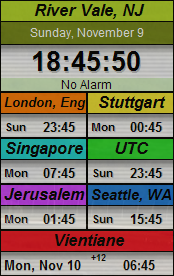 Personally, I always log in UTC, even on those rare occasions (like when I was operating from the boat as K2NUD/MM) when I use paper. It's not hard to figure out the local time difference, and once you start, there's nothing to it. My computer logging programs automatically log in UTC, I keep the clock on the display on my Icom 756 Pro II set to UTC, and I have this nifty program called Qlock that allows me to display local times all over the world (that's how I knew what time it was for XW1B but also shows UTC. It's easy. If you don't use a computer for logging or don't have a program like Qlock, you can use a website like timeanddate.com to find out the current time in GMT. If you don't have a computer (hey ... how are you reading this?) you can always tune to WWV on 2.5, 5, 10, 15, or 20Mhz which transmits the time in Coordinated Universal Time (aka UTC). Remember that UTC is the same no matter where you are in the world!
What I am going to talk about is the surprising level of misunderstanding that some hams seem to have about telling time.
Why is time important for hams? There are lots of reasons but I want to address two in particular. The first one is that when a ham makes a contact on the radio and wants to exchange QSO (contact) information, in the form of a QSL card or electronically, we need to agree on a standard time reference to use. In case the reason for this isn't obvious, because contacts are often made across time zones, if I log the contact time in my local time, it's not the same time (and in some cases, even the same date) at the other end. It can be confusing to try to validate a contact where the time (and date) don't match what you expect. For example, I'm typing this at 6:44PM local time on Sunday, November 9. If I were to make a contact with my friend Bruce, XW1B in Laos, if he were to log that contact in local time, his log would say 6:44AM on Monday, November 10. Instead, we both just log that the contact was made at 23:45 (the same as 11:45PM) UTC or Zulu (which is essentially the same as GMT), on Sunday, November 9, and all's well. (As an interesting aside, there actually is a difference between GMT and UTC, the Wikipedia article is pretty interesting if you're interested in that kind of thing.)
One thing that has happened to me a number of times is when a fellow ham gets the UTC time correct, but gets the date wrong. I've gotten cards that had the correct time (in UTC) but the date was wrong. This typically happens when the UTC time has gone to the next day (such as in my example above). I suspect that some of those are honest mistakes, but I do recall an email exchange with a ham a few years back where he insisted that since the day hadn't changed at his location, the day remained the same. I think that I finally managed to convince him otherwise.
The other reason that I wanted to mention is that for certain special events, and in particular, for contests, hams need to know when the contest starts and when it ends. Unlike the discussion above where it's only a single point in time, a contest involves a period of time. Clearly you should neither operate prior to the start of the contest nor after it ends. Since most contests involve participants, the start and end times are usually specified in UTC. Very simple, right?
Well, I thought so, but apparently not everyone does. A few weeks ago, just before the ARRL CW Sweepstakes contest that I mentioned earlier, someone posted to one of the mailing lists that I receive asking if there would be more hours to operate since the clocks would go back one hour in the middle of the contest. He then went on to ask how to deal with the "fact" that since the time between 1AM and 2AM occurs twice when "falling back" his log entries wouldn't be correct. (In the US, when changing between DST and Standard time, the change is made at 2AM local time. When going to DST, the local clocks jump from 2AM to 3AM. When going the other way, the hour between 1AM and 2AM occurs twice. Remember that this is only the local time.)
My response to him was that since the contest start and stop times are specified in UTC, and UTC, by definition doesn't adjust for DST, that there were still the same number of hours between 2100 UTC on the 1st of November and 0300 UTC on the 3rd of November this year as there are, and have been, every other year. Further, since logs have to be submitted in UTC anyway, why not just log in UTC and not worry about any kind of conversion? Although I did respond directly (not on the mailing list) to the person who asked the question, I never received a response.
Personally, I always log in UTC, even on those rare occasions (like when I was operating from the boat as K2NUD/MM) when I use paper. It's not hard to figure out the local time difference, and once you start, there's nothing to it. My computer logging programs automatically log in UTC, I keep the clock on the display on my Icom 756 Pro II set to UTC, and I have this nifty program called Qlock that allows me to display local times all over the world (that's how I knew what time it was for XW1B but also shows UTC. It's easy. If you don't use a computer for logging or don't have a program like Qlock, you can use a website like timeanddate.com to find out the current time in GMT. If you don't have a computer (hey ... how are you reading this?) you can always tune to WWV on 2.5, 5, 10, 15, or 20Mhz which transmits the time in Coordinated Universal Time (aka UTC). Remember that UTC is the same no matter where you are in the world!Tuesday, November 04, 2008
VOTE!!!!
I'm going to go totally off-topic for a quick posting: If you're a registered voter in the United States, please make sure you vote today. Voting is how you participate in democracy, and if you're eligible to vote and you don't, you're saying that you don't care. I'll bet you do care, and even if you aren't thrilled with your choices in the election, it's not only your right, its is your responsibility as a citizen to do so.
Please participate in the democratic process and make your voice heard.
Please participate in the democratic process and make your voice heard.
Saturday, October 25, 2008
Too much work, not enough radio ... again
It occurred to me that I hadn't posted in almost three weeks. Thinking about why, I realized that I'm in one of those cycles where I'm working more than usual, leaving less time for radio (and other "free time" activities). When I get home from work at 8PM, it's a little hard to find time to fit in radio along with all the usual things that go on around here, and while I have had the radio on, I haven't been making a lot of contacts.
Still, I have been doing a few things, and it's time to "get on the horse again" and post an update.
At the end of my last post, I was talking about the California QSO Party, and how I only had a limited time to work that event. I did work a few more stations, but wound up with only about 20 stations contacted in total. That's by far my lowest total ever, but I did send in my log anyway. Hopefully next year I'll have more time and the conditions will be better.
Last weekend I did spend some time participating in the JARTS RTTY contest. I made 173 contacts spread out over two days, which while not exactly championship level, was fun. I'm really starting to enjoy the RTTY contests more and more, and I think I'll makle an effort to look for more ot them.
Early last week, the kids called me at work during the afternoon with the news that my G5RV had come down, probably due to the high winds we were experiencing. Other than when I dropped it intentionally last year when having some tree work done, it's been up for around 7 years now, which is a fairly long time. I figured that the wires had broken, and I'd need to replace it. I had the kids take a picture of what had happened and send it to me, and it turned out to be not nearly as bad as I thought. All that had happened was that one of the support ropes (which is itself held to the tree with a bungee cord acting as a shock absorber) had somehow gotten disconnected. In fact, probably because that rope has been over a high branch for so long, the antenna itself barely dropped at all. When I got home that night, I found the ropes dangling from a branch, although by the next morning, the pull from the antenna had started to pull the rope up into the tree and was threatening to get out of reach. (There's more than enough rope to be within reach with the antenna on the ground, but it was coiled up and the coil was almost out of reach.) I was able to pull the coil of rope down and I tied the bungee, which was now hanging low enough to reach, to a chair to keep it in place until I had a chance to see what had happened and repair it.
(I just re-read that paragraph and I realized that I should explain that the support rope for the antenna goes up from the ground and over a fairly high branch in the tree. As a result, when the antenna goes down, the rope pulls up).
I'd taken Friday off to use up some of the vacation days that I have left over (my company has a pretty generous vacation policy, but if you don't use up your days, you lose them) so I took the opportunity to fix the support rope. I pulled the ladder out of the garage and climbed up to where the main coil of rope was hanging (in mid-air), and found that the 3 inch long eyebolt had somehow pulled out of the tree. The support rope and bungee were still tied to it, and I honestly can't figure out how it could have pulled out, but that's what happened. The fix, of course, was easy: I drilled a pilot hole in the tree at an appropriate height and simply screwed the eyebolt back into the tree. I tied off the line again, and I was back in business.
As proof that the antenna was still working just fine, I finally made a contact with the VK9DWX team on Willis Island, which I'd been trying to do for the past couple of weeks. Willis is a relatively rare location to work on radio, and I'd been coming downstairs before work to try to make a contact on 40m, which seemed like my best chance. Unfortunately, even though I could hear them fairly well, I just wasn't able to make a contact in the morning. Fortunately, yesterday afternoon I was able to make a single contact with them on 30m CW, so I was able to put Willis Island in my logbook as all-time DXCC entity #287.
The CQ WorldWide DX Contest is taking place this weekend. As I mentioned in my posting about that contest last year, this isn't really my favorite contest, and in fact, as I write this, the contest is probably around halfway over and I haven't made a single contact. I will likely get on the air in a little while, but I don't expect to make a lot of contacts. (Of course, I've said that before then gotten wound up in the contest. We'll see what happens this time.)
Still, I have been doing a few things, and it's time to "get on the horse again" and post an update.
At the end of my last post, I was talking about the California QSO Party, and how I only had a limited time to work that event. I did work a few more stations, but wound up with only about 20 stations contacted in total. That's by far my lowest total ever, but I did send in my log anyway. Hopefully next year I'll have more time and the conditions will be better.
Last weekend I did spend some time participating in the JARTS RTTY contest. I made 173 contacts spread out over two days, which while not exactly championship level, was fun. I'm really starting to enjoy the RTTY contests more and more, and I think I'll makle an effort to look for more ot them.
Early last week, the kids called me at work during the afternoon with the news that my G5RV had come down, probably due to the high winds we were experiencing. Other than when I dropped it intentionally last year when having some tree work done, it's been up for around 7 years now, which is a fairly long time. I figured that the wires had broken, and I'd need to replace it. I had the kids take a picture of what had happened and send it to me, and it turned out to be not nearly as bad as I thought. All that had happened was that one of the support ropes (which is itself held to the tree with a bungee cord acting as a shock absorber) had somehow gotten disconnected. In fact, probably because that rope has been over a high branch for so long, the antenna itself barely dropped at all. When I got home that night, I found the ropes dangling from a branch, although by the next morning, the pull from the antenna had started to pull the rope up into the tree and was threatening to get out of reach. (There's more than enough rope to be within reach with the antenna on the ground, but it was coiled up and the coil was almost out of reach.) I was able to pull the coil of rope down and I tied the bungee, which was now hanging low enough to reach, to a chair to keep it in place until I had a chance to see what had happened and repair it.
(I just re-read that paragraph and I realized that I should explain that the support rope for the antenna goes up from the ground and over a fairly high branch in the tree. As a result, when the antenna goes down, the rope pulls up).
I'd taken Friday off to use up some of the vacation days that I have left over (my company has a pretty generous vacation policy, but if you don't use up your days, you lose them) so I took the opportunity to fix the support rope. I pulled the ladder out of the garage and climbed up to where the main coil of rope was hanging (in mid-air), and found that the 3 inch long eyebolt had somehow pulled out of the tree. The support rope and bungee were still tied to it, and I honestly can't figure out how it could have pulled out, but that's what happened. The fix, of course, was easy: I drilled a pilot hole in the tree at an appropriate height and simply screwed the eyebolt back into the tree. I tied off the line again, and I was back in business.
As proof that the antenna was still working just fine, I finally made a contact with the VK9DWX team on Willis Island, which I'd been trying to do for the past couple of weeks. Willis is a relatively rare location to work on radio, and I'd been coming downstairs before work to try to make a contact on 40m, which seemed like my best chance. Unfortunately, even though I could hear them fairly well, I just wasn't able to make a contact in the morning. Fortunately, yesterday afternoon I was able to make a single contact with them on 30m CW, so I was able to put Willis Island in my logbook as all-time DXCC entity #287.
The CQ WorldWide DX Contest is taking place this weekend. As I mentioned in my posting about that contest last year, this isn't really my favorite contest, and in fact, as I write this, the contest is probably around halfway over and I haven't made a single contact. I will likely get on the air in a little while, but I don't expect to make a lot of contacts. (Of course, I've said that before then gotten wound up in the contest. We'll see what happens this time.)
Sunday, October 05, 2008
2008/9 Contesting Season Starting
It's that time of the year when contesters are kept busy and the Grumpy Old Men are grumpier: The start of the contest season. I'll get to the Grumpy Old Men part in a bit, but first the part of the contesters.
There are contests every weekend of the year, but the more well-known (or "bigger") contests start taking place around now and continue for the next few months. I imagine this has to do with worldwide propagation or something, but to tell the truth I've never really looked into why the "big contests" alll start right about now.
The good news is that for contesters, there's usually something "big" every weekend. Last weekend I participated (or "played around", as I like to say) in the CQ WorldWide RTTY DX contest. In this contest, any station can work any other station, so even if the band conditions aren't very good (in my opinion, they were awful Saturday, though they improved to merely lousy on Sunday) you can usually find lots of stations to work within your own country. Of course, the way scoring works you get more points for working stations outside of your own country, and even more for working stations outside of your own continent, so that's what you try to do, when you can.
The RTTY (pronounced "Ritty") in the name of the contest means that you can only use Radio TeleTYpe mode to make contacts. Originally, this mean that there was an actually mechanical teletype connected via some specialized equipment to a radio, but now, most RTTY enthusiasts use their computer sound card with a fairly simple connection to their radio, along with an encoding/decoding program on their computer, such as the very popular MMTTY. What's really nice about these digital mode contests is the amount of automation that can be done by your contest logging program. As I've mentioned before, I use N1MM's contest logger, which has some really terrific features for handling digital contests, even for casual contesters like me. For example, as with all contests, the exchange of information between stations is structured, with little or no change between contacts. (For this particular contest, nothing at all changes.) The N1MM program allows you to set up your exchange sequences such that once you've gotten the other stations callsign, the exchange process is almost entirely automated. The operator then needs to hunt for stations, adjust the radio to make sure that there's "clean copy" (meaning that you can read the information being sent), and then just do a few mouse clicks or keyboard presses (all configurable) to complete the contact.
One interesting thing about RTTY mode is that although you can hear the sound that the other station is sending, unlike CW (and certainly unlike any speech modes) it can't be decoded by ear. (Ok, I've heard that some really experienced guys actually can decode RTTY by ear. I sure know that I can't. Here's an audio sample, you can decide for yourself). The software used to help tune in the signal has a tuning aid to help you zero-in the signal, so you can use RTTY completely without any audio coming out of your speakers (or headphones) if you want to.
Anyway, I've played in RTTY contests before, and one big thing for me is that they are often a good place to pick up a new country, or a country that I've contacted before on a new band. My decision to participate in this contest was very last minute: I think I fired up the contesting software about 15 minutes after the start of the contest, spent a while configuring it, and then operated for a while on Friday night. I did some more operating Saturday afternoon, and again Sunday afternoon into early evening. I wound up on the air for around 12 hours or so, and made 257 contacts, with a score of just under 115,000 points. I was quite happy with my effort, which I think was decent for a low power station just "playing around".
One thing that I did was to set some "moving target" goals for myself to help keep going. Initially, I wanted to try to make at least 150 contacts, which seemed reasonable on Saturday afternoon. After I surpassed that, I decided that I wanted to break 100,000 points, and then, at the very end of the contest, I decided that I wanted to make at least 250 contacts. (Although I did succeed in that, I was getting a little frantic as I was about 3 contacts short of my goal with not long to go in the contest, and seemed unable to make any others. Fortunately, I managed to work a bunch of stations during the final minutes.) Setting these kinds of goals for me helps to make things fun. Unlike serious contesters, I "cheat" by setting my goals as I'm operating. I do this because I'm trying to keep things fun for myself. If I'd set out to make 250 contacts before I started Friday night, I probably would have gotten discouraged during the day on Saturday when things were going slowly and given up. So, I "cheat" and create goals that seem reasonable for the conditions and the amount of time I'm likely to have available. I'm not suggesting that this works well for anyone else, but it works for me.
This weekend is the California QSO Party contest, which is one of my favorite state QSO party contests. (As I've mentioned before, the goal of these contests is to make contact with as many stations within a particular state as possible, or for those within that state to make as many contacts in general.) Sharon and I had plans on Saturday (visiting a few wineries in the Hudson Valley in New York), so I only had a few hours to operate in the contest on Sunday. Unfortunately, the bands just weren't cooperating early Sunday afternoon, and after about an hour of operating, I'd only worked eight stations. Listening now (around 4PM EDT), things seemed to have picked up a bit, so maybe I'll try again in a while, but my initial attempts were not fun, so I stopped to work on some other things, including writing this.
So what about the Grumpy Old Men comment? It seems that as the contest season gets underway, the complaints start to flow into the mailing lists complaining about the contesters. Some of the complaints are legitimate, since unfortunately some of my contesting brethren do just plop themselves down on a frequency without ensuring that the frequency is not in use. That is just plain wrong, period. However, some of the complaints are made because "the contester was on the frequency that we use every day, and even though they were there first, they should move". Sorry, but that's not the way things work. We amateurs have a reasonable amount of radio spectrum to use. There's plenty of room for all of us if we cooperate with each other. We are fortunate to have these valuable resource to share. If we can't play nicely with each other, then the FCC might just decide to pick up our collective sandbox and give it to someone else.
There are contests every weekend of the year, but the more well-known (or "bigger") contests start taking place around now and continue for the next few months. I imagine this has to do with worldwide propagation or something, but to tell the truth I've never really looked into why the "big contests" alll start right about now.
The good news is that for contesters, there's usually something "big" every weekend. Last weekend I participated (or "played around", as I like to say) in the CQ WorldWide RTTY DX contest. In this contest, any station can work any other station, so even if the band conditions aren't very good (in my opinion, they were awful Saturday, though they improved to merely lousy on Sunday) you can usually find lots of stations to work within your own country. Of course, the way scoring works you get more points for working stations outside of your own country, and even more for working stations outside of your own continent, so that's what you try to do, when you can.
The RTTY (pronounced "Ritty") in the name of the contest means that you can only use Radio TeleTYpe mode to make contacts. Originally, this mean that there was an actually mechanical teletype connected via some specialized equipment to a radio, but now, most RTTY enthusiasts use their computer sound card with a fairly simple connection to their radio, along with an encoding/decoding program on their computer, such as the very popular MMTTY. What's really nice about these digital mode contests is the amount of automation that can be done by your contest logging program. As I've mentioned before, I use N1MM's contest logger, which has some really terrific features for handling digital contests, even for casual contesters like me. For example, as with all contests, the exchange of information between stations is structured, with little or no change between contacts. (For this particular contest, nothing at all changes.) The N1MM program allows you to set up your exchange sequences such that once you've gotten the other stations callsign, the exchange process is almost entirely automated. The operator then needs to hunt for stations, adjust the radio to make sure that there's "clean copy" (meaning that you can read the information being sent), and then just do a few mouse clicks or keyboard presses (all configurable) to complete the contact.
One interesting thing about RTTY mode is that although you can hear the sound that the other station is sending, unlike CW (and certainly unlike any speech modes) it can't be decoded by ear. (Ok, I've heard that some really experienced guys actually can decode RTTY by ear. I sure know that I can't. Here's an audio sample, you can decide for yourself). The software used to help tune in the signal has a tuning aid to help you zero-in the signal, so you can use RTTY completely without any audio coming out of your speakers (or headphones) if you want to.
Anyway, I've played in RTTY contests before, and one big thing for me is that they are often a good place to pick up a new country, or a country that I've contacted before on a new band. My decision to participate in this contest was very last minute: I think I fired up the contesting software about 15 minutes after the start of the contest, spent a while configuring it, and then operated for a while on Friday night. I did some more operating Saturday afternoon, and again Sunday afternoon into early evening. I wound up on the air for around 12 hours or so, and made 257 contacts, with a score of just under 115,000 points. I was quite happy with my effort, which I think was decent for a low power station just "playing around".
One thing that I did was to set some "moving target" goals for myself to help keep going. Initially, I wanted to try to make at least 150 contacts, which seemed reasonable on Saturday afternoon. After I surpassed that, I decided that I wanted to break 100,000 points, and then, at the very end of the contest, I decided that I wanted to make at least 250 contacts. (Although I did succeed in that, I was getting a little frantic as I was about 3 contacts short of my goal with not long to go in the contest, and seemed unable to make any others. Fortunately, I managed to work a bunch of stations during the final minutes.) Setting these kinds of goals for me helps to make things fun. Unlike serious contesters, I "cheat" by setting my goals as I'm operating. I do this because I'm trying to keep things fun for myself. If I'd set out to make 250 contacts before I started Friday night, I probably would have gotten discouraged during the day on Saturday when things were going slowly and given up. So, I "cheat" and create goals that seem reasonable for the conditions and the amount of time I'm likely to have available. I'm not suggesting that this works well for anyone else, but it works for me.
This weekend is the California QSO Party contest, which is one of my favorite state QSO party contests. (As I've mentioned before, the goal of these contests is to make contact with as many stations within a particular state as possible, or for those within that state to make as many contacts in general.) Sharon and I had plans on Saturday (visiting a few wineries in the Hudson Valley in New York), so I only had a few hours to operate in the contest on Sunday. Unfortunately, the bands just weren't cooperating early Sunday afternoon, and after about an hour of operating, I'd only worked eight stations. Listening now (around 4PM EDT), things seemed to have picked up a bit, so maybe I'll try again in a while, but my initial attempts were not fun, so I stopped to work on some other things, including writing this.
So what about the Grumpy Old Men comment? It seems that as the contest season gets underway, the complaints start to flow into the mailing lists complaining about the contesters. Some of the complaints are legitimate, since unfortunately some of my contesting brethren do just plop themselves down on a frequency without ensuring that the frequency is not in use. That is just plain wrong, period. However, some of the complaints are made because "the contester was on the frequency that we use every day, and even though they were there first, they should move". Sorry, but that's not the way things work. We amateurs have a reasonable amount of radio spectrum to use. There's plenty of room for all of us if we cooperate with each other. We are fortunate to have these valuable resource to share. If we can't play nicely with each other, then the FCC might just decide to pick up our collective sandbox and give it to someone else.
Subscribe to:
Posts (Atom)