Showing posts with label QSL. Show all posts

Wednesday, May 30, 2012

QSL cards for TI7/K2DBK

When I returned from my operation as TI7/K2DBK in Costa Rica last summer, I didn't receive any QSL cards immediately. I wasn't very surprised by that, as I hadn't worked all that many stations, Costa Rica isn't a particularly rare entity, and I assumed that for the stations outside the US (where it's a little less common), they'd be QSLing via the bureau or Logbook of The World. Since I had no cards that I needed to respond to, I focused my efforts on getting my operation approved for DXCC credit and getting a certificate so that I could upload the contacts to the Logbook of The World. As I wrote (here and here), that turned out to be an interesting challenge, but I was able to get that approval.

I didn't really think about QSL cards after that until a few months ago, when I started receiving QSL requests via the ARRL DX bureau service. As I've written in the past, the bureau is a way to exchange QSL cards which, while inexpensive, can be quite slow, so lag of 6 or 8 months between the operation and the time to receive a card via the bureau isn't terribly unusual. (Sometimes it can be much, much longer. I'm still receiving QSL cards via the bureau for my operation from Grand Cayman in 2007, and others for operations from home back to 2001. The bureau service itself isn't quite that slow, but often folks like myself will discover after a few years that a particular card is needed.) When I first received those bureau cards, I realized that I had to create a QSL card but it wasn't a high priority, as I wasn't planning to send cards out via the bureau for at least a few months.

Things changed about a week ago when I received the first of several directly mailed QSL requests. Although it's common to send a QSL card relatively soon after a contact, particularly if it's sent "direct" (meaning mailed directly to the station, not via the bureau), sometimes stations will not realize until much later that they "need" the confirmation, or, as I've done, sometimes they simply forget at the time of the contact. Regardless of the delay, I have always made it a point to respond to direct QSL cards as soon as possible (normally I'll send out a return card the day after I receive one). Unfortunately, I couldn't do that because I still had the creation of the QSL card for my TI7/K2DBK on the "to do" list. The receipt of the handful of direct requests (all of which were from non-US stations) was the kick that I needed to get going designing my card.

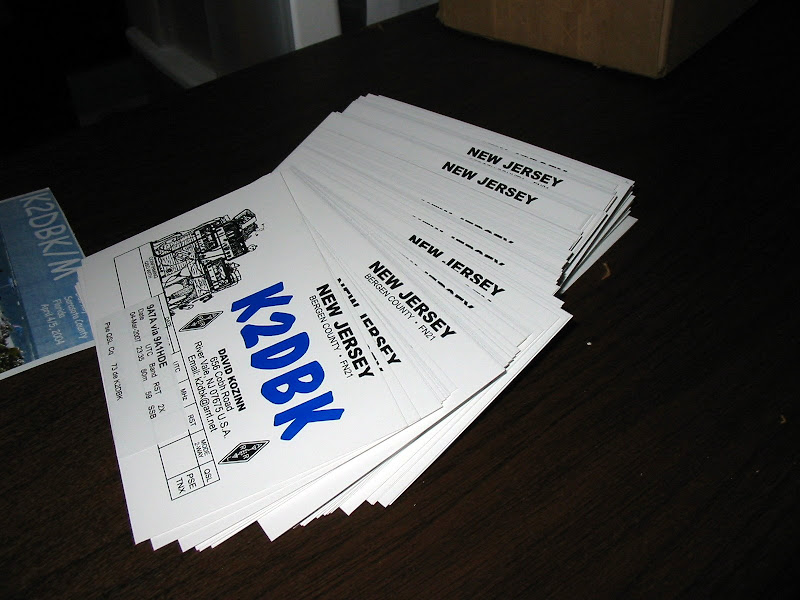
I've always designed and printed my "special" cards myself, because the number of cards that I typically need is usually so small that it's not worth it to have them professionally printed. There are a number of tools that can be used for the actual design, but for me, the hardest part is always coming up with an attractive layout. However, I've come up with sort of a standard that I've used on multiple cards, and I try to follow that now for each new one I create. I've followed that "standard" for the latest card, which is to use a background image shot with one or sometimes two "inserts", along with a QSO information block. I've always used my own photos, not a "stock" photo, as I think it makes the card more personal. I usually include a picture of myself on the cards because I think that makes it even more personal.

When I first started printing the cards, I though that I'd use a gloss "postcard" printer stock (like this from Staples), separate the postcards (they are set up for 4 on a page that have perforations to make separation easy) and just mail them. However, I realized that the size of each card was bigger than the standard QSL card size and I had trouble fitting them in some envelopes. As a result, I wind up using a paper cutter to trim the cards down to about 5.3" x 3.5". Most likely the next time I buy paper stock for my printer I'll just use plain "everyday" inkjet photo paper since it should be a bit less expensive.

With a card designed, I printed off enough copies on my inkjet printer to respond to the direct requests, and I'll be working on responding to the bureau cards next. I think that this particular design worked out really well, and the color of the sand on the beach is light enough so that I can just use a regular pen to fill in the QSO information in the information box and it's quite readable.

Monday, May 30, 2011

Now that's service

Saturday afternoon I was going through my QSO logs in preparation for a long-overdue bureau mailing. One of the things I do prior to doing a mailing is that I validate that I still need the card (sometimes I'll get a confirmation for that band/mode from another operator, or sometimes it'll get confirmed via Logbook of The World [LoTW] since I initially flagged it) and I also check to make sure that I'm not sending to a bureau that doesn't exist, or sending via the bureau when I could send direct to a US manager.

In going through the log, I discovered that I had an unconfirmed QSO with Joel, V44KAI on 6m from 2009. That was my only contact with V4 on 6m so I definitely wanted to confirm it. I noticed that I had two other contacts with him (on different bands) which had been confirmed via LoTW, but not the 6m contact. Joel's qrz.com page explain that because he sometimes encounters QRM/QRN that it's a good idea to contact him before asking his manager, W5TFW. I emailed Joel who replied that some of his older logs were on paper and hadn't been put into electronic form so that they could be uploaded to LoTW.

On Sunday morning I got another email from Joel who told me that he found the (valid) QSO in his logs and had emailed his manager to give him the details so that it could be uploaded to LoTW. I checked and probably within 10 minutes of my seeing that email I found that the matching QSL record was in the LoTW system, confirming V4 on 6m for me.

The reason that I wrote this is because to me this exemplifies the ham radio spirit. Joel is clearly an active ham (try a search for V44KAI on the DX-Summit search page and you'll see what I mean) and as Joel says on his qrz.com page, his manager obviously keeps busy keeping the records up to date. The fact that both of these guys took the time to quickly respond to my question and do the work necessary to provide me with the confirmation I needed helps remind me that despite some of the less-altruistic hams floating around, there are still plenty of good guys. Thanks to both of them for that reminder.

Edit: I was asked what a "manager" is, so by way of explanation:
A manager is a person who handles someone else's QSLing duties for them. There are all kinds of reasons to have managers, including having the manager in a country with a better mail system to reduce mail theft, or simple because the DX station handles a large volume of cards and can't keep up with it themselves.  

Monday, October 04, 2010

One worked, one confirmed

Yesterday I worked Kouichi, JI1FGX/DU9 operating from Mindanao Islands in the Philippines. I'd worked a DU back in 2002 but unfortunately have been unable to get a confirmation from him. His US manager hasn't received logs from him in years, and as a result can't confirm my contact. Kouichi was the first DU contact since then, and I was very happy to discover that he has an active manager in Japan, so my chances of getting a confirmation from him are excellent.

Along the same lines, today I received a QSL card back from the 3C9B DXpedition to Equatorial Guinea that I'd worked in June of this year. That confirms my 295th country in mixed mode and 218th confirmed on CW. (I see that I have about 35 countries on CW that I haven't confirmed yet, I guess I'd better start getting some cards sent out.)

My numbers will change in about a week when the reorganization of the Netherlands Antilles results in a probable deletion of 2 entities and the addition of 4 or 5, but I'm very happy to be so close to 300.

Monday, February 02, 2009

More about the Triple Play Award

I'm not quite sure how many contacts I had toward the Triple Play Award that I discussed last week, but I've made some nice progress since then. In fact, as I write this late Sunday night (or rather, early Monday morning), according to the Awards page within Logbook of the World, I need only a handful of contacts to complete the award. The "slots" left are:
  • CW: Hawaii, Kansas, Louisiana, South Dakota
  • Phone: Idaho, Kansas, Utah, Wyoming
  • Digital: Hawaii, Utah
Actually, by morning, I hope to have South Dakota confirmed on CW; I've uploaded my logs to LoTW and am waiting for them to process. In any case, I'm under a dozen left, and I'm very pleased with my progress.

Although I mentioned it last week, what's really struck me is how incredibly helpful and friendly everyone has been. People will gladly move to another band or mode when asked if you need a contact, and it's certainly contagious. I don't think I've heard anyone yet say that they wouldn't accomodate a fellow award-seeker with the possible exception of asking them to wait a few minutes while another contact is completed.

What I think is really special is that many of the folks who've already received their awards (you can see the current list on the ARRL's Awards page) still hang around to "give out" their state to others. Some have even posted information about their TPA efforts on their web site, like this one from Tom, N9DD which has pictures of the some of the folks that he's met along the way, including yours truly.

The award has served as a focal point for a informal community of hams, and I find that very gratifying. As I've mentioned in the past, I see ham radio as a way to relax and have fun, and it's really great having a new bunch of friends to "hang out" with.

So, as I mentioned last time, why not drop by 3.618 LSB most evenings and say hello (and it's looking like 14.290 or 14.292 USB is becoming the daytime "hangout"). You might just be that #150 that someone needs.

Oh yeah ... if you happen to be located in any of the states that I've mentioned, please drop me a line or leave a comment ... I'd really like to work you so that I can finish up my award!

Update: The South Dakota confirmation did come through, so I now have 9 left to go.

Tuesday, January 27, 2009

The ARRL Triple Play Award

Not long ago, the ARRL announced new award called the "Triple Play Award". The info at the link gives all the details, but the concept is simple: Work all 50 US states on CW, Phone, and Digital (RTTY, PSK, etc.) starting on January 1. All contacts must be confirmed via the ARRL Logbook of The World. To be honest, when I first heard this, my reaction was "well, that's nice, but I'm not that interested in working non-DX stations, and it'll take me forever to work that many stations on all those modes".

But that was before I wound up with over 400 contacts during the ARRL RTTY Roundup and more than 250 contacts in the CW North American QSO Party (NAQP) . I realized at that point that I'd had about 45 or so states confirmed on RTTY, and close to that many confirmed on CW. I picked up a few states on sideband during the SSB version of the NAQP, and realized that I actually had a pretty good number of the 150 required contacts already confirmed.

Andy, K3UK, set up a "sked" (schedule) page on his website (click "LoTW" at the top of the page) where hams trying to find different states could meet to arrange contacts easily, and there has been a decent group of folks there each day for the last couple of weeks. During the evening hours, 3.618Mhz (LSB) has been a kind of on-air meeting place. I started out by "lurking"; just reading the messages posted or listening to the chatter on-air and occasionally making a contact. The real fun started when, after I'd work some station that I needed I'd have another station call because they actually need a contact from New Jersey!

Ok, in case it's not obvious, New Jersey isn't exactly considered even remotely rare, or usually even very interesting, for the purposes of most ham radio awards. However, because the Triple Play Award (or TPA, as the guys on the sked page have been calling it) is so new, lots of folks still need a contact with New Jersey. While I haven't exactly been trying to work giant pileups, I have been "giving out" New Jersey to more and more folks. It's just plain fun to be able to help someone else earn their awards, and, while "hanging out", I've managed to pick up a few of the tougher states myself.

As I was writing this entry, I managed to work WY7FD on both RTTY and CW modes on 80m. As of now, that means that the only states with which I haven't made any contacts for TPA are Hawaii and Utah. I've worked both of those states in the past, so the trick now is to find a time and place to work a station who'll be uploading his log to Logbook of the World.

Speaking of Logbook of the World, because all contacts for this award have to be confirmed through LoTW, you get nearly instant (in relative terms) gratification when you work someone. Most of the folks trying to get the award upload their logs at least once per day (and some appear to do it even more often), so you usually know for certain that you're "in the log" very quickly. Don't get me wrong: I still like getting paper QSL cards, but for an award like this it's really fun just seeing how fast the contacts are confirmed.

One more quick thing: I have to say that it's been wonderful how friendly and accomodating folks have been in helping each other make contacts. Most folks will gladly change modes or bands to help out someone looking for a particular state. It's not that hams aren't friendly in general, but it just seems like my fellow TPA award seekers are really going out of their way to help out.

If you haven't done so yet, why not stop by the K3UK chat room and join a bunch of us on 3.618 each evening?

Tuesday, December 30, 2008

Loose ends

Once again I've gotten a bit behind in posting, but I do have a few minutes and wanted to mention a few things.

I received three envelopes from the W2 QSL bureau recently. A lot of the cards were for "routine" QSOs, but there were a handful of "goodies", including a bunch of new countries confirmed on 75/80m. That brings my total for 80m to 82 confirmed, and I've got nearly another 40 above that worked, so I'll soon have enough confirmations for the 5-Band DXCC award. I'll actually have enough for 5BDXCC plus a couple of other endorsements for single bands, since I'll then have 100 or more contacts confirmed on all bands from 10m through 80m, except for 30m (and 60m, which I don't use and which doesn't count for DXCC purposes.) In looking up my stats, I realized that I've also got far more than 100 just on CW mode, and I only need 6 more confirmations on RTTY/Digital for single mode there. It's nice to make progress, even with the bands so bad lately, though since I haven't done a a DXCC submission in a while it's probably going to be pretty darn expensive when I finally do.

Along with the bureau cards for my regular K2DBK call, I also got a handful of cards for my ZF2DK operation about 18 months ago. I had to print up some more cards (on postcard stock on my inkjet printer) since I'd only printed a fairly limited number of them originally and had run out. It wasn't too hard to do, but I did wind up trying to remember/figure out how to feed the card stock through the printer so that the picture and the text were printed "rightside-up" relative to each other. Well, I tried to do that, and still managed to print two sheets of cards with the printing on the back "upside down". Oh well, the card will still count just the same. And I got to use my nifty "QSO confirmed by K2DBK" stamp that I picked up from W9XR a while back.

In other news, I've got a couple of possible trips coming up this summer. One will be "hamcation", which is to say that I plan to go and operate a significant amount. I'm working out the details, but one possibility would be to go down to the US Virgin Islands, particularly St. Croix, and operate from there. (Ok, I might take a break to check out the beaches and do a little snorkeling now and then.) I may be able to bring along my son Justin, KC2MCS with me. (He's agreed to upgrade to at least a General class license, and possibly Extra, so that he can join me.)

The other trip is more of a vacation with some ham radio thrown in, similar to my try to Grand Cayman. The current thinking is that we might go to Costa Rica (TI) and I'd operate in my spare time there. More on both of these trips when the plans firm up.

On a final note, related to the two possible upcoming trips, I'd like to remind my readers about my DX Publicity Contacts Page where I've collected various sources that are good to notify if you're going to be operating as DX. Please let me know if you've got any updates or additions to that page.

Saturday, November 08, 2008

It's about time

A few weekends ago the ARRL CW Sweepstakes contest was held. It was also the weekend where, in the United States, the time "changes" from Daylight Savings Time to Standard Time. I won't go into the history of DST, or Summer Time, since the web is full of resources that discuss that ad nauseum. I'm also going to show some restraint and not launch into a full tirade (just a little grumbling) about how pointless it is and how especially stupid it is that the goverment of the United States decided to change the start and stop times last year, costing many millions of dollars to have all kinds of software and other equipment changed, while actually increasing energy use. (A recent article about that is here, one from spring 2007 is here.) No, I'm not going to talk about that.

What I am going to talk about is the surprising level of misunderstanding that some hams seem to have about telling time.

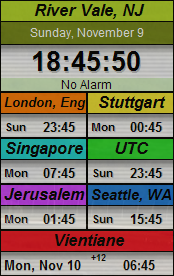
Why is time important for hams? There are lots of reasons but I want to address two in particular. The first one is that when a ham makes a contact on the radio and wants to exchange QSO (contact) information, in the form of a QSL card or electronically, we need to agree on a standard time reference to use. In case the reason for this isn't obvious, because contacts are often made across time zones, if I log the contact time in my local time, it's not the same time (and in some cases, even the same date) at the other end. It can be confusing to try to validate a contact where the time (and date) don't match what you expect. For example, I'm typing this at 6:44PM local time on Sunday, November 9. If I were to make a contact with my friend Bruce, XW1B in Laos, if he were to log that contact in local time, his log would say 6:44AM on Monday, November 10. Instead, we both just log that the contact was made at 23:45 (the same as 11:45PM) UTC or Zulu (which is essentially the same as GMT), on Sunday, November 9, and all's well. (As an interesting aside, there actually is a difference between GMT and UTC, the Wikipedia article is pretty interesting if you're interested in that kind of thing.)

One thing that has happened to me a number of times is when a fellow ham gets the UTC time correct, but gets the date wrong. I've gotten cards that had the correct time (in UTC) but the date was wrong. This typically happens when the UTC time has gone to the next day (such as in my example above). I suspect that some of those are honest mistakes, but I do recall an email exchange with a ham a few years back where he insisted that since the day hadn't changed at his location, the day remained the same. I think that I finally managed to convince him otherwise.

The other reason that I wanted to mention is that for certain special events, and in particular, for contests, hams need to know when the contest starts and when it ends. Unlike the discussion above where it's only a single point in time, a contest involves a period of time. Clearly you should neither operate prior to the start of the contest nor after it ends. Since most contests involve participants, the start and end times are usually specified in UTC. Very simple, right?

Well, I thought so, but apparently not everyone does. A few weeks ago, just before the ARRL CW Sweepstakes contest that I mentioned earlier, someone posted to one of the mailing lists that I receive asking if there would be more hours to operate since the clocks would go back one hour in the middle of the contest. He then went on to ask how to deal with the "fact" that since the time between 1AM and 2AM occurs twice when "falling back" his log entries wouldn't be correct. (In the US, when changing between DST and Standard time, the change is made at 2AM local time. When going to DST, the local clocks jump from 2AM to 3AM. When going the other way, the hour between 1AM and 2AM occurs twice. Remember that this is only the local time.)

My response to him was that since the contest start and stop times are specified in UTC, and UTC, by definition doesn't adjust for DST, that there were still the same number of hours between 2100 UTC on the 1st of November and 0300 UTC on the 3rd of November this year as there are, and have been, every other year. Further, since logs have to be submitted in UTC anyway, why not just log in UTC and not worry about any kind of conversion? Although I did respond directly (not on the mailing list) to the person who asked the question, I never received a response.

Personally, I always log in UTC, even on those rare occasions (like when I was operating from the boat as K2NUD/MM) when I use paper. It's not hard to figure out the local time difference, and once you start, there's nothing to it. My computer logging programs automatically log in UTC, I keep the clock on the display on my Icom 756 Pro II set to UTC, and I have this nifty program called Qlock that allows me to display local times all over the world (that's how I knew what time it was for XW1B but also shows UTC. It's easy. If you don't use a computer for logging or don't have a program like Qlock, you can use a website like timeanddate.com to find out the current time in GMT. If you don't have a computer (hey ... how are you reading this?) you can always tune to WWV on 2.5, 5, 10, 15, or 20Mhz which transmits the time in Coordinated Universal Time (aka UTC). Remember that UTC is the same no matter where you are in the world!

Sunday, August 31, 2008

Writer's block?

I haven't published an update in a few weeks, and I can only plead a mild case of writer's block. There are a few things that I though about, but I couldn't seem to get around to actually writing an entry. I figured that I'd just mention a few things quickly for now.

As a follow-up to my QSL Followup posting, I'm sad to report that my emails had a fairly poor result. I sent out about a dozen emails reminding folks of the cards that I'd sent and asking if they'd received my card. Of the dozen, a little more than half of those "bounced" because of an invalid email address. (For the most part, the addresses I found were from qrz.com, though quite a number of people didn't have any email listed at all.) From the remaining half, I got exactly three replies: I got two from folks in the US, who both pleaded "busy life" (perfectly understandable) and who did indeed have my card (and SASE) and promised to send out a card in reply promptly. I've gotten one back from those two. The other response was from a fairly well-known Italian DXer to whom I'd requested cards from two  DX entities (TY, Benin, and ZP, Paraguy) for new band or mode contacts. He did confirm that he'd received my card and said he would send the requested cards out promptly. I received those two a week or so later, though interestingly they weren't in the Self-Addressed envelope that I'd sent. That's OK, at least he followed though.

I had hoped for a better response, and I must say that I'm pretty disappointed about the lack of response. I don't know if some of the recipients just don't QSL or perhaps have lost interest in the hobby, but I've always felt that even if for whatever reason you don't want to respond with a QSL card, it would be courteous to at least return my card (which won't cost anything; I've already paid the postage) and tell me why.

On another note, I still have not gotten my 6m beam up on the roof yet. I did do a bit more preliminary work, which involved getting some extra feedline up to the attic from my shack on the ground floor of my house, and making sure that I had all the parts and cables that I need. I just sort of never seem to get around to actually getting up on the roof. Hopefully I'll get around to it before it actually starts getting cold.

As for actually using the radio, I haven't made many contacts lately, but despite the just plain awful band conditions, I have managed to pick up some countries on new bands or modes. The most notable is my CW contact with Bruce, XW1B. Bruce and I chat fairly often via an instant messenger on the Internet, and as I mentioned a while back we'd been trying to work on CW for quite some time. Finally, a couple of weeks ago there was some good morning (my time) propagation to that part of the world, and we were able to make a (somewhat shaky, but definitely "good") CW contact. I'll finally get my CW and RTTY confirmation from Laos via Bruce, and I want to say publicly that I really appreciate his patience and help in making those contacts work.

In addition to working Bruce, the only really notable contact was A71A which I worked this afternoon on 20m CW, with CW being a new mode for Qatar for me.

One final note for today: I've had a few folks ask how my son Justin was doing with his recovery from spinal fusion surgery about six weeks ago. I'm happy to say that he's continued to improved, and now no longer needs the cane that he'd been using for almost two years to help him walk. He's got about another six weeks to go until he can stop wearing his back brace, but he's now walking around the neighborhood on a regular basis, which is something that the doctor said was the most important thing he could do for now. Thanks to those of you who've been asking.

Sunday, August 10, 2008

More QSL followup

Last week, I received a really amazing card from VP6DX. As I mentioned in a post last March, the primary way that cards were to be requested was via an online system where the postage was paid for via PayPal. This worked out very well, and one of the nice things was that I got confirmation via Logbook of The World several months ago. But as nice as that was, it paled in comparison to receiving the QSL book from VP6DX. Calling it a card really doesn't make sense. This publication is a total of 36 (thirty-six!) pages (eighteen pages printed on two sides), and in addition to all the pictures, there's a lot of information about the dxpedition itself, about the equipment they used, what life was like on the island, and so on. The contacts with VP6DX were not the only ones I'd had with Ducie Island, and I initialy debated whether to actually sent for the card, since I knew that eventually I'd get confirmation via LoTW, but I'm really glad that I got the actual card for this.

While looking back at the post I mentioned, I saw that I'd given an update on the QSLing that I'd done at the end of December 2007. I thought that it might be a good time to do another update.

Unfortunately, things have changed very little. In March, I reported that I had received 67% of the cards back, which translated to 74 cards. Now, after about 32 weeks, I've received back 72%, or 80 cards. I haven't receive anything from that batch since the beginning of July. I did receive a few cards that had notes apologizing for the delay (one person had moved, one found a batch of cards behind a desk, etc.) and I never expected an instantaneous response.

However, as I mentioned previously, it's really disappointing to not get at least the domestic cards back, since I'd send an SASE with those, and generally the mail in the US is pretty reliable. What I decided to do was to write a note to those folks who I sent cards to but never received anything back, asking if they'd received my card and if so, would they mind taking a minute to just send me a return. I tried to be as nice as possible, mentioning that there are all kinds of good reasons why they might have never received or had a chance to respond to my card. I wasn't able to send emails to everyone, since probably 20% didn't have any email address that I could find, and of the ones that did, I got immediate email bounces from a few, and expect to get a few others back as well. I hope that by this time next week, I will have heard back from at least the majority of those, and I'll provide an update.

Sunday, March 30, 2008

Recent activity

I haven't posted in about 10 days, so here's a little update about what's been going on in the radio world for me.

A few weeks ago, I spent a while working in the Virginia QSO Party. Like my entry last year, this wasn't meant to be an all-out assault, but it was something to do to pass the time. (Fortunately, unlike last year, my back seems to be in decent shape, so I wasn't forced to be in the chair.) I wound up doing better than I did last year, with 195 contacts and 76 multipliers (see last years blog entry for an explanation), for a score of around 23,500 points. I was quite happy with that, and had a really good time participating. It'd be nice to win for NJ again, but I guess I'll find that out when they've finished scoring.

Last weekend, I spent a couple of hours in the BARTG RTTY contest. This is one of the big RTTY contests every year, and while I have made a few contacts in the past, this year I had so much fun that I wound up spending a few hours and made 152 contacts. I picked up 8 new countries on RTTY, but again, I had fun. Initially, I wasn't going to participate at all, but I fired up the RTTY decoder on my radio and saw my friend (and fairly well-known RTTY contester) NO2T so I figured I'd get on and give him a point. I then figured that as long as I had everything all set for RTTY, that I might as well just keep going until it wasn't fun anymore, so that's what I did. I think I've mentioned this before, but the automation in the N1MM contest logger is just terrific for digital mode contests. It takes a little work to set up, but once you get everything configured, you click on a callsign that you see on the on-screen RTTY decoder, it fills that into the callsign field of the log, click once to call that station, click on his information to populate it into the fields in the log (this particular contest uses a serial number and the time of the contact), another click to send your info back, and you're done. It's even easier than it sounds, and it really is a lot of fun to operate that way.

On the DX front, I did manage to work TX5C several times on different bands and modes, despite the "help" from the DX Cops that I wrote about recently. That was a new DXCC entity for me (#286), and I've already sent for the QSL cards.

VP6DX (Ducie Island) has what I think is a great method for requesting QSL cards: It's all done online. I wish more dxpeditions would this. They have said that if you want a card via the bureau system, just fill out the form on their website and you'll get a card. If you want it mailed to you directly, they request that you send a donation to cover postage (via Paypal). If you choose to make a small donation beyond what is needed for postage, they list you as a "sponsor", and they even uploaded the "sponsors" contacts to the Logbook of The World first. Since I did that, I was pleased to see my 15 band/mode contacts all show up confirmed in LoTW. Although I'd worked Ducie Island before, these guys did such a terrific job that I'd have sent for a physical card anyway, even though I know they'll eventually upload all the QSOs to LoTW.

Finally, I thought I'd provide an update on the progress of the QSL card returns. When I last wrote about this in January, I had around 46% of the cards returned. That was about 4 weeks after I'd initially sent out the big batch of direct cards. As of today, about 13 weeks after I sent out the original batch, I'm up to 67% of the cards sent out that I've gotten returned. The cards are still coming in, but a lot more slowly, with perhaps one coming in a week. I'm a little disappointed, since a lot of those were domestic (US), so I'll assume that the postal delays are negligible. At some point, maybe in another month or two, I'll check to see which cards haven't been returned and maybe attempt to contact the station I worked via email. I'm curious to try to understand why someone wouldn't return a card that came with an SASE. It will be interesting to see if the trickle completely shuts off after May 12, when the US postal rates go up. That rate increase wasn't even planned when I sent out my original cards, so anyone wishing to send back a confirmation from May 12 forward will have to add postage themselves.

Saturday, January 26, 2008

Many happy returns

I thought that I'd do a follow-up on the QSLing post from last month. It's been just over four weeks since the big batch of cards went out, and I thought that it would be interesting to take a look at the return rate.

The cards all went out right around the 27th of December, and I sent out a total of 111 cards direct. (I'll ignore the bureau cards, since it's way too soon for any returns from them.) I was pleasantly surprised to get the first return back on January 2. (The station was in New Jersey, as am I, but that was still pretty quick). I got another card or two a day for the first week after sending, but on the 5th of January the flood started. On that day, I got 15 cards back (including one bad address), and on the following Monday (January 7), I got 11 cards back. One of the cards that came in on the 7th was TX5NK via DJ8NK, which proves, if nothing else, that the mail between the US and Germany is pretty efficient. By the end of the 2nd week after sending the cards, I'd received back 39, or around 35%.

For the next week after that, I'd get an average of around 2 per day back, but this week I got none until today, when I received one confirming UP0L (Kazahkstan), which confirmed my 277th all-time country. As of today, about 4 weeks after sending out the cards, I'm at about a 46% return rate.

Looking at the cards that came back, although I've received some of the DX cards back (those that were sent outside the US), I haven't received a significant portion, which doesn't surprise me. Despite the fast turnaround for that first card via DJ8NK, I expected that it will take a month or two for many of cards sent overseas to come back. Some of that is due to the mail, and some no doubt due to the time it takes the station on the other end to respond. As I've pointed out, although I personally make it a point to turn around any request that I get within a day, not everyone can do that, and I know that some of bigger stations and managers only do QSLing on a periodic basis.

I am a little disappointed that I haven't received more of the domestic cards back. I've gotten back 35 cards, but 29 are still outstanding. Hopefully those are from folks who just haven't gotten around to answering my card. Every one of the cards I sent out domestically was sent with a SASE, and all the non-US cards went out either with either an IRC or green stamps. (That's ham-speak for cash for return postage.) Actually, the US return rate is actually a bit worse than that: I checked to see how many of the DX cards went via a US route (usually a manager), and there are still a bunch of them outstanding. Some of those cards are going via well-known managers, and I'm positive that I will get them back, but I'm wondering what the final return rate will be?

I should say that although it sounds like I'm being impatient, I realize that for the most part, QSLing is not an instant gratification part of this hobby. Certainly it took me quite a while to get around to sending a lot of those cards, and I don't expect to see returns from the bureau cards for a year or more. I just hope that QSLing isn't on the way to becoming a lost art, especially when someone has made it so that all you need to do is to drop a card into the pre-addressed postage-paid envelope.

One final comment while on the topic of QSLing: I do like to get paper cards back, but I'm also a big fan of the ARRL's Logbook Of The World, as I have mentioned previously. For getting band or mode "fills", it's terrific, and I don't think that I'm losing anything by not having yet another piece of cardboard from a station that I've already worked on 4 other bands. As the cost of QSLing continues to rise, it's a great way to save money.

Although there are websites that give all kinds of statistics about who is using LoTW, I've posted a poll on my blog that asks if you use LoTW, and if not, why not. I listed a couple of common ones, but if you've answered "No (Other)", I'd appreciate it if you'd post a comment here telling why. Please note that if you receive this post via an RSS feed or from another website, you will need to visit my blog and scroll down a bit to see the poll on the right side.

Sunday, January 06, 2008

Odds & Ends

It looks like this week's blog entry is going to be another potpourri.

I finally finished mailing out the entire pile of cards that I discussed in my last entry, and all the work to send the cards to the outgoing QSL bureau at the ARRL in Newington has been completed. Fortunately, my slight procrastination in actually sending out the bureau cards paid off. Earlier this week, I received a package of cards from the 2nd area incoming QSL bureau which, in addition to confirming cards that I'd sent out, had some new confirmation requests that I needed to send back in return. It was only about five cards, but had I not put them in with the batch that I will try to get out this week, they probably would have waited several months. It's also a good feeling to have zero cards to have to send out. Whew.

What's kind of fun is that now I've already started getting cards back. The majority of the direct cards went out on the 27th of December. I got the first response back on the 31st, which is pretty amazing, even thought it did go to (and come from) a station in NJ. (I believe that the first one back was for VP2MZM via K2DM.) Yesterday was a banner day, with 15 cards coming back (though one was as "Return to Sender"; I had the wrong address for someone). After just over a week, I've gotten back 19 cards already (18 if you don't count the "return to sender"). which works out to be about 16%. (I'd previously said there were 134 cards sent direct; I was mistaken and there were 134 QSOs that I sent out for confirmation direct which went to 111 different stations or managers, so it was "only" 111 out direct.) I don't normally track response rates, but I think it might be interesting to do this time because of the relatively large batch that went out all at once.

I didn't work much DX this week since I was back at work, meaning no radio during the day, but it was nice to hear that Solar Cycle 24 may have finally started this week. (I felt compelled to mention it here, because practically every other ham radio blog and website mentioned it. I didn't want to feel left out.) What will be interesting to see if which group of predictions are right: The ones that say this cycle will be huge, or this cycle will be slightly below average. If I'm still blogging in about 11 years, I'll try to remember to follow-up. The good news is that even though the predictions about this cycle starting in 2007 were wrong, it would appear that those who were predicting another Maunder Minimum type of trough were wrong too.

One thing that I've been squeezing in is to try to help a fellow blogger who is working towards his Amateur Extra license. Although I'm still pretty much a new ham by most standards (first licensed in early 2000), I have managed to pick up a little knowledge here and there, and I enjoy sharing that when I can. We've been emailing back and forth discussing antenna system gain, how you compute Effective Radiated Power (ERP), and trying to understand how much (or how little) a few watts of difference really makes (or doesn't make). It's been fun for me to discuss this, as I try to check my facts, and I usually wind up learning a little with each email.

Sunday, December 30, 2007

QSLing (or The job isn't done until the paperwork is finished, Part II)

Back in August, I wrote an entry that talked a bit about my "routine" QSLing (mostly answering incoming requests) but focused more on getting a card ready for my then-recent ZF2DK operation. I've spent a bunch of time over the last week catching up on the QSLing that I should have been doing all along, and I thought I'd write a little bit about that as well.

As I mentioned previously, I try to be really good about responding to cards that I receive sent
directly to me (as opposed to via the ARRL Bureau). Most of the direct cards that I get tend to be from US stations that I've worked in a contest, though I think the majority wind up being for contacts on 6 meters, where my grid square might actually be of interest to someone. (Unfortunately, for the most part, a station located in New Jersey isn't exactly considered "rare" to anyone, although I have worked a few DX stations in the past that did need NJ for the WAS award or possibly Bergen County for a County Hunter award.) As a result, most of the DX cards I get come in through the W2 bureau. There are some DX stations that QSL every contact (which seems a bit excessive; I don't need confirmation from any given station more than once for any band/mode combination), but using the ARRL Outbound Bureau is a very cost-effective (though relatively slow) way to get cards back for those "band/mode fills". (My preference, of course, is to use the Logbook of the World service, but not every station uses that.) The one exception to my "respond the same day" to an incoming card is that when I receive a card via the bureau, I mark it for QSLing via the bureau instead of actually responding instantly. The way the bureau works is that you take advantage of sending out cards in bulk. You can send a small number, but it's not as cost-effective.

It seems that I'd been marking outbound "response" cards for quite some time, at least a year. Maybe more. What I'm supposed to do is to print out the card labels and send a batch of cards out to Newington (ARRL HQ, where the actual outbound bureau is located) every few months so that things don't pile up too much. That's what I was supposed to do. Unfortunately, with everything else going on, I'd gotten behind on answering those cards, along with sending for cards that I needed to get (but not urgently; a typical response time for a card sent via the bureau system is 1 to 2 years,
and much longer isn't unusual). Since I had some time off from work over the past week, I figured that this would be a good time to get caught up on my QSLing.

It turned out to be a lot bigger job than I'd expected. I figured that I'd probably have a couple of
dozen cards to go out via the bureau, and maybe a dozen or two cards to go out directly. (More abou those later). It turns out that I had 268 cards to send out, which, oddly enough, happened to be split exactly (134 each) between the bureau and cards that needed to be sent out directly. When I realized how big project was, I figured that I'd get the direct cards out first, then tackle the bureau cards. (What's another few days when you're talking about a year or two for a response?)

What I discovered about the direct cards was that there was a mix of a relatively small number of cards to go to stations located overseas (DX stations), but a lot more that went either to QSL
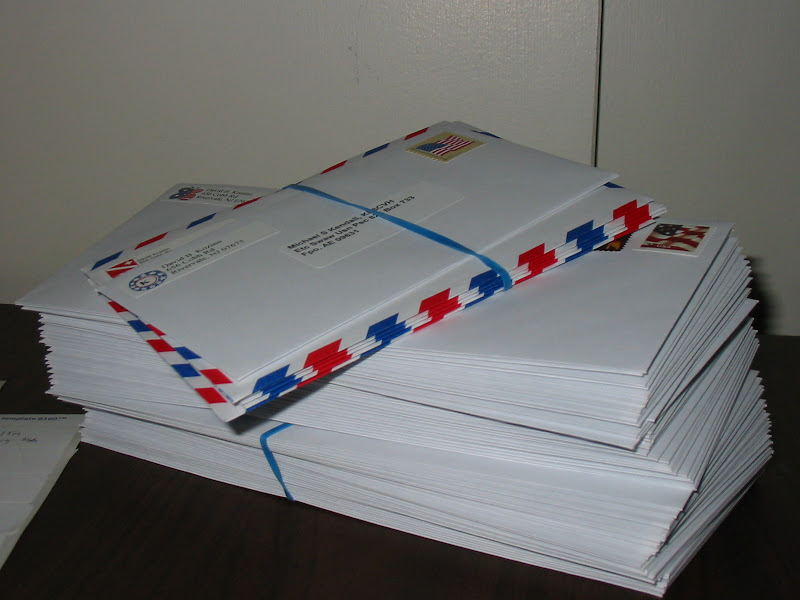
Managers located in the US or to stations located in the US. (A QSL manager is a person who handles the QSL duties for another station.) What I'd forgotten about was that a year (or two? or more?) ago, I marked a lot of my 6m contacts for QSLing to confirm their grid square, needed for the VUCC award. In fact, I marked about 65 of them. Because the ARRL bureau system only allows cards to be sent to stations located outside the continental 48 states (with some exceptions), those cards all had to go direct. So first, I spent quite a few hours (mostly very late at night; one of the advantages of not having to go to work the next day) researching to make sure that I had the correct addresses. After that was all set, I printed out labels for the cards (with the QSO information to go onto my QSL cards) and address labels. It's then a fairly mechanical process of affixing the label to the QSL card, usually writing a short note on the card (which often winds up being just "73, David" when I'm doing this many), putting the card, along with either an SASE (for domestic cards) or a SAE plus some means to supply return postage (typically either "Green Stamps" or an IRC) into an outer envelope, putting on postage, the address label, and a return address label (making sure it says "USA" if it's going overseas, sealing the envelope and repeating. And repeating. etc. The result is what you see in the picture, although I took that after I'd already mailed about 15 other airmail letters.

Of course, then we have the bureau cards. The good news is that there are no envelopes or addresses to worry about, though I did my research there too. Some stations do not accept cards via their bureau, but what's nice is that some stations will now sent you a return card via the bureau via either an email request (such as DL5AXX) or via a web form (such as DJ2MX). I assume that those stations just don't need my card, which and are happy to help you out. That's a
nice "spirit of ham radio" thing, and personally, I'd be happy to do that as well (if someone ever really needed my card.) I recommend doing the research to find out if a station will respond this way, as it can save you a considerable amount of money (versus a direct QSL; It's now USD$3 to get a card returned from Germany, that doesn't count the postage to send it there). The someone tricky part about using the ARRL outbound bureau is that you do need to send the card to the correct manager and the cards need to be sorted in country-prefix order. Fortunately, my logging program prints the labels out in the correct order, but you still need to affix the labels, then, as per the ARRL's instructions, you need to write the QSL manager's call on the upper-left corner of the back of the card, and put any cards going to manager into the pile with that side up. Whew. Ok, it's not the hardest thing in the world to do, and if I'd just managed to keep up with this, it wouldn't be nearly as big a task.

So the good news is that hopefully over the next few months (or years, for the bureau cards) I'll get some responses back from all of this work. While I strongly believe in electronic QSLing through the Logbook of The World, I do like coming home to find a new card or two in the mail.

Saturday, August 25, 2007

The job isn't done until the paperwork is finished

One of the advantages of being a "small pistol" station is that I don't worry about how to deal with the thousands of QSL card requests that some of the "big gun" contest stations and DXpeditions have to deal with. Over the past year, I made a bit over 1700 QSOs, which includes my operation from the Cayman Islands and any contests I've been in. I've never tried to figure out what percentage of stations I contact that I "need" for some award (DXCC, WAS, IOTA, etc.), but at this point in my ham career, I'm sure it's not a big percentage. (I should clarify that last statement: It's not that I don't wish that I had a higher percentage of "new ones", it's just becoming harder and harder to find and work them.)

However, one thing that I've always made it a point to do is to make sure that if I get a QSL card from someone, they get a card back from me. For those cards that come "direct" (which means that someone has mailed their card directly to me, just like you'd mail a letter to someone), they'll get a card back direct, usually within a day of my receiving their card. Often, the sender with include an SASE (self-addressed stamped envelope) or at least an SAE (self-addressed envelope), though sometimes they don't. Again, I don't send out that many cards, so I don't mind paying the return postage; it's part of the cost of being active in the hobby. (One of these days I'll pull up my soapbox and complain about those stations who don't seem willing to return a QSL card to me, even when they are stations in countries, often the US, that have a reliable postal system so I know they got the card, and when I've included an SASE or SAE plus postage; but that's something for another time.)

When I receive a QSL card request for a contact that I've made from my home station, I just reach into the box of cards that I had printed (by The QSL Man, W4MPY, who I highly recommend), fill it out, and send it back, usually the same day that I receive the card. Because I figured that I'd eventually use up a bunch of my "regular use" card, I had a couple of thousand of them printed up professionally, which means that they tend to look nicer than they would if I'd printed them myself, plus the per-card price is cheaper. The only problem with having cards professionally printed is that if you aren't going to have it done in quantity, it winds up being pretty expensive on a per-card basis. There are a couple of companies that will do small runs (100; a normal printing run is 1000 or more) of cards, but they are usually limited in what kinds of designs they'll do. For my Cayman trip, I made about 120 total QSOs. I'm guessing that at most, I'd have no more than 50 or so requests for cards, so even doing a batch of 100 commercially doesn't make a lot of sense.

So, as with my previous trip to the Outer Banks and to Lido Key, I decided that I'd design and print up the cards myself. For those trips, I took a few pictures and made up cards using some pictures from the trips along with the appropriate text/ I use Adobe Photoshop Elements which is more than powerful enough for something like this. (It's gotten somewhat more expensive than when I first bought it; I think I paid something like $20 or $30 for version 2.0; looks like it's now around $80 for verison 5.0, but there are plenty of alternatives.) The front of the card just has the basic information, and I use a regular word processor to set up a QSO table and any other info that I want to print on the back of the card. Everything is set to print on inkjet or laser postcards that will print four to a sheet. I used some card stock from Staples, but I sure there are alternatives. The tricky part is getting them to run through the printer the right way so that I get the QSO info on the back more or less lined up correctly on the back so that it's centered on the card. After I've gotten the cards printed, I separate them and then I usually need to trim them a bit. A standard QSL card looks like it's about 5 7/16" (13.8cm) x 3.5" (8.9cm), but in order to fit my cards on the stock that I use, mine wind up as 5.25" (13.335 cm) x 3.5" (8.9cm). When I pull them apart, there's a little room left over on each card, which I trim off. Not only does it look nice, but it's then close enough to a standard size to fit easily into most envelopes.

I'd originally hoped to make a lot more QSOs than I did on my Cayman trip (for reasons that I've described ad nauseum in previous posts here), but the only impact that had on my QSLing is that it meant that I won't be having the cards professionally printed. So, as with the previous cards, the hard part was actually sitting down and doing the card design. I will freely admit that I am not the best (ok, I'm probably one of the worst) graphic designers in existence, but I've pretty much figured out a template to use, which is to use a large background picture and have one or more inset photos. I finally figured out what to use for this trip, and after spending a bit of time juggling the images around (plus with some advice from my younger son Brett, who is far less "graphically challenged" than I am, along with my older son Justin, KC2MCS, and of course my XYL Sharon), I've finally come up with a card design that I'm reasonably happy with, which is shown here. This is still a draft, and I realized that I needed to add in the IOTA reference, which is required in order to be valid for IOTA award purposes. I'll take care of that as soon as I finish writing this entry, set up the reverse side, and try to get the cards printed this week. I've got about a dozen folks who sent cards direct and I'm feeling a bit guilty that I haven't been able to respond yet.